Episode Transcript
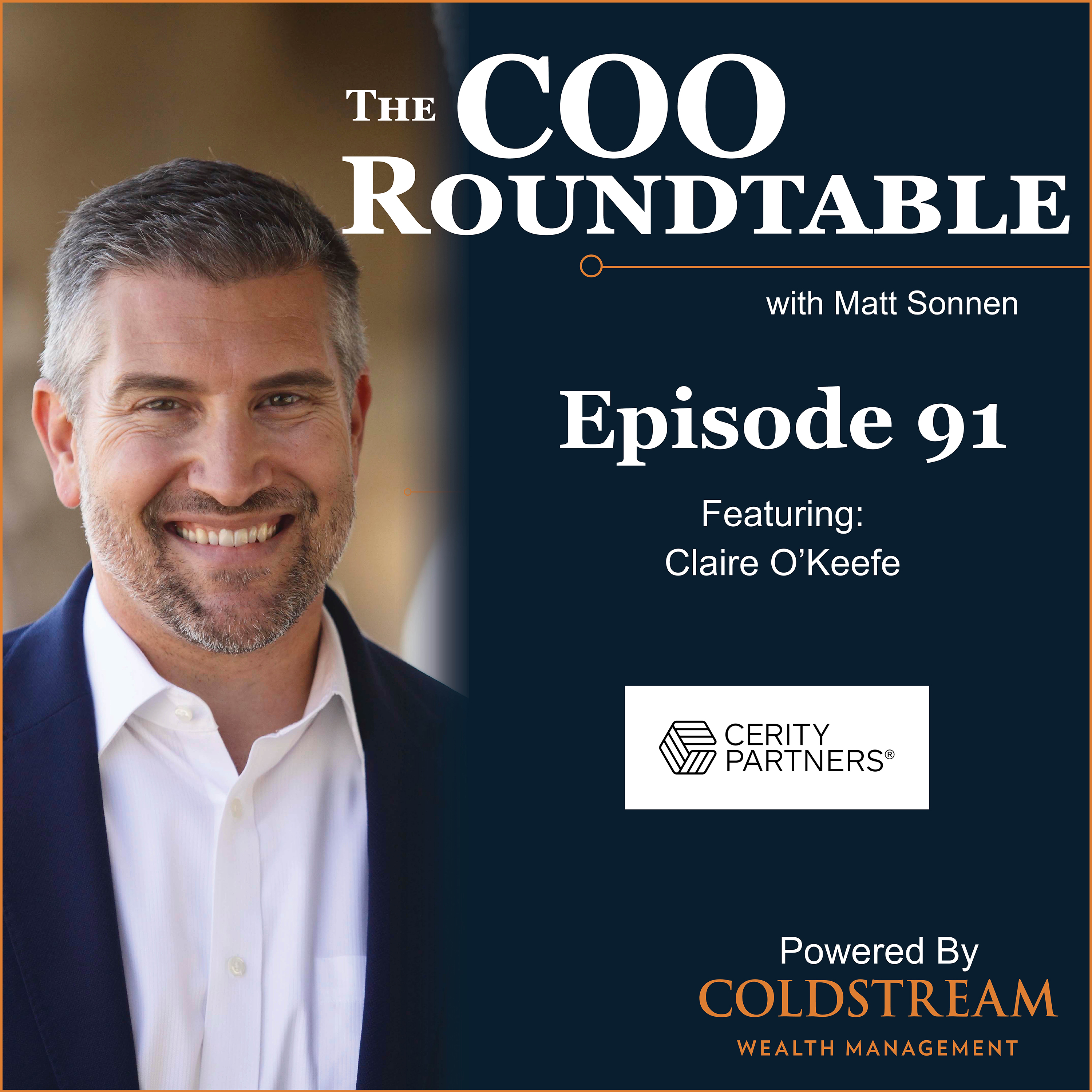
The COO Roundtable
with Matt Sonnen
Episode 92 – Nicole Bonanno & Sean Conway
00;00;04
Luke Sonnen: Hi, I'm Luke Sonnen. Welcome to The COO Roundtable, powered by Coldstream Wealth Management. Here's your host, Matt Sonnen.
00;00;14
Matt Sonnen: Welcome, everyone, to Episode 92. We have a great conversation in store. We're going to cover M&A integrations, technology integrations, and we're even going to talk a little bit of human resources; all areas that I know our listeners live and breathe every single day. So, we're going to jump right into it.
Joining us from Peapack Private Bank and Trust in Bedminster, New Jersey, is Nicole Bonanno, the firm's Senior Managing Director and Director of Client Service. Nicole works in the bank's wealth management division, which manages approximately $14 billion in the wealth management division. And they have about 125 employees. Nicole's bio says that she “manages client service professionals and activities for the division, in addition to working with senior management on strategic wealth initiatives and projects.”
And I've really enjoyed getting to know Nicole as we've prepared for this podcast. She really knows her stuff and you're all going to learn that very quickly. So welcome to the podcast, Nicole.
00;01;16
Nicole Bonanno: Thank you so much for having me. It's great to be here.
00;01;19
Matt Sonnen:
Great. And then joining Nicole is Sean Conway, Director of Operations and trading at Curi Capital in Chicago, Illinois.
Curi Capital manages about $14.6 billion for clients, and they have around 170 employees. Sean has been at the firm for over 18 years, and his bio states that “Sean is responsible for leading, managing, and coaching the private client operations team, which focuses on continually improving the operational and administrative processes and systems for the private client service teams.”
And in addition to all of that, his bio also says, “when wealth advisory teams combine with Curi Capital, Sean leads the effort to acclimate the new employees to the firm's systems, culture, and processes, and to transition legacy clients to the firm's service model, investment platform, and providers.” So, you can see that Sean is very well positioned to dive deep into all of the technology and people integration questions that we're going to be throwing at him today. So, Sean, welcome to The COO Roundtable.
00;02;25
Sean Conway: All right. Thanks so much, Matt. Glad to be on Episode 92 with you.
00;02;29
Matt Sonnen: Great. Thanks. Well, Nicole, I'm going to let you kick us off. Tell us a little bit about Peapack Private Bank and Trust.
00;02:36
Nicole Bonanno: Great. Thank you. So, Peapack Private is the wealth management division of Peapack Private Bank and Trust. Our bank has a very long history. The bank itself was founded in 1921. And the trust company, which now includes investments in wealth management, dates back to 1972. Today, we are proudly the largest new Jersey-headquartered, bank owned trust company. And as you mentioned, we have about $14 billion in AUA. We service about 4,000 relationships. We have 125 employees spread across seven offices in New York and New Jersey.
We offer the traditional services that you would imagine: investment management, financial planning. But as a trust company, we also offer trust and fiduciary services. We do tax preparation, and we also have a family office. But in addition to that, since we are also a brick-and-mortar retail bank, we can offer our clients traditional banking services, deposit lending solutions, we have equipment financing and leasing, we do investment banking, corporate advisory, and most recently, we added yacht financing to our services.
Our core client in the wealth division is typically an individual, a family, or business with about $5 to $10 million in investable assets who's looking for investment management and financial planning and hopefully some of those other services I mentioned.
What I think is really distinctive about our model is single point of contact. So, every client has a relationship manager, which in itself is not revolutionary, but that relationship manager serves as the quarterback of the relationship and the person is supported by a broader team within wealth and outside of wealth, which I think is what the differentiator is.
So, clients don't have to navigate different areas and deal with different people of the bank, if they have multiple products. And that tends to be one of the biggest complaints that we hear with larger banks, is that they have to navigate many layers, and with Peapack, that's not the case.
Historically, much of our growth has come through acquisition. We acquired eight firms over a six-and-a-half-year period. So obviously that was a significant amount of growth. But that also came with the integration of people, platforms, processes, which is something that, I've been honestly intimately involved with. And most recently been really focused on organic growth, particularly in the New York and Long Island markets, because the bank expanded into those markets in 2024. So, that's us in a nutshell.
00;05;28
Matt Sonnen: I love the one-stop-shop that you're building. That's very, very important. That's great.
00;05;33
Nicole Bonanno: Yeah, we're really proud of that. And clients do appreciate that because it makes it much easier to navigate the bank and all of the layers.
00;05;41
Matt Sonnen: Yeah. Well, Sean, give us an overview of Curi Capital.
00;05;47
Sean Conway: Absolutely. And, Nicole, that sounded great, I think we know who's going to win the “who sounds more professional on this episode”? So great work on that. I also am excited to see the similarities between our two firms. I think it should make for a lot of head nodding, which your listeners won't be able to see, but I have a feeling we’ll agree on quite a few things that we'll be talking about.
So, when it comes to Curi Capital, it's a firm that's 21 years old, and I've been fortunate to play a part of that firm for about just over 18 years now. And I'm aware that answer kind of makes me sound like a parent, but in a way, I feel this familiar attachment to this firm. It's just been part of me growing up professionally and the cooperation and collaboration throughout this firm is like just a huge part of our culture. So, I'm hoping that a lot of my answers have that come through.
But we've had a couple recent name changes, so stick with me on this. The firm was founded in 2005, and it was founded at that time as RMB Capital. We then merged with Curi Capital at the start of 2024 and became Curi RMB Capital, and then we officially became Curi Capital in 2025. So, I think when Matt was introducing me at the top of the episode, he was going through some bios that included different roles I've had at the firm, and we just had a lot of change over the last couple of years. And so, I think even my own role has adapted alongside our name. So hopefully, you won't see any new name changes in the near future, but who knows?
When the firm started out, we offered wealth management services and investment management products to our clients, and we first grew through referrals and word of mouth, and then later on through acquisitions.
So that's how we became a $14 billion-plus firm with now 181 employees. So, a couple more from even when Matt introduced us. And now in addition to those two core businesses, we also have a family office services unit, just like Nicole, a retirement plan solutions unit, and then Wealth Builder is our new business unit. And that focuses on the planning and investment services for individuals that are at the start of their wealth accumulation.
So, I'm going to take it in two ways here. If you're an advisor that would be joining Curi Capital, what we aim to do is provide a platform that's built on optionality and efficiency. When I say options, I mean things like services you can provide to your clients, investment solutions, ways that you can provide client reporting. And when I say efficiency, it's in the ways of centralizing the administrative support that we offer. And then integrated platforms, which is one of the key things that my team in particular works on.
If you're a client and you're looking to join Curi Capital, we want to be ready to support you at any stage of life that you're in. So, if you're a business owner looking to sell a firm you built or a physician that's just starting out their practice, we've got solutions that can meet you at that life stage. And I honestly think that a sign of a great advising firm is seeing clients that become friends with their advisors. And so, some of our client events honestly feel more like family gatherings. And it's just been so fun to watch that over the years As, you know, we've grown from the very beginnings of RMB to Curi Capital.
And so, the very last thing I'll say, because I can say a lot, but the last thing I'll say and I am certain, Matt, that everybody says this, but I swear I really mean it. I do feel like our firm is entering a very exciting moment.
You may have seen that we just announced that we have a new capital partner, and that is Vistria, and we just also paired up with Wealth Partners Capital Group; both those partnerships we think are going to unlock some major opportunities to make investments in the firm and acquisitions that we believe are going to take Curi Capital to the next level.
So very, very excited about all that. And of course, it all assumes that AI isn't going to kill us all by Christmas.
00;10;14
Matt Sonnen: Yeah, well, we're going to get to that, we're going to get to that. But, okay. So, you talked a lot about the different roles you've had and all the name changes. So, tell us just a little bit, Sean, tell us about your career path and what got you to the position that you're holding today.
00;10;32
Sean Conway: Yeah, it's an interesting one, and again, this is going to add more points in Nicole's column for being the more professional one, I have a feeling. But it's been a journey.
I started out in sort of the financial services industry at Merrill Lynch, and that was really right after I graduated college and after a couple of years there, just when it was time to make a decision if I wanted to go down the advising path, I decided to tell my boss that I was going to go backpacking in Europe.
So that threw a wrench in that plan. So immediately, you know, hopped across the pond, was backpacking in Europe, came back to Chicago, and at this point, I was looking for employment, which is code to say I needed to make some money again. And I was introduced to RMB Capital. And so, I joined that firm on the advisor team with one of the founders, which was, Dick Burridge Jr., and I'm very glad I joined that team because at the time, I was lightly distracted with other hobbies. I wasn't quite sure if, you know, I wanted to stay in finance, but I got drawn in by the camaraderie at the firm and this idea that we were building something bigger. And so, been working through, you know, the advising side of the firm, eventually was tapped to become the Integration Manager at the firm when we started to move into making more acquisitions.
And so, Matt, that's really the part of my bio that was related to how I was helping the individuals from firms that we acquired get acclimated to the systems, the culture. And when I tell you, I've never learned so much in a period of my career than I did as an Integrations Manager.
I think all that exposure to processes and systems that made it easy for me to move over into operations, and now in my role as the Director of Operations and Trading, I'm part of a very experienced team. A lot of individuals I've worked with for ten plus years, and we collaborate nonstop with, you know, with our IT team, with our marketing team, our compliance team. So just a really experienced and exciting team to be part of, but that's kind of my winding way of getting there.
00;13;02
Matt Sonnen: That's great. It's always my favorite question on the podcast: tell me how you got to where you are today and all the twists and turns, and that's great. So, thank you for running us through that.
Nicole, run us through your career journey to how you got to where you are today.
00;13;17
Nicole Bonnano: Yeah. So, my path was not as straightforward as Sean's. So, you know, I've been in this business now in financial services for more than 35 years, which is hard for me to believe, and 27 of those years were in traditional wealth management.
But this is not what I dreamt of as a child, and I wanted to be an attorney. And I wanted to be attorney from the day I was born, and that was all I ever wanted to be. So, I started college and dropped out in my freshman year and realized attorney wasn't happening and college wasn't happening. So, my parents were always very supportive, and they were like, you don't have to graduate from college, but you definitely need to get a job.
So, I was panicked; I had no idea what I wanted to do, and I had a colleague that I went to high school with, and she said to me, I work for this brokerage firm in the town that we grew up in. And she said they're looking for somebody to stuff envelopes for marketing campaigns, part-time. So, I said, I have no idea what a brokerage firm is but sign me up because it's a paycheck and my parents will be happy. So, I went to work for this firm, and I stayed there for five years, and I learned a lot about the industry itself. Brokerage, trading. So, I worked my way through that firm. I did accounting work. I went to back-office operations, and I eventually ended up on the trading desk there. And that's really where I learned about investments and how the stock market works. That firm eventually went bankrupt. And, I realized, okay, I guess this is the industry I'm in.
So, then I spent another five years bouncing around in different, like, back-office operations roles and eventually landed in client service for the first time at Smith Barney and I worked there for five years, and I realized, I don't think I'm cut out for a large corporation like Smith Barney, but I didn't really know where to go next. Like, what was my next move?
So, a former colleague reached out to me, and she said, look, I'm working for this registered investment advisor in the city. They're basically just starting out. She's like, we need someone for client service. I said, okay, this sounds great. The only drawback that I thought was it was in New York City. And I was like; do I really want to commute into New York? But I said, you know what, I'll go talk to them and let's see what this is about. So, I went and I met with them. I loved both of the principals. They offered me a job on the spot, and I went into client service immediately.
I was the second hire that they had. And that's how I really learned about wealth management, and not so much the brokerage, but more of a relationship-based financial planning, from soup to nuts. And I moved from client service there into operations leadership when the person who actually recommended me for the job left. So, she was doing all the operations the HR, the technology, the compliance: you name it, she did it.
And when she left, they were like, okay, Nicole, we want you to do this. And I was like, great. I have no idea what I'm doing, but I'll give it a shot. So, I did that. And that's really when I got into learning how a wealth management firm runs. And I was doing all of the things I mentioned: HR, compliance, finance, technology, and the client service, and I learned most of that on the job. It was all self-taught. And over the span of 13 years that I was with them, I helped build that firm to what it was in 2017 when Peapack acquired Quadrant, and that's how I ended up at Peapack. So, after the acquisition, I took everything that I had built and learned, working for them for the 13-year period, and I moved into working with Peapack’s Wealth COO. And they were in acquisition mode, and they said, Nicole, we'd love to take you on the team to help you integrate all of the firms that we've acquired so far and any that we acquire in the future. Again, not something that I had done, but I realized that I could take the skills and everything that I've learned over the course of what I had done up to that point and kind of help integrate these firms.
So, I did that for quite a few years, and then in 2021, we reorganized the, what we call middle office, which includes the client service organization, and that's when I was named Director of Client Service. And now today I lead the 27-person client service team, but I also continue to work the strategic initiatives and other kind of broader business management functions.
We haven't acquired anyone since I think it was 2022 or 2023, so I kind of walked away from that part of it, but still kind of working on integrating a lot of what we've acquired, over the last six or seven years.
00;18;40
Matt Sonnen: Well, that's a perfect segue into my next question, because, yes, I was going to say both of you have historically grown through M&A. Sean’s talking about, you know, they're about to get ramped up again with, with the investment in their firm, but I do think it's interesting that both of you kind of made a conscious decision to slow down and pause, to give yourself some time to digest all of the activity that you had gone through and, and get integration right. So, Nicole, what are some lessons learned that you can share with us that all that M&A activity taught you?
00;19;20
Nicole Bonnano: Yeah. So, I love this question because I'm like, I’ve got to pick one lesson? Because there's probably about 100. But I put some thought into this. So, as you know, as I mentioned, we grew pretty quickly.
So, it was eight firms over a six-year period. So, there was a couple years where we acquired two firms in a year. So, it was a lot, and it was not a lot of time to breathe before, you know, we acquired the next one. So, as you can imagine, with all of that, acquisition activity, and integration, we learned a lot, right? We learned a lot along the way.
So, you know, one of the most consistent challenges that I feel from my perspective, for what we went through was what I would say is resistance to standardization and change. So obviously no one likes change, no human being likes change, but this type of change and process standardization is definitely something that is a challenge.
So, what makes it the most challenging in my mind is, you know, every firm is different. Every firm you acquire has a different operating model, different processes, different systems, there's some overlap but different systems. And most of the principals have a very strong sense that the way they did things is what made their firms successful. So, when you say you're going to change something that they've done that they feel that they built, that made them successful, you know, there's resistance to that. And I understand that.
So, the biggest lesson out of all of that that I learned is that you need to be very clear, very early, about what will change and when. So, you're not saying on day one everything changes. And you shouldn't be saying on day one nothing changes. But as long as you have timelines that are discussed, preferably during deal negotiations, and in a perfect world, those terms are built into the transaction documents, then I feel like everybody knows going in what to expect. You can't leave the timelines open-ended, because if you do that, it becomes really easy to just keep pushing those decisions out and not addressing them. And it makes it really easy for the principals of the firms that you acquired to just keep their head down and do business as usual. Right? And that doesn't move you forward.
So, you know, the longer people are allowed to just keep doing things the way they've always done, it makes it that much harder to scale, to build consistent workflows, to train new hires and really integrate the organization. And I always say eventually the check comes due, and you're going to have to deal with it at some point.
So, the challenge is that it's a balancing act, because at the same time, you know, you can't again change everything at once, but you can't leave things as they are. So, I think we learned that things like client onboarding, trading, any type of key client deliverable like performance reporting, financial plannings, you need to standardize that as soon as possible, or at least come to some type of agreement early on as to what that's going to look like.
Those are the areas that would create inconsistency and create risk, and it really creates a, fragmented client experience if you don't come to some decisions early. Then there's the technology conversion part of it and implementations, and that can take longer, right? Because sometimes you have to decide what system are you going to use. If it doesn't have a system that we love, let's say the CRM, then that means we have to go out and do due diligence and find a brand new CRM.
So that takes time. So that's not something that can happen overnight ,but again, the key is to have a roadmap and be firm about what the end state looks like and how long it's going to take to get there. And I think if you do that, and you're thoughtful about the pace of change, then you're really being thoughtful about what people can realistically absorb over a period of time.
00;23;34
Matt Sonnen: Yeah, well, I can even one-up you, Nicole.
00;23;38
Nicole Bonnano:
Okay
00;23;38
Matt Sonnen: You have it written out, you know, and it's all in writing, and they see it ahead of time, but what always cracks me up is they don't hear in their head, in their ears, they don't hear “our CRM must change in six months. Our trading tool must change in one year,” you know, whatever these with timeframes are, what they're hearing is: “hey, guys, we have six months to convince them that our CRM is the greatest thing since sliced bread, and they won't want to change our CRM, and we have one year to convince them that our reporting process and tools are way better than theirs, and they're going to come on to ours.”
And it just it always cracks me up when, like you said, the payment comes due and you say, okay, six months, let's do your CRM, and they go, “were you serious about that?”
00;24;19
Nicole Bonnano: I definitely went through that. So, I've sat in meetings where the principals will be like, well, why don't we use X system? It's what we've been using for years, it's perfect. And I'm like, well, that X system worked for a firm with $100 million under management, but it doesn't work for a firm of $14 billion.
0024;35
Matt Sonnen: Yes, exactly. Exactly. Well, John, give us some of your M&A lessons learned that you've picked up over the years.
00;24;45
Sean Conway: Absolutely. And I was over here on mute clapping at the, the comment of the check comes due from Nicole, I love that. I mean, it's so true, and the longer you wait, the bigger that check’s going to be.
00;24;57
Matt Sonnen: Yeah.
00;24;58
So, at the risk of being repetitive, I'm only going to highlight three, even though the lessons come fast and furious during M&A.
00;25; 07
Matt Sonnen: Yep.
00;25;08
Sean Conway: And there's going to be some elements to some of these three that are relatively similar to what Nicole shared. One of the first ones here is: just don't let a good opportunity to change go to waste. And what I mean by that is that you want to be prepared for a really clear and quick system transition. And this is where I'm kind of repeating what Nicole says, but also, I think bears being repeated. You want to clearly define what is changing and when it's changing. Because if you can set the timeline expectations with the new team and the incoming clients and deliver on it, then you're taking advantage of this short-term period of change management, because the longer that transition takes, the more ingrained those habits become, and the harder change actually ends up being.
So, I couldn't agree more with how Nicole was phrasing it. And again, that's just, don't let that opportunity go to waste.
00;26;08
Matt Sonnen: Yep.
00;26;09
Sean Conway: I think the second lesson that I would highlight here, and this one's a tough one to learn, because it really is, the onus is on the firm that's making the acquisition, and it's that coordination can be a capacity killer.
And this is what I mean by that. If you haven't clearly defined internally who owns what and when they need to take advantage of what they own, then when it comes to that pre-close and post-close period of the deal, you are destined to burn time trying to coordinate with the different individuals around the firm. And that's the worst time to be trying to coordinate who's going to own what parts of an integration, or who's going to own the different aspects of a relationship that's coming in.
So, nobody wants another meeting when stress levels are super high, and so that's why I think it's really important to get that clearly defined ownership going into an acquisition deal, both pre-deal and post-deal.
00;27;09
Matt Sonnen: Yep.
00;27;10
Sean Conway: And then that last one that I would point out—it's hard to phrase it, so, the way that I actually have it written down is: people need people.
And the lesson here is that, if culture is really important to your firm and you’re an integrator, you're not just, you know, an aggregator, the importance for culture is going to need to be a firm effort. And so, I say that because you don't you can't just assume that incoming new team members can just take a training course, and they're all set on some of the internal procedures, or that you can send an email to the new clients of the firm, and that they're going to feel great about the acquisition.
It means that advisors that are new to the firm will love to have an advisor that's been at the firm to help them acclimate and help them understand how things operate. It also means to me that clients are going to appreciate having an existing member of the firm join a meeting with their advisor and explain, you know, the investment philosophy or different investment solutions that we have.
And it also means that if you're on the M&A team at the firm, you're going to need dedicated reps across the firm that you can go to for help when certain parts of the project get really tricky. So, you're going to want to know who you can connect with on the operations team or on the marketing team, just to make sure that acquisition becomes successful.
So, I think we had to learn that lesson the hard way, where you want to be able to tell everyone at the firm that acquisitions and the integration process aren't going to deter them from their normal course of business. There should be an element of buy-in across the firm if you want to make sure that the culture shines through and that the new people feel welcome, or the new clients feel like they they've got a home that they're comfortable with.
00;29;02
Matt Sonnen: Yeah. So, your last, when people need people, that's another a great segue into my next question, which is just basically on the people side of M&A. This is always tricky. You want to make sure that they feel safe and welcome to your firm as they join via acquisition. Sean, tell us how you thread the needle of learning someone's skill set as they're joining the firm, and then pairing that skill set with what the current need happens to be at the firm, at your firm?
00;29;31
Sean Conway: Yeah. Yeah. This is, this is a tricky one. And it's largely because you— depending on the size of the acquisition that's being made—you have a limited amount of time to get to know incoming new teammates; and the risk here is that if you don't understand the talent that's joining, you have the opportunity to lose some superstars that could have joined from the other firm.
00;29;58
Matt Sonnen: Yeah.
00;29;59
Sean Conway: So, there's a couple of things that we do, and I don't think there's really a perfect formula for this, but I'll give you three different things that we try to do.
First, a home office visit is really a great way to get a sense of who your potential new teammates could be. And by that, I mean getting the team together from, around the firm, going to meet the individuals in their home office, maybe spend a couple days there, have a couple conversations, learn some of the processes they're doing, but ensure that that team that's making that home office visit isn't just a group of executive leadership. Bring along department heads, individuals where they might be inheriting a new team member, and really give it a chance to give everyone, I should say, a chance to get to know each other and gauge, kind of, what does that culture feel like?
The second thing I would say, here at Curi Capital, we're an EOS shop, which is the Entrepreneurial Operating System. It also has gone by the name of traction. And so, Matt and Nicole, are you two familiar with the EOS?
00;31; 13
Matt Sonnen: Absolutely. Yeah.
00;31;15
Nicole Bonnano: I am not.
00; 31;16
Sean Conway: So, I'll reference that a couple times. By no means can I, you know, clearly explain all of it, but when I tell you it's truly a really simplified operating system that helps with goal setting and analysis of individuals for helping people make decisions on, you know, do you have someone in the, in the right role? When we employ some of the concepts of being an EOS shop, one of the components is making sure that you've got the right people in the right seats.
So, the primary questions for this is: does the person understand the opportunity? Do they want the opportunity? And then, do they have the skills to handle it? And so, if you're able to go to incoming individuals with a role where you're able to then talk through those questions with that person and they can make the decision themselves, you know: is this something that I want? Do I have that skill set? Do I understand it? Then you can get a little bit further, along with clearing up some of that uncertainty as to whether or not there's a good fit for them at the firm.
And one thing that I want to point out: they don't have to be coming into a brand-new role that's been created or a role that exists at the firm, because there's going to be integration work that needs to get done, and the individuals coming in are perfect to help with that.
So, if there's a service that you've now inherited through an acquisition, you're going to want those individuals to help continue to support that and help make sure that the rest of the of the other team is trained up on it. So, I think there's always work that can be allotted, just, you need to be clear about the role and then the metrics assigned to the role. Which really is the last point here; assigning metrics to the role so that the new employee knows how their performance is reviewed.
00;33;15
Matt Sonnen: That's great. Well, Nicole, how do you determine what the next hire need is at your firm, and then figure out, how are you going to fill that need with an employee who's joining the merger?
00;33;25
Nicole Bonnano: Yeah. So, this is always interesting, and from my perspective, I sat on both sides of the table. I sat on one side of the table as an employee who was being acquired and entering a new firm, and then once I got to Peapack, I was on the integration team and sat on the side of the table as we're acquiring you, and I was the face of kind of meeting some of these folks in the early stages of the acquisition. So, I feel like I have a good perspective.
So, you know, this is one area that I feel like Peapack does and did very well, throughout all the acquisitions that we've made to date—you know, we looked at it as we were acquiring people and talent, not just revenue and assets.
So, across all eight of the acquisitions, we did not let one single employee go, and that was intentional on our part. So, we started this early. So we started, you know, during the due diligence phase, conducting, like a formal organizational assessment of the firm, you know, that we were acquiring and that we wanted to be able to identify, the right role for each one of those staff members before the deal was finalized so that by the time the acquisition and the deal closed, every employee knows where they're going to fit in, in the new organization, on day one. So there is no mystery, there is no worry, because when you are an employee of a firm that's getting acquired, you worry, I worried as a staff member of Quadrant, and I know that a lot of the firms that we've acquired, when I talk to the staff, they worry too: like, is my manager going to change? Is my job going to dramatically change? And will I still even have a job? Right? So, it's important that they know not only yes, you're going to have a job, but what that job will be and who you're reporting to.
So, you know, when someone joins, I don't just look at title, and I don't always just look at job descriptions, right, because some of the job descriptions may be old and outdated, so they don't always tell the whole story. So, on the client service side, when I'm looking at, you know, folks who’ll be joining my team, I always look at a couple things. I'm going to look at their institutional knowledge, you know, I want to look at how well do they know their clients, right, have they really built relationships with these clients? Are the clients still confident and safe with them? Their willingness to learn, their openness to change, which we talked about already, and their ability to lead. Because on my team, I'm always looking for the next set of team leaders. So, I always like to see, is there anybody that's up and coming on these teams that I could kind of mentor into that role over, you know, the next couple of years?
And a great example that I have in a real-life situation of a firm we acquired was a woman who joined us in 2018 through one of the acquisitions. And she had like an interesting role because she did a little bit of everything. She handled their billing, she did some operations, and she actually did some client service work as well.
But she didn't really have that much opportunity to grow, even though a lot of the work that she was doing was important and, and it touched a lot of clients and it touched a lot of team members as well. So, in 2021, when I took over the service team, we kind of reorganized the entitled entire middle office, and at that time, we had to think, where was this woman going to go, based on her strengths, and where would she have the greatest impact? Because she could have gone in a couple different directions and ultimately, she joined our data analytics team, which includes billing. And now today, she's responsible for the billing of about $6 billion of our total AUM. And she's grown tremendously in that role.
So, it's just an example of bringing someone on that doesn't necessarily fit exactly in an existing role and giving her the opportunity to move into something in a larger organization. So, you know, I really think that's what a good integration should do. It should really give people clarity early and then create the opportunity for their capabilities to grow within the organization.
00;37;47
Matt Sonnen: Well, you both talked about this a little bit already: the amount of change that anyone can go through at any one time is limited. Obviously from a merger integration perspective and from an efficiency perspective, you want to get them onto your systems and following your processes as soon as possible, but at the same time, again, humans can only handle so much change at any one time. So Sean, how do you lay out the integration plan for the employees?
00;38;15
Sean Conway: Yeah. And this one, I think, is going to have a couple elements to some of the answers that Nicole and I have given before. Also, Nicole, I love that you highlighted that example in your answer before just talking through an individual that turned out to be a superstar that you got from an acquisition and then having provided her a chance to grow into that role. I mean, that's exactly what you want to be able to offer incoming employees, I feel.
00;38;46
Nicole Bonnano: Agreed, it was something we were really happy about.
00;38;50
Sean Conway: So, I think, you know, going to what Matt's asking about, you know, how do we lay out the integration plan for employees; to me, it all comes down to setting expectations and delivering on them.
So that's something I've said before. But you've really got to be honest about what is changing and when it's changing, and to the extent individuals need to know we are going to hold the line, even if it does lead to some uncomfortable conversations. Because the more you waver on that, the longer the change is going to take, and oftentimes then it leads to, you know, that death by a thousand meetings that I mentioned before.
So from the two trillion lessons that we've learned from M&A and then with, a bit of help from, our new partners at Wealth Partners Capital Group, we've developed project plan templates and then an adaptable integration guide that helps us communicate these plans to either the principals during the pre-deal signing, or directly to the incoming team post-deal so that they know what to expect when it comes to the integration plan and they can see the timelines assigned to it.
To support those plans, we also use project management software. We've got an LMS tool in the form of Trainual, and then, of course, we make sure that there are people assigned to that people element that I mentioned above. And that's just, again, to help avoid burnout or somebody that's really not coming along with the change and having a hard time understanding, you know, some of the new systems or processes that they’re not working with.
00;40;39
Matt Sonnen: Well, Nicole, what is your change management roadmap for teams that are joining via merger?
00;40;46
Nicole Bonnano: So, this is one area that started off differently in the early acquisitions, and then we actually built a real, documented change management roadmap. So, it's one of the things, we learned lessons in the early days and then pivoted to a different approach.
So, you know, one of the things I think we learned early on is that the integration doesn't magically happen simply because a deal has closed. There's a lot of work, as we all know, that goes involved in this. But sometimes I think we just think, well, it's closed, so we're integrated. So, in the beginning, in the early days, our approach was basically to leave everything in place and alone. Systems, reporting structures, processes: everything was business as usual from day one. And, you know, while that may have felt less disruptive in the moment, it really delayed all of the integration work, and it made it harder for us to create a scalable organization. So, we learned from that experience, and we completely changed our approach in the later acquisitions, and today our current integration process begins literally on day one. We bring all the employees together to formally introduce everyone that hadn't been prior to the deal closing—new managers, teams, project teams; everyone meets everyone very early, so they know who to go to for what.
It's really important to create that connection with the new teams, and clarity, right, so that no one is confused or said they didn't know what was happening.
Similar to what Sean mentioned, we have a formal integration project team that is led by our project management office, so that team meets regularly. We manage the roadmap, we're tracking dependencies. We're making sure all the employees understand the timelines and what comes next.
And then, you know, as I think I mentioned earlier, system conversions and training doesn't always happen day one for many, many reasons. And if there is a new system that's going to be needed early in the integration, then we are very thoughtful about where we're scheduling the training on top of everything that's going on.
So, it's interesting because we also learned that the roadmap, you know, varies by role because, you know, someone on my team, on the client service side—a portfolio manager or a person in operations are going to experience different parts of the integration—but every role is going to be affected by some type of change; that's just inevitable.
00;43;32
Matt Sonnen: Yeah.
00;43;33
Nicole Bonanno: But the key is to not avoid the change, but it's really to avoid asking people to absorb too much major change at the same time. So, an example would be, you know, I would not ask someone on my client service team to have to learn a new CRM and a new portfolio management system at the same time. We would definitely stagger those, because it's too much too soon and it creates what I call change fatigue, and then people shut down. So, I think a well-planned roadmap and a sequence that has clear priorities, timing, training, and most importantly, constant communication is what gives everyone the best chance to participate and succeed.
00;44;25
Matt Sonnen: Great. Well, so now the employees have landed and they've successfully completed that integration process that we just talked about, so now you want to make them successful contributors to the organization for years to come. So, Nicole, I'm going to go to you first. What tools or processes do you leverage when setting their quarterly or even their annual goals for the individual employees? And then how do you tie those to the larger goals of the firm?
00;44;53
Nicole Bonanno: Yeah. So, Peapack does have a formal quarterly goal setting process, which I think is really helpful because it keeps the goals current and it keeps a more regular conversation between the employees and their managers as opposed to just letting it go, you know, every 12 months, which I feel like is a too long of a period of time.
So, every quarter, the employee will identify their own goals and they'll discuss them with their manager before they formalize them in our system, and then the manager has the opportunity to add their own goals, if they have any, based on team or business priorities. Once everyone agrees, they document those goals in the system, and then throughout the quarter, the employee and the manager are constantly meeting, you know, to assess the progress and to track it in the system.
Then we also have bank-wide goals that apply to everyone. Things like compliance training, right, so we have to go through, as a bank, compliance modules, so that's built into the quarterly goal process. And as well as adoption of our CRM is something that we added a few years ago for all employees. As far as communication and kind of tying it back to the goals of the firm itself, I think that the bank and wealth leadership do a really good job of communicating all of those priorities behind the goals.
Our CEO holds a monthly all-staff call, and he covers strategic initiatives, financial results, you know, any priorities of the bank as a whole, and since we are a publicly traded company, we also have our quarterly earnings releases, so those are discussed as well. And then within wealth itself, the President, of the wealth division, he has a recurring all staff call, he has his senior leadership calls, as well as his direct report meetings. So, there's really multiple opportunities for everyone to connect what the bank and the wealth division’s priorities are, to their individual goals.
Since I'm in client service, you know, my team is not direct revenue producing, so they don't obviously have any revenue goals, their number one priority, obviously, is the client experience. But the work that they do obviously directly supports the growth, supports the revenue generating relationship managers, wealth advisors, or portfolio managers, and what they do, you know, is responsible for, like making onboarding cleaner and more efficient, helping the relationship manager spend more time with clients and less on administrative tasks. My team helps improve retention based on their relationship with the clients, and they also, you know, build capacity to support new advisors, new offices we bring onboard, new teams, and new clients. So, for my team leaders, I also place a great deal of emphasis on their training and career pathing and development. That's probably the most—two most important goals that they have, because I'm always trying to build the next layer of people, who can bring us to that level of growth without losing the client experience that we're very proud of.
00;48;12
Matt Sonnen: Well, Sean, I think you're going to point to EOS in your answer to this one, because I know EOS does a great job of defining the firm's larger goals and then tying those back to the individual goals of the team members, but talk to us about how you guys are handling this.
00;48;26
Sean Conway: Yeah. And Matt, I was just going to like, my only answer, I was going to be like, oh, we use EOS, next question. No, I think Nicole has it as well, it's—as long as your firm has an operating system in place that you can lean back on, then this is where I think communicating goals to new individuals at the firm can become really, a simpler exercise than maybe it looks like on the face.
So, using EOS at our firm, it has our goal-setting fit into a very specific model. And so, I'll give you that kind of a quick breakdown of it, but the firm is going to set three- and ten-year goals, and then those goals get broken down into annual firm goals. From those, those will now inform annual department goals. We'll take the annual department goals, those inform annual individual goals, and then those get broken into quarterly goals, which I think in the EOS parlance, those are called rocks. But that's where each member owns at least one annual goal that ultimately rolls up and up until you're actually able to point really clearly to how you're helping the firm move towards those annual three-year and ten-year goals.
So, we've had a lot of success, specifically the departments that have adopted this EOS structure in showing individuals just how they're helping move the firm forward, and it also helps kind of entrench this feeling of, you know, I am doing something that matters to like the movement and the forward progress of the firm.
So, I love the simplicity of it. I think if you don't have an operating system in place, it's going to be one of those things that, as you start to pursue more and more acquisitions, if it's tough to communicate goals, you're going to be kind of swimming upstream each time that you're trying to make sure that someone feels like they're part of the organization.
00;50;32
Matt Sonnen: Yeah, for sure. Well, we've been talking for almost an hour. This is probably the longest any of you have gone without talking about AI, so, let's dive into AI. Sean, I'll go to you first. How are you setting expectations within the firm about what AI can and cannot do?
00;50;52
Sean Conway: Yeah. This has been, it’s been an interesting year. Here at Curi Capital, our Chief Technology Officer set out the IT vision at the start of the year, and he called this our year of exploration, but I will be honest with you, two; at times it has seemed more like a year of exploitation. And, I myself, I am an AI optimist at this time, but there are promises that are being made to our firm from different vendors or different partners and custodians that sound an awful lot like back when our vendors would say they could integrate with everything.
00;51;35
Matt Sonnen: Yep.
00;51;36
Sean Conway: And then, you know, it would turn out all they deliver is like a single-sign-on functionality. Thanks, thanks for that. So, it's been interesting. Our firm has been really clear about, we're taking a three-pronged approach to this.
The first that we're doing is, we're creating different AI solutions with some consultants. So, we’ve partnered up with some outside consultants, given them some ideas, some parameters, and worked on creating some AI solutions with them.
Another prong to this is we're working internally on creating our own AI solutions. In an interesting turn of events, it does feel like this prong and the one before are starting to blend a little bit now that, I think the capabilities that come with this rapidly advancing AI solutions, it's allowing more internal creation where we normally would have pointed to—this is something that we're going to need outside help to build, so that's been interesting to see develop over the year.
And then the last prong is we're working with our vendors and the solutions that they're rolling out. And this is really important to us at the firm; when we pick a vendor that we want to partner up with, we emphasize how important it is that we are in a partnership, we're not just paying them for service. So, for example, we work with Envestnet: Tamarac’s one of our reporting and trading platforms, and we try to integrate ourselves with their team so that we can be involved in any type of beta testing so that we can provide feedback and maybe provide some ideas that we think won't just help our firm, but also help advance the needs of other firms that that work with the platform.
So that one has actually been, I feel like, a little bit slower of a prong throughout the year. I do think some of the larger institutions are working hard on rolling out agentic solutions, but, I think that hopefully what they're recognizing is that everything is going to be based on the quality of data that the agent’s kind of being built on. And quite honestly, I have a feeling that quite a few firms and vendors are running into an issue where that one, you know, that one portion of data that you always overlooked is now just yielding garbage results for the solution you're trying to develop.
So that's the approach that we've been taking. We've had some successes, some definite not successes. And again, I'm still very much an optimist to what AI might be able to do for our firms, especially in the financial advising space, but one thing I'll note, if the two of you haven't seen this, I, I just watched this documentary on a flight. But if you haven't seen The AI Doc, which is literally called The AI Doc, or How I Became an Apocaloptimist; that does a great job of just kind of explaining the opportunity and pitfalls that we're faced with. So, I've been recommending that lately just to kind of level set, you know, where people's expectations are at, where they are.
00;55;05
Matt Sonnen: Yeah. Thank you for that. I'm well aware of it, but I have not seen it yet. So now you've just pushed me to, yeah, I'm going to go I'm going to go find it. Yeah, absolutely.
So, Nicole what's, what's been your firm's usage of AI, and probably more importantly, how are you navigating all of the hype around AI?
00;55;20
Nicole Bonnano: So, it's funny, so, I have seen that documentary; it is amazing. I actually made my 77-year-old mother watch it because she doesn't understand what AI is, and she recently watched it and had a much better understanding, so yes, I would recommend that to everyone.
Like Sean, I am an AI optimist. I use AI in my daily personal life and obviously at work, and similar to Sean's firm’s three-pronged approach, we're kind of doing the same thing. So, you know, our CTO as well has taken the lead on this and is doing an amazing job for our firm.
We already incorporate it in the day-to-day toolkit for all employees, and we're using a lot of the programs that I'm sure everyone's using as the basics. Copilot, we're launching ChatGPT Enterprise—we're starting to roll that out to certain employees, I actually have a license, so I'm using that now.
And we're using things that are very basic AI-generated, you know, meeting summaries through Zoom and Teams. So, anything, all the basics. The next level is—we have launched a program called AI champions. And what an AI champion is, is someone who sits in every department, who is able to take recommendations, pain points, process questions. Any employee can go to their AI champion with an idea, a process, an issue, and they can work together with the champion, the department, and IT to determine whether if we have an existing AI solution that can solve the problem, something we can custom build, or maybe it's something that we can't do right now.
So today, I just we just had an update from the CTO; the AI champion program has completed 100 projects to date, which is most of 2026. I think it's amazing because we have a small team—we don't have, you know, a 20-person IT department working on this all day, every day, so the fact that we've completed 100 is impressive.
00;57;38
Matt Sonnen: Yeah.
00;57;39
Nicole Bonnano: An example that I can give, like a concrete example of something in wealth; so, since we are not an RIA, we're, you know, we're regulated by the new Jersey Department of Banking, any wealth account has to go through what we call a Reg 9 review, and it's got a two-part review. It happens initially when we open accounts and then it happens annually. So, every account has to go through these reviews. One is administrative, kind of looking at the address, the fee schedule, kind of like just making sure everything's correct. And then the more laborious one is on the investment side, you know, matching, is it matching the targets, do we have the IPS? Is everything in line? You know, does it hold any restricted securities? So, it's a very labor-intensive process. And on the Fidelity and Schwab accounts, that is or was being done completely manually through spreadsheets and the investment analyst would have to pull up Tamarac to get the models and the asset allocation and then go find the IPS.
And then it was a lot of work, and it was brought to the AI champion. The AI champion brought it to IT, and they actually built an in-house solution. And it's basically taken the data from Tamarac, it's bringing it in to answer some of the questions, and it took something that probably took 30 to 60 minutes per account and cut it in half.
And it's amazing that it's something that we built in-house and it makes such a huge impact on the people that actually perform these reviews. So, you know, I look at AI as a productivity tool and a thought partner. I don't think it's going to eliminate every single job in wealth management, I don't think it's going to, you know, turn into The Terminator and kill us all by Christmas, but I do think it's going to really reshape our industry, especially in areas like, you know, investment and market research, trading. I could see it obviously revolutionizing and streamlining onboarding and opening new accounts, meeting preparation and follow-up—that takes, you know, relationship managers, it's a lot of time to do the meeting prep to do the follow up.
So, I really think that AI and those types of tools that are coming out by a lot of these third-party companies are going to really make our jobs easier and more efficient. But I certainly don't believe it's going to, you know, eliminate anything.
You know, I think digital employees is something that's interesting. So, we started like, launching them. IT created a digital employee so when you put in a service ticket, the digital employee answers you, and if it can fully answer your question, it closes the ticket. If not, it obviously gets assigned to a human. So different departments are starting to utilize those digital employees, so I think that's something we're going to kind of look into.
And then obviously the last, I think the biggest part, which is what interests me, especially in client service and operations, is agents and, you know, this agentic AI and actually having the technology complete a lot of administrative, repetitive tasks; you know, that costs money. Those aren't really things that you necessarily can build in-house, and there's still apprehension about giving these agents access— in our industry obviously access to very sensitive information. So, it's all going to take time to vet out. I think, like Sean's approach and our approach here at Peapack is the same, we're definitely not wanting to get left behind, but we're not jumping on this to say we're just going to take AI and just lay it on top of everything. We're in a people business where clients pay us a lot of money to give them advice. They want to have, you know, confidence in what we're telling them. They're building legacy, they're worried about their kids. So, you know, we're not going to just turn this over to the robots, to give them that advice. So, I think that it's going to be a partnership. But I'm still—the jury's still out on what it can actually deliver at this at this stage.
01;02;01
Matt Sonnen: Yeah. Well, Nicole and Sean, I cannot thank you enough for your openness today to address all of these different topics that I threw at you. Like I said at the intro, these are all things that our listeners are dealing with every single day. So, I know everyone has benefited from both of your experiences in these areas. So, thank you both for being here today.
01;02;20
Nicole Bonnano: Thank you. This was wonderful.
01;02;23
Sean Conway: Absolutely. Thank you so much.
01;02;24
Matt Sonnen: Well, that is a wrap on Episode 92. Everybody. We will talk to you soon.
© Coldstream. All rights reserved. May not be reproduced, republished, or distributed without prior written consent. Information drawn from third-party sources believed to be reliable but not guaranteed as to accuracy, timeliness, or completeness. None of the information provided constitutes an opinion or a recommendation or a solicitation of an offer to buy or sell any particular security. Coldstream analyses are not intended to provide, and should not be construed to constitute, complete accounting, insurance, legal, or tax advice. The investment strategies and securities shown may not be suitable to you. Past performance is no guarantee of future results.