Episode Transcript
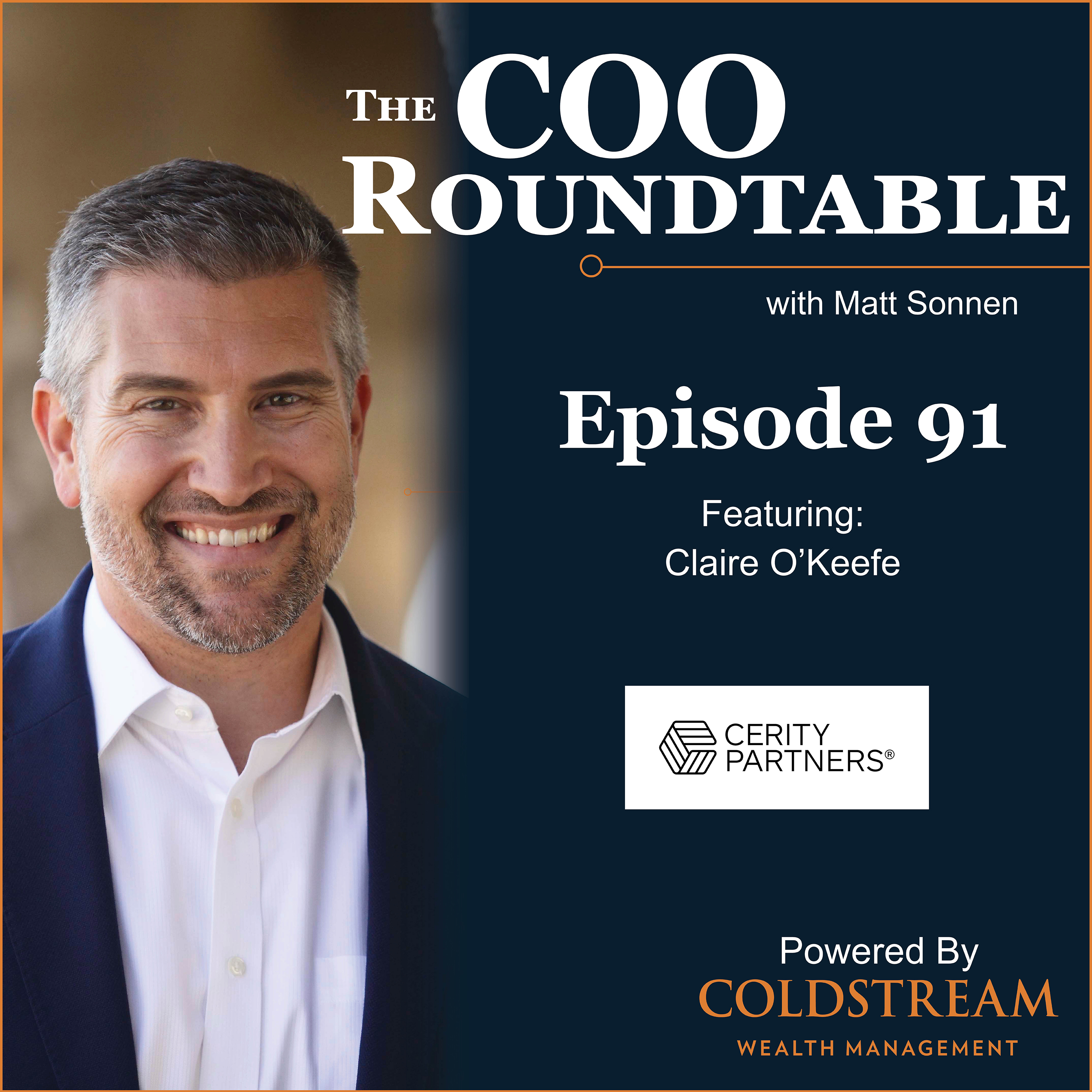
The COO Roundtable
with Matt Sonnen
Episode 91 – Claire O’Keefe
00:00:05
Luke Sonnen: I'm Luke. Welcome to the COO Round Table powered by Coldstream Wealth Management. Here's your host, Matt Sonnen.
00:00:14
Matt Sonnen: Welcome, everyone, to Episode 91. As you all know, with The COO Roundtable, we typically have two guests per episode, but once in a while we have a guest that has the level of experience and the stature in our industry that we give them an episode all to themselves, and today we definitely have someone who meets that criteria.
I'm really excited to be joined today by Claire O’Keefe from Cerity Partners. Claire is partner and head of partner development at the firm, and that means that she sits on the executive and operating committees at Cerity, and she also leads their M&A conversations with potential partner firms. So not only is Claire in a leadership position at one of the country's largest and most complex RIAs, but she also has the opportunity to look under the hood of hundreds of RIAs across the country. So, Claire and I are going to dig in and have a really nice, deep conversation about RIA Practice Management, which I'm very excited for. So, welcome to the podcast, Claire.
00:01:13
Claire O’Keefe: Thank you Matt. I appreciate the very kind words and introduction. I have a lot to live up to.
00:01:17
Matt Sonnen: Yes, well, I think most, if not all of our listeners know of Cerity Partners, but for that one listener out there that's not familiar, why don't you give us an overview of the business?
00:01:28
Claire O’Keefe: I'd be happy to, Matt. So, for those of you who are not as familiar with Cerity Partners, we are a national wealth and investment management firm founded at the end of 2009. The vision from day one has been to build the first of its kind global professional services firm in wealth and investment management, one that will one day celebrate a 100th anniversary. If we're so lucky, maybe a 200th anniversary, and build a brand and reputation as powerful as McKinsey, Deloitte, and Cravath are to their respective service industries. So yes, go big or go home is the mantra here at Cerity Partners.
From a client perspective, we proudly served three profiles of clients. High-end, ultra-high net worth private clients and their families. We have an acute focus on active wealth creators, namely executives and business owners. We love working with young executives who our services often begin with planning attacks and evolving into broader wealth management as they liquidate and grow. And at the opposite end of the spectrum, where we are serving as a fully outsourced family office for our ultra-high net worth clients, families, and individuals.
The second profile of clients: companies and their employees, where we're bringing our wealth management services into companies and then institutions, very often including large university endowments.
On the colleague side, I have the privilege today of working alongside approximately 1800 other colleagues, 400 of whom are partners of our firm, approximately. And we operate as a true meritocracy-based partnership, where every partner has a voice and say in the growth and evolution of our firm and has unlimited upside potential.
Any partner, by way of example, can become the firm's largest shareholder based on their contribution to the growth and success of the partnership. And we also have a very defined path to partnership for our next generation colleagues, giving them something to aspire to. Our ownership is also widely held. This year was an exciting milestone as we broadened ownership and now have approximately 1400 colleagues who hold equity of our firm.
A really important data point, Kurt Miscinski, who is our founder and CEO, remains our largest colleague owner. His ownership now is single digits, and he's never sold a penny of equity. And that was by design. He never planned for the firm to be his firm. It was designed to be a true partnership, where we are all building something special together and all feeling like we are in it together, and doing that together.
00:03:58
Matt Sonnen
That's incredible. 1400 of 1800, roughly, are owners. Coldstream is very proud of our broad ownership. But over our 30-year history and as we've grown the number of employees, we've never really gotten above two-thirds. It's always been right around two-thirds. But you guys with that, just doing the quick math, 75%. That's incredible.
00:04:19
Claire O’Keefe
It's incredible. It's been, it was a really wonderful milestone this year. You know, I often talk about the fact that we are—we're not an employee model. Quite frankly, we don't even use the word employee.
We're a partnership model, an entrepreneurial partnership. And that phraseology is really important, tied into kind of the culture of the firm.
00:04 :38
Matt Sonnen
I like it. Well, my favorite question on this podcast every month is always asking guests to go through their origin story and tell us how they've zigged and zagged their careers to where they are today. And you have a really amazing story; I've heard you talk about it before. Not only do you have some direct COO-experience in your background, but you actually started out in education. So, walk us through your background.
00:05:05
Claire O’Keefe
Zig zag would be a good phraseology to use and having listened to your podcast with many talented COOs, I will share very humbly that I wore that hat for many years. However, I pale in comparison in terms of my expertise on the COO side to many of the individuals you've had on your podcast. And when I think about talented colleagues in our organization and operations.
But my journey grew up in Ireland, born and raised a large Catholic Irish family. I jokingly say I bolted out of there at the ripe old age of 18, went to college in the UK, and moved back to Ireland and became an elementary school teacher, so taught in inner city Dublin. I've always had the travel bug and so after my first year of teaching with some friends of mine who were also teachers, we said—okay, where are we going to go? We have the summer off and we decided we would come to the U.S. and quite frankly fell in love with all things U.S. that very first summer.
Did that for two years, decided after three years of teaching I would take a career break, which gets a chuckle from a lot of people exhausted after three years of teaching. I like to say, said differently, I had no real responsibilities at the time and figured it was a good opportunity to go travel the globe. My assumption was I would travel the globe for two years, come back, continue my teaching career, find the cute boy, get married, have the kiddos, white picket fence, and the rest will be history.
The universe had a different plan for me, which I am incredibly grateful for. I joke with my family all the time, I'm the black sheep of the family that they still welcome back. The whole clan is still back home. So, when I came here after my third year of teaching to travel the globe, I jokingly say I fell in love and fell into financial services. Those two things together. So, I started with a small boutique wealth management firm in New York, quite frankly, just putting food on the table for a year as my husband at the time went back to college and then just decided to stay. And that was the firm that I was with for about 13 years. I had a great opportunity and a terrific mentor in Tom Fanning at that time. Learned a lot about what I love to do, and maybe what I love to do a little bit less. And so wore the dual hat of operations and also became an advisor during that time and loved working with talented individuals.
I was then recruited to a firm in Seattle to wear somewhat of a similar hat, as you might appreciate. My mom and dad were less thrilled that I was getting further and further from Ireland. A wonderful leadership experience. And you know, I know in your podcast you talk a lot about what are the things that you do that kind of help inform you as you grow in your career? For me, that was a great experience, particularly tied into leadership.
I came to appreciate having come from New York, where “go hard or go home,” that in Seattle, as an example, I was like—all right, we're wrapping for the day, it's 3:30, 4:00, we're going to go outside and we're going to go for a hike. And I was like, wait a minute, that's the middle of the day in New York City, and so it just gave me an appreciation for different strokes for different folks and work to live, live to work, and how do you find that right balance? And everybody's programmed uniquely differently.
All of that said, I had had the good fortune of meeting Kurt Miscinski right before he founded our firm. Didn't quite have the gumption at the time to say, hey, I'd like to come join you. And so had remained great friends. He'd always been a mentor. And so, as I was approaching the ripe old age of 40, I took out the white sheet of paper, said what do I want to do, where do I want to be, and most importantly, who do I want to do it with? And they were all rhetorical questions. So, I called him up and said, hey buddy, I need to pick your brain. He said, hey, you should come join us. I was like, great, do I have to update my resume?
Fast forward. That was back in 2018 when I joined our firm. At that time, we had about 125 colleagues, about 35 partners, privately managed, you know, close to $9 billion of assets. Today, we probably manage now $1.4 trillion of assets, or advise on $1.4 trillion of assets. And so, it's been an incredible journey. And I would share the thing that I've been most passionate about and continue to be most passionate about: its people. I've benefited so much from mentorship, partners, and colleagues leaning in to surround me and my journey. And part of that is hopefully I'm having some added benefit to some of the talented colleagues I get to work with.
00:9:27
Matt Sonnen
Well, you're always very humble. And so, you were kind of joking about whether you do or do not have deep operational experience. But I will say that there are others and we aren't going to name any names, but there are others in this industry that are, quote, leading M&A for their firms that do not have anywhere near your appreciation for the operational challenges and complexities that go on behind the scenes.
So, I'm curious, with that background, when you're evaluating a potential partner, how does that experience change what you look at—whether it's the back office itself, whether it's the client experience at the firm you're talking to, or just the growth numbers that they're putting in front of you.
00:10:09
Claire O’Keefe
Yeah, great. Great question. I think when you have worn the COO hat, however snugly it fits or does not fit, you know, I think there's an element of just process and organization. And so when I'm fortunate enough to meet a prospective group of partners, you know, the devil is in the details in terms of really understanding what has made a firm successful.
And I think behind the scenes it is, you know, when you think about a client experience as an example, you know, we all know organic growth, quite frankly, the lifeblood of any firm, and you need to lean in and make sure that the firm is growing organically, attracting new clients, enhancing existing client relationships. Well, you can't do that unless behind the scenes you have the pipes and plumbing and the organizational to deliver an exemplary client experience. I'm always really curious as to what is that process—if Matt is introduced as a prospective client, well, what is Matt receiving? What is the communication to Matt? Matt says, yes, I'm in. I want to sign up. What is that onboarding process? Where we delight or where they delight in that client journey. And then the implementation of the service. Is there incredible discipline around the delivery of what, ultimately, Matt, in this example, has engaged a firm to deliver. So, I think of the operational aspect very much tied into process. I think the same way in terms of firms who have been terrific at developing next gen talent and investing in them, and part of that is you have a process.
What is the process? It's not just come in and open your laptop and do administrative tasks. It's if somebody wants to become a future advisor. Yes, we've all had to carry the bag and do things that maybe we don't love to do as much, but you have to have a plan for that individual to continue to grow and build.
So operationally, I think of it probably more in the process side of things my technology colleagues will definitively share with you. I love to use technology, but I would never be our firm’s CTO, and so I'll leave that to them to kind of get further into the weeds. But it's really client and colleague experiences is the lens through which I look at it.
00:12:21
Matt Sonnen
Yeah. And consistency, right? Is this firm set up to have a consistent process? Not only from a compliance perspective is that important, but just from an efficiency perspective, is the firm going to be more profitable if—it's hard to be profitable when everything is an exception and everything is a fire drill and.
00:12:40
Claire O’Keefe
Everything is a snowflake?
00:12:41
Matt Sonnen
Yes, exactly. Yes, yes, yes.
00:12:42
Claire O’Keefe
And it's a fine balance, in listening to some of the many guests that you've had on your podcast. There's a fine line between how do you scale and build and how do you have process and procedures and infrastructure, and at the same time not take away that wonderfully unique aspect of what is, for lack of a better phrase, the intimacy of a client advisor with their client relationship. What is that communication style? What is that manner? You know, what are the soft touches? You know, it's not a transactional relationship, which I think all of us in the independent RIA space love the most. It's a relationship service. And while the planning is great and the investments are great, at the end of the day, clients want to feel cared for.
Clients want you to know that if, gosh forbid, something happens to them, their family is taken care of. And that's a whole lot more to do with a thoughtful gift because their granddaughter is about to graduate or they're moving home. And we had one colleague who actually went to our client's former home—the home that they'd raised all of their children—took a photograph, had an artist create a beautiful watercolor of the home, and gave it to the clients as they were moving to their new home so they could bring some of the old into the new one. So, like the intentionality of that.
And I think when you hear stories of that, and I do every single day of the week, you know that the commitment from an advisor is I'm there for this family, and I'm doing so much more that is outside of the process. The process piece enables, quite frankly, and even if we think about AI and efficiency, like, how do we enable more of the humanity as we continue to kind of grow and build in that way?
00:14:26
Matt Sonnen
Yeah. Well, I have a two-part culture question for you.
00:14:31
Claire O’Keefe
My favorite topic.
00:14:32
Matt Sonnen
Yes. Okay. Well, first let's start with the culture at Cerity Partners itself; you have 1800 teammates, you have offices all across the country. How do you create and maintain a culture of a firm that size? It's got to be difficult.
00:14:50
Claire O’Keefe
It's intentionality, I think is the word that I will use. So, we have a philosophy, if you will, or an ethos of “build a palace, not a prison.” Build a place that colleagues want to come to. They're excited every day. They're doing work that is rewarding and meaningful to them. They're also hopefully creating their own personal wealth creation journey. So, for us, it's colleagues who want to be here. It's no fun getting up every morning: oh, I’ve got to go to that place! Right―that's not the spirit of, it’s not good for anybody, mentally or otherwise. It's also, quite frankly, not good for the culture of any firm.
We define culture and think of it kind of in three ways. You know, to be ethically driven; we should always do right by clients, colleagues, and the communities within which we operate, both in terms of living but also kind of our broader financial services industry. Expertise focused: we should always be sharpening the saw. And learning: it doesn't matter where anybody is in their professional career path, the ability to continue to lean in both technically, the power skills—as my human capital colleagues call them—of emotional intelligence and presentation training, how you show up. And then entrepreneurial operated: we are a group of entrepreneurs, and so that doesn't necessarily mean that every one of us has mortgaged the home and borrowed from friends and family to start a firm. It's really much more tied into a creative mindset. So, if you're an advising role and your client, Matt, has a particular issue and challenge, how are you being creative and entrepreneurial in solving that? If you're in the technology function, how are you thinking about limiting friction points as part of a client experience journey, whether it's onboarding or other things? So, we think about it through kind of, through that lens. And then just kind of the execution, if you will, of it is tied into, again, humanity. And so how do we continue to lean across the partnership?
And so we've got many different forums by which colleagues will get together. So, every month, we have a monthly partners call. Every partner of the firm is on the call. They receive the full firm financials, get a full update, so everybody feels fully informed as what's transpiring. We also do an annual partners meeting where we're all together for 3 to 4 days.
There's a lot of strategy, a lot of tactical. We'll also share―there's a lot of fun and there's a lot of relationship building. And so, when you have the partners that are bonded friendship wise, then that trickles down to our non-partner colleagues. There may or may not be some karaoke as part of that. But what happens at the partner offsite stays at the partner offsite. Having a bit of fun is also part of the culture.
And then and then we have other forums where like our principles and senior principles and our associates and senior associates get together. So, a lot of technology has enabled, you know, cross-pollination, if you will, across the partnership from a national footprint standpoint, much more easily. But we also want to get people together in person. So just actually in the last couple of weeks, our colleagues in the Mid-Atlantic region brought several practices together. The colleagues and the principal level designed the agenda, the partners financed it, which was great. And so, we think about just forums, both virtually and otherwise.
I'd say the other big component is our Cerity Partners University. So, we have a physical campus in Louisville, Kentucky. We just graduated our very talented class of ‘26. Those talented next-gen colleagues are now off to offices across the country. They're continuing to pursue their 201 training, 301, 401 training now through Cerity Partners University, their CFP, their CFA, etc. but they're also bonded, right? So, 40-ish colleagues who are now the class of ‘26, they're going to hopefully grow within the partnership together. And so, Kurt often likes to share, not just drinking the Cerity Partners Kool-Aid but hopefully starting to make the Kool-Aid.
And I'd say the other component with intentionality with a wonderful colleague, Masha Hodi, who leads our colleague engagement and colleague engagement tied into communication. So how are we cascading information? Because people receive information in different ways.
So, we have a lot of forums by which you communicate inclusive of―Monday morning, we all wake up to: here's the Cerity Partners news, if you will, for the week, which is really exciting. Also care: we're all hopefully going to be colleagues for a long time. Things happen, so if somebody is sick or whether it's a family member or a colleague, a new baby is born, let's make sure we're celebrating the growth of the Cerity Partner’s family and then making sure that we're celebrating―when we're winning, let's celebrate around those things. So that is Masha’s full-time role. She does a phenomenal job at it. Just naming one colleague and supported by some other colleagues in that function will continue to grow and build it.
So, I don't think there's any one thing. I think it has to be a combination of things. And while for some who may be listening―close to 1800 colleagues may sound like, oh, that's a lot. You know, we've, to this point and hopefully we'll continue―our organization still feels really small. And I think that's because we're incredibly flat. There's no hierarchy, there's no bureaucracy. I sincerely say if a 22-year-old associate wants to speak with Kevin Hilden, our president; we’re 15 minutes on for a Teams meeting and just jump on; there's no ego around the many ropes and roles you need to go through in order to get to each colleague. And I think maintaining that flat perspective and having some humor along the way makes it feel quite small.
00:20:15
Matt Sonnen
Yeah. No that's fantastic. Well, my second culture question is about the firms that you're assessing to potentially join Cerity Partners. And I'm sure every single RIA owner that you speak with, because I've dealt with this, I'm sure every one of them puffs their chest out. They say we have the best people. We have the greatest culture here. Everything's fantastic. And then if you go and actually talk to some of the employees, many times―not all the time, obviously―but many times you'll hear a completely different story from the from the employees. So, I'm curious how you assess a firm's culture and ensure that they're joining, and when they join, they're going to be additive to the culture that you have worked so hard to build.
00:20:59
Claire O’Keefe
That is an awesome question. I sincerely believe it's spending time with people and just really, really understanding just their “why.” So, you know, I have conversations every day of the week. I absolutely love hearing stories. We have some phenomenal pioneers in the industry who were the―they went out there day one when the RIA was like, hey, what, what is an RIA like? Just, you know, they launched it. They built it. They were the visionaries. They brought in talented colleagues to support them in the building.
And so, I would say in an initial, which is often a Zoom meeting for me, it comes down to the phrase, “we before me.” So, in a conversation, when all of the questions are tied into what is it going to be like for my colleagues? What is it going to be like for my clients? They're putting themselves as the owners or the shareholders kind of on the back end. That's really important because the spirit of our partnership is that we're tied into, you know, positively impacting the financial lives of clients, of colleagues, and our community. And so there has to be that common DNA.
I think the other aspect is just the excitement around being part of a partnership. It's different for us. It's different in a good way, but it's not the right fit for everybody. Some, I think, individuals prefer to come to the office: plug and play―hey, I'm told what to do, I go home. You know, for us, we've got, as we like to say, incredibly talented, experienced, and opinionated partners and colleagues, which makes us have very spirited debates in our firm.
But that just leads to this dynamic, ever evolving, agile, entrepreneurial partnership. And so that has to be exciting. Like, I play this out; we were all together in Los Angeles as a group of partners for our offsite this year, you know, to sit in a room with close to 400 partners, that has to feel energetic and exciting versus, okay, I'm used to being the loudest voice in the room.
And we have ample forums for conversation. We are very thoughtful. I'll say, just in terms of how we're eliciting feedback. We vote as a group of partners and we use polling software. So, it's not just the loudest voice in the room, but if somebody is truly―when I say so, it needs to be so―then that's not what's going to work in a partnership because you can voice your opinion, we can have constructive conversation. When the partnership votes, we lean with how the partnership votes.
And so, I would say in that aspect, I try to bring to life some of what it feels like. I always strongly encourage, and I would definitely encourage anybody who's listening, who's considering, “I'm going to go explore the marketplace,” either with an advisor, whether it's an investment banker or otherwise, or directly, you've got to spend time with people who've joined a firm. You know, I talk about a partnership, and we talk about a partnership that is a different field, but we don't just use the word; it's an action. And so, you've got to look under the hood and have conversations with colleagues who have joined, who've been in your seat. And so, we encourage that broadly. I literally say: open the website, tell me who you want to talk to, facilitate that conversation because they're going to be your partners and colleagues.
And lastly, I would share: it's the ethos of―you want to be part of building this? Like, this is your last job. Like we're not a firm somebody should say, I'm going to try this on for size, and I'm going to take my practice and I'm going to flip that step like this. Like, that is, the intentionality should be whether you're the 22-year-old colleague joining us or the 65-year-old partner who is joining us, that this is your last stop. Like, that's the intentionality. And so, make sure that you're spending the time to get to know one another around strategically where are we going, is that exciting? Being part of the partnership, if that's exciting.
00:24:48
Matt Sonnen
So, you touched on it a little bit in that answer, but so that's what you're looking for pre-them joining. So, after they've joined, a lot of these very entrepreneurial driven advisors, owners―they've been so used to, you know, “I've made all the decisions.” And it's really tough sometimes for them emotionally, mentally to really get their head around, “oh I don't make all the decisions anymore.” So, after they've joined, how do you keep that many autonomous, entrepreneurial advisors rowing in the in the same direction and without squashing that entrepreneurial spirit of theirs?
00:25:35
Claire O’Keefe
Yeah. Well, I mean, we spend a lot of time together. So, it's upfront; the exclusivity process is—we refer to it as a mutual due diligence process. So, everything we believe to be true about a group of prospective partners, quite frankly, everything they believe to be true about us. So in that diligence process, which is often 6 to 8 weeks, you spend a lot of time together.
And I've often thought about the restaurant industry kind of as the analogy for any business, right? In order for the front of the house to work incredibly effectively, the back of the house needs to do the same thing. I also think about the restaurant in terms of: how do people treat people? And so, you know, as part of a diligence process, prospective partners are interacting with many colleagues across many functional areas, and not all of them are partners of our firm. And we've got a good eye on raising some flags of, you know, how somebody interacted. And now—everybody can have a bad day, but if there's an inherent, I am, you know, something that comes across where there's a superiority feeling—like, that's not okay. So, I think there's just an element of understanding that.
So, I share that in the context of like, that's what diligence is for; it’s mutual diligence. It's not that we have everything perfectly figured out. It's truly let's get to know one another. So, when colleagues are here, we've spent a lot of time describing the partnership, them understanding the partnership.
But to your point, once you're here and we've merged, okay, now what does it feel like? And so organizationally within our partnership, if a group of colleagues join us, they tend to join us as a practice, so all of the colleagues who are actively serving client relationships or in a supportive role, so think CSA or executive assistant—they're all part of the practice.
We don't want to disrupt what has worked incredibly successfully for many years in terms of serving those client relationships. The partner who leads that practice is referred to as a practice leader. In some instances, we have dual practice leaders, and that practice leader has full autonomy over the colleagues within the practice: their compensation, their professional career path, very much supported by human capital and a practice development function. But they also have control, along with the other partners and colleagues, within the practice of the services they're bringing to their clients. Leaning into the Cerity Partners toolbox, what can add more value? The colleagues they wish to cross collaborate with, whether that's within the practice or across the firm, or using our Centers of Excellence in order to provide the best of the firm to those clients, and then, quite frankly, where they want to lean into in terms of growth.
And so, we have multiple channels of organic growth. As Chris Hemstead, who leads our practice development, likes to say, well, what's your major? What's your minor? Where do you want lean in? Try not to spread yourself so thin. And so designing and developing an organic growth plan. And that is not a top-down approach. Chris and the practice development function sit side by side with the practice to help them to say, where do you want to lean in, what's your special sauce? Do you have a target niche, or niche as many like to say? I can't transition to that American word; it's got to be niche. Do you want to lean into Women and Wealth, is it divorcees, business owners? And so defining that. So, in that that's kind of the design element.
Punchline: there are always personal things, right, we're in the business of, you know, serving and advising clients, but also developing and collaborating with colleagues across the partnership. And so, a huge part of it is just caring and connecting and communicating and meeting colleagues where they are. So somebody who has been a founder, who founded a firm 30 years ago; it is a big change. I'd say that is a different change than somebody who may have been part of a large organization in the past, saw all the benefits of a large organization. Maybe some of the things they didn't like. They founded their own firm. Maybe they had that for up to a decade, but now they're like, oh, I scratched that itch. I was the business owner. I want to go back to being part of a more robust organization, but without all the stuff I didn't like. And so, in that, I think the integration process, which is really a colleague assimilation and mindset, can be at different speeds for those colleagues, but it is truly meeting every partner and colleague where they are on that journey.
00:29:45
Matt Sonnen
Great. Well, I've been obsessed with a quote from Michael Kitces ever since I heard him say this recently on his podcast, because I deal with it all the time at Coldstream, and I got to assume Cerity deals with this as well. He said, “with organizations that have grown really rapidly, you get to a point where there's only two types of people on your team. Either they don't know how to do anything because they're too new to the organization, or maybe they've been there for a long time, but they don't know how to do anything because the organization has changed so much that they're still stuck in that—well, this is how we used to, well, we don't do it that way anymore. So, you wind up with nobody at your firm knows how to do anything for these two very different reasons.”
So how do you—you’ve talked about Cerity University, but I'm curious how you tackle training at that scale with that many people and with just, again, the firms changing, people are being at it all the time. So how do you guys deal with this problem that Michael brings up in his podcast?
00:30:46
Claire O’Keefe
Yeah. Good observation, Michael. Yeah, many pearls of wisdom. It does all tie back to Cerity Partners University from a content and training aspect. And there's obviously different training. So, I would share—a group of colleagues that is joining us via merger—we are going to do a full technology integration. But that is going to be a measure eight times cut once.
Make sure we understand exact workflows, make sure we understand the client experience. And a lot of that—the pre-work, if you will, and due diligence—is what lays the foundation for the integration work and the complexity.
We want all colleagues and clients to have an exemplary experience. We want everybody to be on the same technology stack so that we can do that, and we can, as we're thinking about efficiencies, we can lean into kind of the core technology stack. So, the training and development, there's an, I'll say, an integration part of that. Some of it is truly practical of, you're moving from system A to system B, what is that? And so that is for training for CSAs, as an example, our operations type colleagues, which quite frankly, I respectfully say, those that are in a lead advisory role may have never touched it, never look at it, that isn't kind of what they seek to do on a day-to-day basis.
And so, I think the trainings, Andy Wolfgang, who leads Cerity Partners University, it’s not just for training, but it's also for quality of delivery of service. Partners, cross functionally both with colleagues who are experts and being advisors—so, if you think about financial planning as an example, what is the standard of excellence when we think about a financial plan? Everybody has a different definition. Family office services, probably the most overused phrase. What does that actually truly mean? And what it means to you might be different than what it means to me, and so in that we have—Andy leads many initiatives across our partnership, bringing in colleagues who are the lead advisor for these many aspects of what we deliver to clients to say, let's together work on what is the CP way.
So, what is the Cerity Partners way, the standard of excellence across everything we're doing that is similarly occurring in the operational components. We think about billing, yes. We bill every six ways to Sunday, let me tell you at this juncture. Our billing colleagues are phenomenal. But what is the optimal kind of way to do that? And how do we create the standard of excellence?
So, all training and development, the development of it, the curriculum is designed through Cerity Partners University. The training itself: a lot of it is virtual, some of it is on site. So as an example, as part of a merger process, there will be physically boots on ground for many of the trainings to help bring colleagues up to speed.
And then I think there's training and development, which is really important. If as a firm today, you provide financial planning and you have a smaller investment advisory toolbox, okay, now you join Cerity Partners, all right, there's a lot, like where does one go? So, helping colleagues as they join us, first and foremost, you're now part of the firm, you're part of our partnership. Your history doesn't need to disappear, it just needs to become part of what we're doing.
So how do you share the Cerity Partner story? How do you talk about capabilities that you yourself may not have, but now you've got this incredible, powerful group of colleagues that can help you in both serving and developing client relationships and then the execution of that. And so, we spent a lot of time on training and development tied into all things sharing the story. How do you tap into services? How do you bring the best of the firm to every client? Because quite frankly, there's nothing better than, as part of our clients rather becoming clients now at Cerity Partners via merger, to suddenly say, oh, tax has been a pain point for you forever. Great, we can do your taxes. Hallelujah. Right? And so, if that's not a value add, then that advisor should not bring tax to that particular client relationship. But it is an easy way for clients to suddenly experience the benefit.
I would share with you, bill paying is an incredibly laborious service, and probably one of the stickiest, because clients who can afford to pay for it are like, absolutely, I do not want to do that. Tax is the same thing. Like, there's lots of services that are laborious and they—as much as having a great return on investment portfolio, they are quite frankly, less concerned with that—it's, give me peace of mind of my planning, take away the friction points from my day to day.
So, we endeavor, and we'll never be done. It's always iterating, evolving. With full content and curriculum and colleagues can opt in or out of certain trainings, and some trainings are formal trainings as part of an onboarding process.
00:35:20
Matt Sonnen
Yeah. Well, I talked about, I'm so impressed with the intersection that you have between an operational background and M&A expertise. And so, you're the perfect person to answer this one.
For an RIA today thinking, well, we might sell in five years. They've got like a five-year window. What should they be doing now to clean up their operations to make them an attractive partner five years down the down the road?
00:35:51
Claire O’Keefe
I think of it no differently than if you have a beautiful home, beautiful in your eyes, and you're thinking, hey, we might want to downsize in five years using your time horizon. Yeah, you probably have a real estate agent come in and do a punch list, right?
And so having somebody come in independently and look at your business; there's many talented professionals in the space that will do that, and really what they're looking at is through the same lens of the things that we look at when a talented group of colleagues comes to market, if you will. First and foremost, certainly checking the cultural box, but put that to the side and assume we've all done that and that strategically we feel will be better together than apart. The things that we look at: organic growth, organic growth is the highest driver of value, and that, I would also say, is organic growth in addition to client and colleague experience. So, if you're winning a lot of client relationships, but you're losing a lot at the back door, that is not indicative of a terrific client experience. So, growing, and we know within our industry unfortunately that is something that many many firms struggle with: some of its capacity, some of the quite frankly, is probably don't have all the capabilities to win broader relationships in this day and age, where many clients just want to solve for everything with one firm.
So organic growth and net positive organic growth, we look at net organic growth of revenue. So, nothing to do with market, nothing to do with colleagues happen to have joined with a practice from another organization or you had merger. It's truly, how are you growing? Because that's the health of the business.
We look at client profile. And so, from a client perspective, I would encourage, if somebody was considering this, look at your client base today. Do you have client concentration? It's wonderful that you've served the Smith family for many years, but now they represent 25% of your revenue. That is both a good and a bad thing. So that doesn't mean that you can't command top valuation, but the structure of your proposal is likely going to be different, because you can't run the risk of any firm that the Smith family, the day after you close, you see a nice closing payment that the Smith family is not here. So would encourage as part of a client analysis, okay, that is the situation today. How do you start to lean into other families, making sure that you've got multi gen relationships? How do you start to develop more clients to that diversification through organic growth? The 25% continues to become much less. Similarly, just in terms of average client size, so depending on, kind of, your growth aspirations or where you wish to play: is mass affluent your niche? Is it emerging wealth? Is it high net worth? Is it ultra-high net worth? Is it on the institutional side? Just kind of thinking about, well, where do you want to play? And so, if historically it has been more in that emerging wealth, but you really want to lean into high net worth, okay, well what are the services today or the capabilities or quite frankly, maybe the talent that you don't have that you need to have in order to start to win those relationships? And that doesn't mean that your whole client base has to be that, but if you wish to join a firm that focuses on high end, ultra-high net worth, then your client base has to match. And if it doesn't, then I would say on the other side, it has to be, you've got the right talent, you've got the tenure. You just haven't had the at-bats, but you can play up.
So those are the kind of some of the components—on the on the advisory team side, definitively, if you've got one lead advisor pretty much owns 100% of the business, manages 100% of the client relationships, that is a lot of risk for anyone, so making sure that you have more of a team approach. The ensemble approach to servicing those client relationships, and that truly—and I say this respectfully, sometimes, you know, individuals feel that because they won the client relationship—we don't know that kind would never go anywhere because I won the relationship, quite, which is all good, and the client may like you, but if, you know, Susie or Jimmy are the lead client advisor, and quite frankly, they have the heart of that client, you're at risk that if Susie or Jimmy are not excited about who you choose as your future partner, well, they may take the Smith family with them.
And so how do you make sure that you're balancing not just kind of client concentration, advisor concentration, making sure you've got the right talent and then quite frankly, making sure that you're sharing in some of the success with the next gen. I've seen that the most, where you know somebody is left, it's usually because I don't see an opportunity for me to become an owner. I can't create a personal wealth, have a personal wealth creation journey as part of this firm. That's not good for any next gen talent. And so, you've got to make room for them.
Say, all of those outside of this, which is probably the obvious: anything regulatory, any risks, you know, SEC audits that suddenly serve up a whole host of things, disclosures, if you've had a personal bankruptcy as a lead advisor, like that's not something we would be comfortable with. They look credibly, you know, could have happened many years ago for somebody. And there may be valid reasons, but that ultimately, if somebody is going to join your firm, they're going to be representative of that.
So those are many of the things I would also share, to round out the answer to this question, on the five year—just because you think you need to do certain things to get to five years, there's you should potentially consider, well, what does your nirvana look like? So regardless of the time frame, hey, these are the things I love to do. If I had my druthers, I wouldn't do X, but I'd lean in more to Y, because, you know, five years from now, the environment may have changed. You never know what happens health wise. And that's not me putting the fear monger on anybody. But it's, you may not have to wait five years. It may be worthy of having some conversations to say, what is it that I wish to do?
Because the quote unquote selling of a business, sometimes people feel like, oh, that's the end. I would tell you, we have had many, many, many, many partners and colleagues who have joined us. The merger was the first bite at the apple. The growth they've experienced within our firm—they look at their capital account—it's more than they received in merger consideration, which is phenomenal, right? So, they are growing and being part of a larger growing firm commanding ultimately higher valuation. There's a crossover, right? So, you’ve got to do the math. And I've often helped people to do that. So those are just some of the things I would consider if I was in those shoes.
00:42:14
Matt Sonnen
I've got two more questions for you, and I can't let you go without; you said the A-word earlier, I can't let you go without talking about AI.
00:42:21
Claire O’Keefe
Do we—we couldn't get through one hour without AI?
00:42:25
Matt Sonnen
Exactly, exactly. So, I know publicly, you know, Cerity has talked about AI as part of the platform that you, you know, one of the value props of what you're offering for folks. In your mind when it comes to AI, what's actually gaining traction today and what is more hype and isn't really a huge lift, it's more marketing that we're hearing from a lot of these AI vendors.
00:42:54
Claire O’Keefe
We've- so blessed that we've had colleagues who've leaned into AI, large learning models for many years. I’d say, our colleagues in the engineering side, if you will, technical side for coding we've been doing it for many years and continue to lean into doing that. We've had to—we think about like concision, right? All the information that we have.
How is AI being able to—how can we quickly find something like, so how do we make it easier to access information?
As, you know, companies, whether it's Salesforce or portfolio accounting systems or, you know, services like our solutions, excuse me, like eMoney as they've continued to evolve with AI, you know, they're obviously incorporating it into their technologies tech stack. So, we don't, we're not a technology company, we don't seek to be. We were incredibly fortunate this year to welcome a new leader to our leadership team, Will Peng. Will is our Chief Innovation Officer. Will has been involved in VC companies for many years. He was the founder of a firm that he successfully sold last year. That was an e-solution very much tied into the intersection of financial advice and AI. So built this agentic platform to make it more easy to access information.
Will, is I believe here, all of now two months, has done a phenomenal roadshow across our partnership, partnering with our colleague Stefan Ludlow, who's our Chief Technology Officer; Kevin Hilden, our president; and many, many other colleagues, inclusive of Kurt, our CEO, around how do we think about, most importantly, client experience and colleague experience?
And so, this year, we rolled out Claude Enterprise to every colleague of the firm. That is a heavy investment. But wanting to start to—for everyone to become fluent, start using it. We've had AI hackathons, we've had our interns this year—I had three interns as part of the partner development team—and that's where they, what they created was phenomenal, developing skills.
And so, it's no different, I think, than when the internet first came about. It was like, what is that? Like, you got to start to use this? So, there's this element of, you know, start to become fluent. And it's some colleagues are at, you know, at the end of that, of their learning and really excited about it every day. Others are dipping their toe into it.
You know, also we have Zocks and Box, and that has been incredibly well embraced by colleagues, particularly colleagues who are in an advisory role on capacity. So, it's giving them efficiency. Note taking is obviously kind of one of the easier things. But now with Will designing truly that—all the way from first touchpoint, all the way through the client experience and the delivery. And so, I think where we will be this time next year is going to be a really exciting aspect for our partnership. But like, we all know, this is just the tip of the iceberg.
Our President, Kevin Hilden, gave a wonderful presentation at our partner offsite this year, and he used some images from The Flintstones. So, like the Flintstones— if you go back and you look at it, for those of you that didn't watch, you should, it's kind of funny, but so much of it was a—hey, in the future, you'll be able to do X, Y, and Z. Like, we are in the future. And I think it's incredibly exciting.
The humanity piece, I continue to think that's the aspect that, at least for the foreseeable future, AI is not going to take over. And I've also said to colleagues, as part of my talented team, they figure out what AI cannot do. The analysis, the review of information: those things are going to become pretty standard. So, we got to take it to the next level, where certain roles will start to evolve and dissipate, there will be clearly newer roles that will be created. And so, it's going to be fun, I think, to see it.
00:46:52
Matt Sonnen
Yeah. Well, my last question is simply: how do you survive your day every day, Claire? I said at the beginning, you're on the executive and operating committee of one of the largest and most complex RIAs out there. You're having all of these M&A conversations with other firms and evaluating them. So how do you not just crumble under the weight of your to do list every single day?
00:47:08
Claire O’Keefe
You're very kind in your observation, I think we're all in the world of: everybody wants everything yesterday, you know, as technology has been wonderful, technology is ultimately—we are all accessible 24/7. I go home to Ireland and Teams messages don't stop, right? And so, I will say first and foremost, I love what I do. And so, loving what I do gives me energy.
Waking up every day,
What does it look like? Where am I? My niece, who is six: she asked me the other day, she's like Auntie Claire, what car do you have? And I was like, I don't have a car. She's like, oh, that's right, you have a plane. And I was like, I literally don't have a car. Like I travel all the time I'm on the road. I said, I don't have the Cerity Partners’ private jet yet, that's a plug, if Kurt would like to hear and get me one of those—that would be phenomenal.
It's truly being passionate about what I do when up from a focus standpoint, it's: what are the big rocks? And a former business coach shared with me once said, “what are—as you continue to grow and build, regardless of where you are in your career, what are only the things that you can do? And that's not in an egotistical way or an arrogant way. It's what is the highest and best use of your time?” And as we've grown and built, when I first joined, our mighty leadership team was probably all of six strong. We're now 30-plus strong right across many different functional areas.
And so as we continue to grow and build, what are the big, big rocks? What are the things that need to be focused on? Start to get comfortable as a perfectionist, type-A triple, triple, triple. I don't like to leave any email unanswered. Responsiveness: I've always prided myself on that. That has become probably the biggest challenge. So how do I think about that? How do I make sure I'm bringing other colleagues into the team?
Which leads me to the team: who you surround yourself with is incredibly important, and part of my joy is mentorship and developing next gen. I’m incredibly proud of the colleagues that are both within my direct practice development team, but also colleagues across the organization. And so, it takes all of us to be successful. So, I think when you have the right colleagues with the right skill set, and quite frankly, what gets you here doesn't always get you there. So, you've got to continue to look at that.
And then the last is the basics. Got to exercise. That is a must do. And whether it's a small, teeny gym in a little hotel, it's like you can find a treadmill, you can do something for 30 minutes to get your heart racing and do a little weights, try to sleep. My Oura ring tells me regularly I don't do that as well. But good news for me: even if I only had four hours of sleep, I apparently get one hour of deep.
And then, you know, making time for the fun things. It doesn't have to be an all or nothing. It's really important to—that social aspect, for me, at least—as an extrovert, I need the people that I love closest to me. I need to make sure that I'm spending time with them, and I also need to indulge my passions: being outside, travel, making sure that I have those on the calendar.
There will always be stuff to do. I think it's just a matter of managing it all and then listening to your gut. If it starts not to feel fun and it starts to feel like a grind, you’ve got to change something because life is way too short not to be doing what you love to do and doing it with the people you want to be with.
00:50:18
Matt Sonnen
That's right. Well, fantastic. Well, I didn't want to put too much pressure on you at the beginning, but I had very high expectations for today's conversation, Claire.
00:50:26
Claire O’Keefe
You put pressure on me in your opening remarks, so thank you.
00:50:29
Matt Sonnen
Well, you did not disappoint. So, I cannot thank you enough for taking the time today, sharing your unique vantage point on the industry. I know I got a lot from today's conversation, and I know our listeners did too. So, thank you so much for being here today.
00:50:45
Claire O’Keefe
Thank you so much for having me. And you do an incredible service to our industry and the many different guests that you have and the information that's shared. And I think it's one of the most wonderful things about our industry; we're all in it together. We all want to make it better together. And so, to anybody who's listening, if there's ever anything I could do to be helpful for you across anything, you just want to connect, my door is always open.
So please reach out.
And Matt, thank you for having me.
00:51:11
Matt Sonnen
Thank you. Well, that is a wrap on Episode 91. We will talk to everybody soon.
© Coldstream. All rights reserved. May not be reproduced, republished, or distributed without prior written consent. Information drawn from third-party sources believed to be reliable but not guaranteed as to accuracy, timeliness, or completeness. None of the information provided constitutes an opinion or a recommendation or a solicitation of an offer to buy or sell any particular security. Coldstream analyses are not intended to provide, and should not be construed to constitute, complete accounting, insurance, legal, or tax advice. The investment strategies and securities shown may not be suitable to you. Past performance is no guarantee of future results.