Episode Transcript
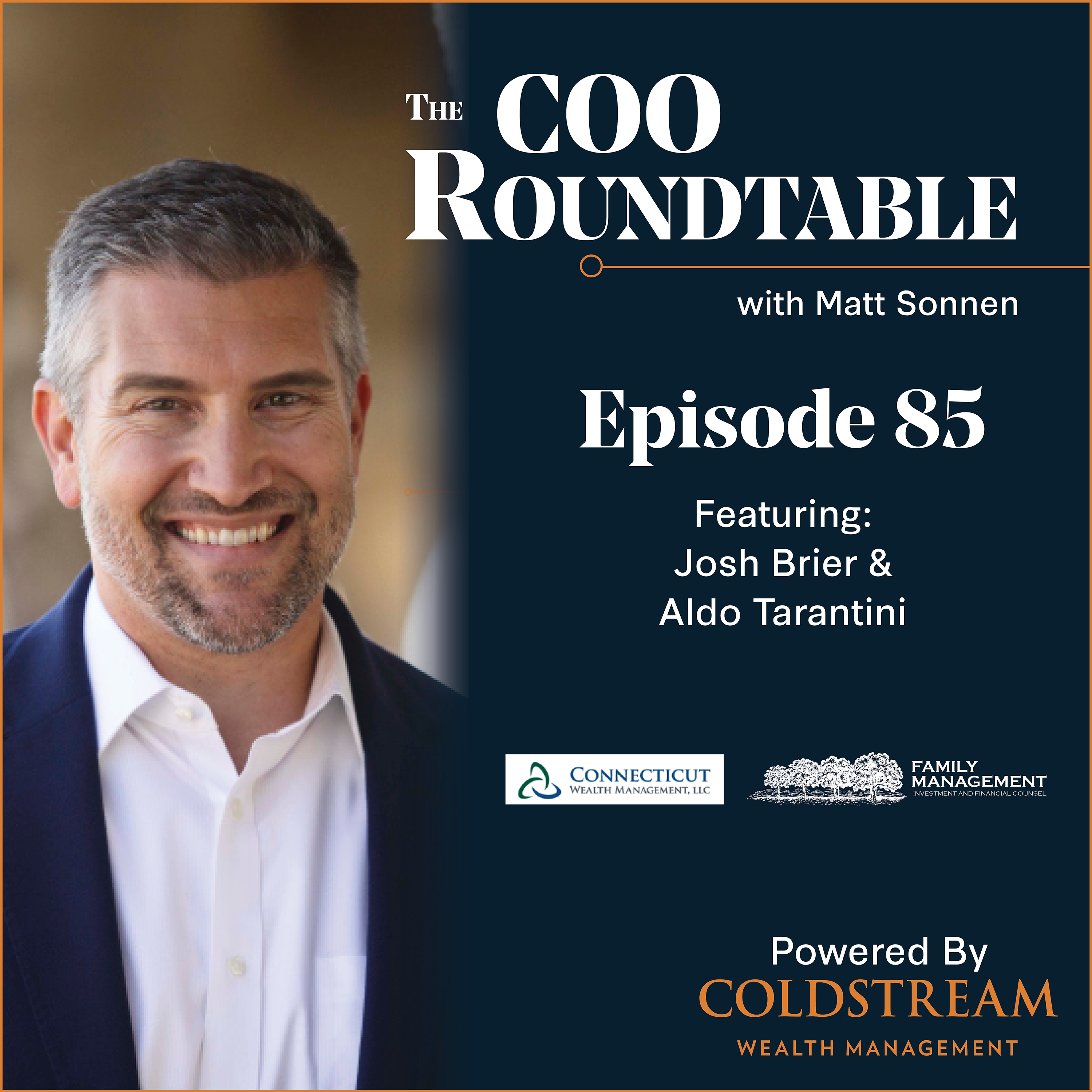
The COO Roundtable
with Matt Sonnen
Episode 85 – Josh Brier & Aldo Tarantini
[00:00:00] Hi, I'm Luke Sonnen. Welcome to The COO Roundtable, powered by Coldstream Wealth Management. Here's your host, Matt Sonnen.
[00:00:14] Matt Sonnen: Welcome everyone to Episode 85. We have a great conversation lined up today, so we're gonna jump right into it. Joining us from Connecticut Wealth Management is Josh Brier, the firm's COO.
[00:00:26] We had the prior COO from Connecticut Wealth Management on the podcast back in Episode 64. That was Kailee Ostroski. Josh joined Connecticut Wealth Management in March of 2025, and he has a wealth of experience in financial services. I'll let him go through his career background in a minute. Josh's bio states that "as COO, he leads the firm's operational strategy, ensuring efficiency, scalability, and an exceptional client experience." And we're going to hit on all of those topics during our conversation today. So Josh, welcome to The COO Roundtable.
[00:01:02] Josh Brier: Matt, thank you. Great to be here.
[00:01:04] Matt Sonnen: And joining Josh is Aldo Tarantini, Managing Director and former Director of Operations at Family Management Corporation in New York City.
[00:01:14] Aldo has been at the firm for 12 years, and I'll let him explain shortly how he has balanced his time between serving clients and overseeing operations and technology at the firm. Similar to Josh's bio, Aldo's LinkedIn page states that "he oversees the evaluation and implementation of initiatives that enhance operational efficiency and client experience."
[00:01:37] And being an advisor who works directly with clients, Aldo is very focused on client experience and we're going to go into detail on that today. So welcome to the podcast, Aldo.
[00:01:47] Aldo Tarantini: Thank you so much, Matt. Great to be here.
[00:01:50] Matt Sonnen: Well, Aldo, I'm going to let you go first. Why don't you tell us a little bit about Family Management Corp.?
[00:01:55] Aldo Tarantini: Sure. So Family Management started in 1989. Humble roots - it began as a family office for the two principals that started the firm with their own money and sort of built out from their family and friends. And over the years, employee count has grown. So has the assets. To date, we're at $5 billion AUM and growing.
[00:02:21] I started 2013. Our assets were a little over a billion, so I've seen quite a bit of growth over the time that I've been here. Employees are around 23. Interesting fact: when I started in 2013, we had roughly the same in place. So it is a true testament to the power of technology and the effort that the folks here are putting in at the firm.
[00:02:51] And you know, we are now a full service registered investment advisor. Last year, we made the difficult decision to close our broker dealer. So now we're strictly an investment advisor. Ideally, we look for clients in our sweet spot at say, $5 to $10 million. And, you know, like I mentioned, the growth we've had during my tenure from a billion to $5 billion, historically, we've grown through word of mouth. We don't do really any formal advertising, or marketing. We have a website, we have a newsletter. But if you look at the slice of revenue, year over year, it's almost 90 / 10, 90% being referrals, intergenerational, planning, where, you know, grandfather to son and then to grandson or granddaughter.
[00:03:48] So it's been a real good, loyal client base. Some of the clients have been here since the beginning, which is pretty incredible. So, you know, we're looking to obviously continue to grow. We're aware that marketing is super important. Most of the growth has been organic. We are looking at some inorganic opportunities as well as partnering with other firms to round out our service offerings.
[00:04:16] Most recently, partnering with a firm for estate and insurance planning.
[00:04:21] Matt Sonnen: Fantastic. Well, Josh, give us the rundown on Connecticut Wealth Management.
[00:04:26] Josh Brier: Happy to. And, you know, some real parallels listening to Aldo and the amazing things that he and the team there have accomplished. You know, we just celebrated our 15th year in business. Our original year of founding was 2010, and was founded by our two co-founders, Kevin Leahy and Denis Horrigan, who lifted a wealth management practice out of an accounting firm. And really thought that there were ways to serve clients better and more independently by separating those two businesses.
[00:04:55] And so that's how we got our jump on the world. And we are currently managing right around $5 billion in assets. We have right at 70 teammates, as we speak today. And, you know, we have the privilege of serving a variety of families and individuals in their financial planning journey, with I would say a particular expertise in the business owner space.
[00:05:19] We have worked, you know, as our founders are business owners, we've worked very closely with business owner clients from our founding through today and just our shared mindsets, our shared values of hard work and taking really good care of both the people that work for your company and the clients and customers of those businesses just seems to put us in a place where we're having lots of those conversations, both with existing clients and the possibility of bringing on new clients. And so, I'd say our ideal client is sort of that: somebody with some complexity in life where they want and desire the need for a holistic financial planning team to be able to assist them in achieving their life's aspirations.
[00:06:00] And so, you know, that's how we have grown historically, is just doing a really incredible job for our clients, for our team. And as Aldo said, that's led to a lot of word of mouth. Overwhelming majority of our new clients who come into the firm today come to us as a result of a referral from an existing client or a center of influence that we work with, either in the legal or accounting or, you know, pick your other professional services space.
[00:06:25] And so we're very proud of that and the opportunity that we've had to basically grow through just the amazing work we're able to do for clients and people finding value. And appreciation for that type of work and recommending people close to them to join us. And so, you know, the other way we've grown historically is similar, but different in that, you know, that really great work and sense of, you know, having a client base that's really appreciative of the work that you're doing makes its way into other realms. And so we've had the good fortune of partnering up with some other independent practices, RIA practices, independent practitioners who have decided that, you know what? Connecticut Wealth Management is the kind of place that fits the value set of what we want to do for our clients and, you know, we want to make sure that our clients are taken care of. So we've been able to partner up with a handful of other practices where, you know, founder wanted to retire at some point and really wanted to make sure there was an amazing landing spot for their team and their clients, or somebody who had aspirations to grow their practice larger and really just wanted to team up with some like-minded folks who are going to do it, you know, exceptionally, and make one and one plus each other, you know, equal three as opposed to the two. So that's how we've grown historically. And as we look forward to, you know, what the future brings us, you know, we just, we want to do a really great job for our clients at the end of the day. That has been the secret sauce for what's led to our success.
[00:07:57] And so what does great look like moving forward? Well, it's doing even more to make sure that we're helping our clients achieve their life's aspirations. And so, you know, as you can imagine, as clients become more complex in their needs over time, and all of a sudden you start looking at intergenerational wealth transfers and business complexities, you know, they're asking more and more of us, whether that's acting as trustee because they trust us so much in making sure that, you know, the desires that they want to have for their accumulated wealth and the nest eggs that they've built up be delivered in a way that's consistent with their values. You know, we've been asked to step in some places there, we've been asked by many of our business owner clients to help them figure out ways to grow and be more successful in their day-to-day world, so that way they can take advantage of the fruits of their labor.
[00:08:47] And so those are two places where we continue to see, you know, great growth opportunities in the future, to continue to make sure that the legacy and the desires of our existing clients are met through multiple generations and trustee services and helping our business owner clients, you know, really be able to take advantage of the success that they've had and achieve the things that they want to achieve.
[00:09:08] Matt Sonnen: I like how you talk about the complexity of the client. When there is that complexity, your value prop is so easy. It's harder when - oh, they just need some quarterly rebalancing. It's harder to show your true value, but when there is that complexity there, it makes your job really easy.
[00:09:23] Josh Brier: No doubt.
[00:09:24] Matt Sonnen: Yeah. Well, Josh, I'll stick with you. You've had a fascinating career. You've had experience in banking, a credit union, you were the COO at one of the Focus firms after I had left Focus. Walk us through your career path.
[00:09:39] Josh Brier: Well, I appreciate that. I'm not sure it's ever been referred to as fascinating, so I appreciate the description.
[00:09:45] So, I've had just a really - some good fortune and privilege to work in some great spots and get some crazy good experience along the way at that hopefully has been put to good use. But started out my career in retail banking at Bank of America, was there for about a dozen years, half of which was on the retail bank side and working with the retail branches and making sure that the depositors and the borrowers of that institution were coming to reality. And then having made my way to the back office, if you will, in the operational risk space for the second half of my career there, right around the financial crisis, which was really a great opportunity to sort of look in the underbelly of a massive financial institution and its work. And so I'd say that was the catalyst to the second half of my career, which started to step into more, you know, organizational, strategic leadership opportunities in the community banking space. So was able to, you know, really put a lot of that experience and knowledge to great use and helping community institutions, you know, really figure out what was the value proposition that made them different and differentiated them in the spaces against the competition and, you know, those led to just some wonderful relationships over the years. And in my last space, working community banking up in Massachusetts, we actually had an independently operated and owned arm of the institution that was wealth management services.
[00:11:13] And so it was my sort of first foray, if you will, in that line of business and really got an opportunity to get comfortable and exposed to the amazing work that can be done in that space when it's done well. And that opened up opportunities to be introduced to folks in the RIA space and then ultimately pulled me from community banking to Focus Partners Wealth, which was the successor entity for GYL Financial Synergies, which was part of the Focus family of firms and really got an opportunity there to help an independent RIA come and be part of a larger combined RIA that was being built to really compete and provide value with some of the largest RIAs in the country. You know, the strategy there, you know, which makes all the sense in the world, was, you have these amazing individual pieces under the Focus Financial umbrella. So bring the best of those together and create a really impressive value proposition that stands up against all over the industry. And so that was very interesting work and, you know, but through that process, one thing I learned about myself is I really am at home and at my best, I think, working for an independent entity that, you know, really wishes to differentiate itself in this marketplace through employee ownership and through the ability to craft its own long-term narrative as opposed to, you know, just not trying to create a very impressive value proposition. Not that there's anything wrong with that.
[00:12:43] You know, my just preference was to work in a space like Connecticut Wealth Management has to offer and was really excited to join this team because, you know, we are a financial planning first firm, and I know a lot of wealth managers in the space say they offer financial planning and what I've come to learn through my career is, you know, there is, there's financial planning, and then there's financial planning.
[00:13:05] Matt Sonnen: Yeah.
[00:13:06] Josh Brier: And we are the latter in a good way in that, you know, we really have differentiated ourselves and provided long-term value to our clients by positioning ourselves and truly being that partner with them on their financial planning journey to make sure that, you know, all the steps they're taking, all the money moves they're making, all the plans they're putting into place are with one goal in mind, and that's achieving their long-term outcome. And so it's something that, you know, resonates with me, both on a personal and values level and being able to be part of an organization and a team that delivers that for people and our clients every day is what keeps me moving.
[00:13:42] Matt Sonnen: Awesome. Well, Aldo, talk to us about your career journey and how you woke up one day as a Managing Director at the firm.
[00:13:50] Aldo Tarantini: It was a very non-linear path. You know, I went to undergrad. I got a degree in biology and chemistry and thought I was headed for the medical profession and did a hard pivot before graduation and ended up in lending, commercial and residential.
[00:14:10] I did that for a number of years at a smaller private firm, and then we got hit with the great crisis - financial crisis. And, I had to, you know, reinvent myself again, went to business school, got my MBA, didn't know what I needed it for, but wanted to expand my network, wanted to get a better understanding of the finance world, the business world, how business has worked.
[00:14:36] Worked my way through there and eventually landed a role at Bank of New York Mellon. I was there for a number of years and then, I got my big break when I got a role at Alliance Bernstein and really sort of narrowed my focus in the finance space to wealth management. They had a really incredible training program.
[00:14:59] I was very fortunate to work with one of the most senior advisors at the firm who had been there 30 years. Managed a huge book and really took me under his wing and taught me a lot of the business, how to deal with clients, how to manage portfolio - I mean, just, you know, something - the schools could give me the paper, the paperwork, but this mentorship really changed my direction in life. And I was at Bernstein and for a couple of years, and then an opportunity opened up at a private, smaller RIA, the one I'm at now. And I remember to this day being approached by someone from the firm and I said, oh, I love it here at Bernstein; I can't leave. And so I eventually did, obviously, I'm here today.
[00:15:48] I joined Family Management in 2013. I joined as an advisor. I started managing some of the clients that were part of the firm's book and then started building my own book of clients. But immediately the curiosity and some of the frictions that I ran into, both from client experience, technology, the way I could do my job, some of the impediments to dealing with clients, started an initiative where I would, you know, bring ideas to the table. Hey, what about if we did this? Or what if we didn't do this? This probably would be better for the client. And I was very fortunate that even though we were well established at this point, the firm has always sort of maintained a young entrepreneurial startup culture where every idea, if it's a good one, you know, can be taken and digested by the firm and implemented. And I tell people that even today when I hire people, and that there's not this top-down. Every idea, if it's a good one, is worth looking at. So it was a really interesting opportunity because I had built this book of business and I was managing firm clients and we had our COO depart in late 2018, and I had already made a number of initiatives at the firm and said, you know, this is something I really want to do. And so I pitched the two founders of the company and they obliged. And I became the Director of Operations, but the rub was I had to also maintain the book of business and the clients that I had, but I actually turned it into a sort of a synergy where I could extract feedback from my own clients and the firm clients and some of the client-facing things that operations was involved, whether it was quarterly reporting or portal or even the way a meeting was run. I got to see firsthand. Not when things get really bad and the advisor comes to you and says, hey, this doesn't work, or this broke down, or whatever - I got to see it firsthand and it really helped me make a lot of decisions rather quickly in shaping the firm to where it is today.
[00:18:12] And more recently, as we've grown now, you know, we're larger in size, many more clients, it's become more difficult for me to run in that dual nature. So, towards the end of last year, I made a difficult decision to hang up the ops hat and go back to an advisory role where, you know, my roots started from. However, once you get into operations, you never - you never really get out because my name's on so many documents and tied to so many processes. So we have hired a new COO and, you know, we're helping him get up and running, but I'm still very much involved in the business itself and, you know, I love operations and, you know, never will fully exit it. So that's just, that's my story.
[00:19:06] Matt Sonnen: Well, the story of you raising your hand and just saying, you know, hey, I have an idea of this, I have an idea of that: that highlights something that we've talked about many times on this podcast. And that's the fact there really isn't a defined job description for a Director of Operations, for A COO. Nothing beyond just, hey, just handle everything around here that isn't getting done today. That's typically what the job description is. So when you did raise your hand and said, hey, I think I can help, how did you go about shaping that role as Director of Operations?
[00:19:37] Aldo Tarantini: Well, I think the role shaped itself before I knew I had a role because I had built, you know, a number of different processes and systems that almost became my responsibility, unofficially and then officially. For example, we didn't have a CRM. We were operating out of Outlook for contact cards, you know, so, hey, we need a CRM. We looked at CRMs. We ended up with a CRM. So then how could we use a CRM? They're expensive. It's not just a Rolodex, it's, you know, it's a sales tracking tool, and it's a way to monitor opportunities, and what else can we do? We can build workflows to onboard clients and, you know, sign documents and store contracts and you know, that kind of stuff.
[00:20:25] And then, you know, more importantly, when I started, we had an internal system, right? So the portfolio management system was something only the advisor or the associate could see. The client did not have a portal that I saw. They had the custodial portal, and they can get their statements and they could see their holdings. But a lot of the stuff that we do are private assets not held at the custodian. So the client didn't really have a full picture on an ongoing basis; they had to wait for their monthly or quarterly reports to come out.
[00:20:58] And, you know, there was another idea: hey, it'd be great if we retire this system and look to something more modern where the client had a nice polished portal, but, you know, we had 600 plus families that needed to be contacted and you walk through and all of that. But I, you know- building out the role, those little pieces of ideas became cornerstones of the firm.
[00:21:26] And you know, we sort of built roles around those areas. Now we need somebody to maintain the system and people to work in the CRM. And you know, all different jobs sort of came out of these initial ideas. So it was very rewarding. I think it helped us grow as a business to better get a better handle of where our money's coming from, how we're doing year over year or quarter over quarter.
[00:21:53] And then it was just off to the races, you know, scrapping the entire accounts payable process. It was all manual, paying paper checks and automating the entire process and digitizing our entire 3000 square foot file room and, you know, offloading all of our servers in our office into a digital, into the cloud.
[00:22:15] My idea, my grand plan was advisors should be out of the office talking to clients, going to their homes, sitting at a restaurant, whatever it is. But if you're in the office without a client, you're not talking to the client. And my goal as an advisor and as the Director of Operations was to unshackle the advisor.
[00:22:38] How can I do that? So it was digitizing the phone system, digitizing the files, getting the portal and the portfolio management system right on a tablet, off of the computer screens, getting rid of the desktops entirely, going to laptops, hoteling methods so anybody at any time can go to any office and just plug right in and sit down.
[00:23:00] So these kinds of ideas - The one idea of unshackling the advisor led to all these technological advances and then 2020 hit and no one expected that.
[00:23:15] Matt Sonnen: Yep.
[00:23:15] Aldo Tarantini: Work from home would be a permanent thing. And we worked from home for a year and a half and it was one of the best years we've ever had in business. We were prepared from a technology perspective, there was no interruption in business and we just operated as normal as normal could be during that time. So I didn't predict the future, but I sort of set up the firm to go in a direction where we could be mobile. It turned out to be invaluable because of the environment we were in, but that sort of set the stage for all things in the future, which is empowering the advisor and improving the client experience, just reducing that friction that the advisor - gets in between the advisor and the client.
[00:24:05] Matt Sonnen: Well, Josh, you've been a COO at a few different firms, and I recently read a quote that said, "the role of the COO remains probably the most shadowy and least well understood of the entire C-suite. And one of the reasons for the confusion is that the nature of the role varies from firm to firm, more than any other C-Suite position."
[00:24:25] Why do you think that is, Josh?
[00:24:28] Josh Brier: Shadowy. This role gets more exciting by the day.
[00:24:35] The way I have viewed, you know, the role and certainly seen it executed at a couple different, professional stops is, you know, to me, the COO position ultimately is one of the truest reflections of where an organization is the day that COO steps in and where they want to be heading.
[00:24:57] Maybe that's where, you know, this quote is sort of the most germane in that, you know, if an organization finds itself on a growth footing and it's really got a market opportunity to expand and to create a series of, you know, business steps that lead it to some sort of success that it maybe didn't have available to it in prior periods. You know, the COO needs to be the person who's able to help facilitate that. And if it's an organization that's, you know, finding itself in some sort of transition from a crazy growth trajectory onto a more of a stability path, you know, the COO needs to be the position that helps the rest of the C-suite align itself to making that transition.
[00:25:36] And so I think, you know, to me, as I've looked at different organizations that had the privilege of spending time at a few, I would say the COO role has not been the same at each of my stops. They've all been a little bit different and I think that is perhaps where, you know this, it's sort of a little bit harder to pin down the COO description and expectations of the C-suite. You know, when you go from one organization to the next, you know, the finance and accounting function, the facilities function, perhaps even a little bit of the tech stack looks pretty similar from one to the next. And so the Chief Financial Officer, CFO responsibilities seem like they could be fairly well-defined and sit within some guardrails. And, you know, you look at the human resources function, you look at some of the other C-suite level functions around marketing and the like, and you could start to see some really good parallels, but, you know, as far as the reporting infrastructure and the direction of the organization, I've seen those influence the expectations and where a COO needs to be most plugged in and successful in order to be able to help an organization achieve its strategic objectives and, you know, that would be my sort of response to perhaps why the position is viewed in the way it is.
[00:26:50] Matt Sonnen: Yeah. No, I think that's great. Aldo, I mentioned in the intro that with your role as an advisor, working closely with clients every day, you're very focused on the client experience. How have you tried to shape the client experience through your role when you were in that Director of Operations role?
[00:27:07] Aldo Tarantini: So, as you mentioned, I had access, right, front-row access to clients. I have two great examples of literally in the middle of a meeting I could ask and get feedback and take that back to the team and make changes. So, I mentioned earlier that we rolled out a new portfolio management system with a shiny brand new portal. I had a few clients of mine that were - some of which had a technology background, others were marketing - people I was comfortable with that I could go to first before we did this mass rollout and I gave them first access to the portal and I was, you know: hey Michael, be honest - you know, what do you like? What don't you like? Too many clicks. Not enough clicks. You know, we went through lots of different areas in the portal. What are the most important things to you when you're looking at your portfolio? Is it performance? Is it withdrawals? What strikes you the most? Even down to, you know, crazy things like color palette, like what - you know, do you want to see lots of red on the screen, green on the screen? I mean, I really listened to what these clients had to say regarding the experience that they were going to have every day, right? There's some people that first thing they do in the morning is they check their accounts, the credit cards, and their portfolios, and I wanted a good experience for the client and I took that feedback to the team and we worked out a portal and then rolled it out to everybody else.
[00:28:46] In that same vein, I get reports out of the system and we go and meet with clients, and I sit there and we go through various topics and charts and detailed performance reports, and I notice sometimes either the client's glazing over or wants more information. So it helped me start literally drawing on the page, move this chart, get rid of this, get rid of this page.
[00:29:13] And I took this, again, back to our reporting team and we're able to improve - and we're still doing that to this day - improve our reporting so that when we sit down with a client, the most pertinent information is available. It's clear to them what we're saying because they're looking right at it, and all the information is organized correctly.
[00:29:33] So having the access to the client has been innumerable in my career and I really appreciate the honesty that clients provide.
[00:29:45] Matt Sonnen: Yeah, I like that feedback loop that you had built in there. That's great. Well, talking about sort of the advisor versus the back office, Josh, our industry is very quick to say that operations doesn't bring in revenue to the firm so it's not as important as the sales team or as the advisors are, but just wait until the client portal goes down or an advisor can't access their CRM ahead of a client meeting - you know, all things will go to heck. So tell us in your own words how important you think operations is to shaping the client experience.
[00:30:19] Josh Brier: Yeah, I guess, what's the current-day ism? Technology is great when it works and, ah, you know. But, you know, Matt, I actually, you know - one of the things that I've had the benefit of having, you know, a few decades in an operational role and helping organizations find the right glide path for how they attack delivering consistently and, you know, and at a high quality volume for their clients is - I feel like the tide is turning a little bit here, you know, where the underlying operations of a firm, particularly as they've become more and more complex over the years, and I'll come back to that in a second. Frontline advisors, management teams, stakeholders are more and more coming to see how critical a streamlined, well-functioning operational stack is to being able to deliver exceptional outcomes for their clients.
[00:31:14] And just as importantly, because we work in a competitive space for talent where, you know, not every young person coming out of college today is just sort of banging down the door to get into this industry. Operational efficiency, proficiency of an organization seemingly are becoming more of a competitive landscape for the acquisition and the retention of talent because if you don't feel like you can deliver consistently and with ease for your clients at a place where these things aren't in great working order, yeah, maybe you want to pick up and try your hand at another shop.
[00:31:49] And so I find, you know, candidly, day by day, the conversation around, you know, why this is important, should we continue to invest here, are becoming less the conversation and it's more, alright, we know we have to invest here. We know there is tremendous value to be created, both from a client perspective and a team perspective.
[00:32:10] You know, how do we go about doing it? What's the best way to invest and spend those dollars? And I think that's a very positive transition, you know, in the, financial services industry because we're, you know, getting back to what I was mentioning, revisiting earlier is, you know, we're coming out of a phase where we were in a build it phase, if you will.
[00:32:29] I just joined a technology conference and I thought they had a few great guest speakers and one of them really just positioned, you know, what I'll call the last 10 to 15 years in our industry as a whole is the build it phase: if you have a problem, build a solution that addresses that problem and then find the next problem, build a solution that addresses that problem.
[00:32:48] And what we're finding today is we did a decent job at solving those individual problems, and then we created a new problem. How do you connect all of those solutions that address each of those individual problems in a way that makes the client and the teammate experience the exceptional one it's supposed to be, the efficient and productive one it's supposed to be.
[00:33:09] And I think that sort of set the stage for what is going to be coming in front of us, which is, let's move out of this, "let's build a solution to each of our problems." And let's more start to think of: all right, we've addressed these critical problems. How do we make the lives of our clients, our team, more efficient so that way, at the end of the day, everybody can do what they most want to do, which is do more for clients, spend more time in front of clients, spend more time solving problems for clients, and delivering, you know, incredible outcomes. Because at the end, we know that that is the key to long-term sustained profitability and success. And so I think that's really where we've come, so long-winded way of saying, I feel like we're in a good place, or, at least as an industry, in understanding that, yeah, man, operations is truly where you make or break what you're able to do for your clients and your team.
[00:33:59] And so you better be focused on it and not just neglect it.
[00:34:03] Matt Sonnen: Yeah. Well, let's talk about technology. Josh, how are you leveraging technology at Connecticut Wealth Management to drive efficiencies for the firm?
[00:34:14] Josh Brier: Yeah, so I think a continuation of that thought, you know, we - if, you know, think about the typical technology stack for any wealth management firm.
[00:34:23] You know, you've got a CRM system, you've got your Microsoft-based systems of records, so email communications, Teams messaging; you've got all your document storage; depending on your value proposition, you've got some way of overseeing and then managing your investment stack, and then the offerings you have in that place; and you might have a client portal thrown in there; and you know, you're doing some planning work. You know, and I know that's a pretty generic way, but you know, by and large, that's what a wealth management firm has in its stack. And today, for most of those firms, those are all distinct systems that you have to have expertise across the board in.
[00:35:00] And if, depending on how you deliver for your clients, you may expect your frontline advisors and support team to be experts in all of those places. And so what we found over our organizational experiences, we did a really solid job at bringing in tools that address those individual challenges. But we need to be better now that we've brought in solutions there on helping our team actually use them in a much more efficient way and a way that doesn't require them to have an engineering degree in data analytics, you know, across each of those spaces in order to get the most out of a tool. And so we're spending a lot of our time in: how do we make those systems interoperable and compatible with one another, and sharing of information and making sure that the way data is being communicated and housed is harmonious and is being done in a way that allows our client-facing teammates to be able to put information in front of clients that they feel really good about that was really efficient for them to gather and put our best foot forward in being able to give the type of advice that our clients expect to receive from us on a day-to-day basis.
[00:36:11] And so that's where we spend a lot of our time today. You know, obviously I'd be remiss if I didn't talk about AI in this current realm and environment, but on being something that obviously we have both implemented and explored, and so, you know, AI just, it takes on so many different facets.
[00:36:32] We probably don't have enough episodes in your podcast for the rest of this year to hit on all of them. But you know, by and large, the question is, are you using AI to do your job better with clients or using AI to do better behind the scenes in how your systems operate? Are you using AI to replace and automate process and procedures that you've created across your organization?
[00:36:58] And, and the answer, you know, for us is all three, and we're trying to find the most diligent and appropriate ways to bring those solutions to bear such that it doesn't create the type of disruption that would cause us to not be able to deliver for clients in the exceptional way they've always become accustomed to, but allows us to just do our job better over time.
[00:37:20] And so, those are the types of solutions we're most focused on today, specifically within the AI realm, is: how do we make the lies for our clients simpler? How do we make the lives for our teammates simpler? So we can prioritize and have the capacity to do what we do best, which is be in front of clients delivering recommendations and guidance and solutions that are helping them achieve the financial outcomes they desire.
[00:37:45] And they don't really want to be concerned or frankly impacted by our RIA working through our AI journey.
[00:37:53] Matt Sonnen: Yeah. Well, Aldo, I know you have several tech initiatives that you've kicked off at the firm. You've mentioned some of them, but talk to us about those.
[00:38:01] Aldo Tarantini: Oh, in a similar idea, I mean, Josh really nailed it, which is the idea that everyone wants to have more time for the client, right?
[00:38:12] The client is what is the lifeblood of the business and all too often it's not just the operations folks that are involved in operation, it's the advisors and associates that are getting caught up in processes and paperwork and other things that reduce the time that they have to deal with clients, and that's unfortunate.
[00:38:34] Among the many things that I mentioned, our newest tech initiative, and I think probably the most consequential since I've arrived is the complete consolidation of all of our firm systems. So we're trading on one system, we're billing on another system, we have a portal on this system, portfolio management. It's a cohesive environment, but it's not a consolidated environment. We've made a really strong effort for most of last year, and now part of this year, hopefully in June, to try and consolidate 40 years of data into one system whereby all of those functions I just mentioned can be run out of one system.
[00:39:22] I can't even begin to imagine the efficiencies that are going to take place. I mean, right now information's passed between systems, through APIs and Excels and emails and whatever, but the visibility that we're going to gain, having all of these different important job functions talk to each other now real-time, is incredible and that is going to allow us to go back more so to our main focus, which is our clients. Even, you know, our trader is not an advisor, but he takes calls from time to time from clients and, you know, it's a rewarding position to be able to service the client and get out of the routine - in some cases, monotony - of a role.
[00:40:12] Regarding AI, it's, you know, I agree with Josh: we could probably have a whole separate session on this. We don't know. You know, I've read a lot of different articles about how it's going to change the world, change wealth management. It's going to change everything, but, you know, it's a slow change. I know things are developing very fast, but we've taken a very careful approach.
[00:40:36] We've looked at a number of different models. We have institutional versions, enterprise versions of a number of different LLMs that we're testing internally for processes and whatnot. No clear winner yet. And you know, we're continuing to evaluate. It's clearly going to be a very, very important part of our business going forward. I just can't pinpoint yet where that ends up. Right now, nothing replaces the face-to-face, the conversations. I know a while back, everybody was all up in arms about the RoboAdvisor and oh no, the RoboAdvisor, and guess what? RoboAdvisors are terrible. People don't want to talk to chat bots and whatnot.
[00:41:23] So we;ve got to think about where our future as a wealth management firm is going to be and how AI can fit. And yeah, it can definitely, probably glue together processes and eliminate repetitional things and provide analysis and portfolio review and all of those things. But nothing is going to replace the human touch.
[00:41:49] Matt Sonnen: I agree with you. I think AI is moving so fast, I think the right answer is to just slow down and see how it plays out. I get emails constantly from our firm saying, why aren't we using this tool? Why aren't we using that tool? And I don't know that that tool's going to be around next week.
[00:42:04] Right. Or it'll just - there's going to be a new tool, better tool that comes out next week. Right. So I'm trying to take the wait and see approach, but I don't know if our firm's going to allow me to do that.
[00:42:15] Well, here's an interesting question that I don't ask enough on the podcast. Can you describe a mistake - or maybe not a mistake, let's not call it a mistake, but maybe a describe a pivot that you had to make where you were headed down one path and then realized that wasn't going to work and then you had to change directions in some kind of solution that you were trying to implement at the firm.
[00:42:36] So, Josh, I'll let you answer first on this one.
[00:42:40] Josh Brier: It's a great question. And you know, I think the thing that that comes to mind is, you know, we've been in this build a solutions world, and it's so easy to get caught in the trap of - particularly when a really shiny new object gets in front of you that seems on the surface to really address, you know, something that is not operating optimally in your business. You know, you gravitate towards that. You want to implement that. And it's funny, even though I can't say that I've learned this with perfection over time, because you get the really fun object in front of you, you want to deploy it and you want to put it in. You know, I find myself more often than not, in each of those situations where you're solving for something, making sure you need to get back to what are we trying to solve here?
[00:43:27] Matt Sonnen: Yeah.
[00:43:27] Josh Brier: And, and are we doing it through the lens of the people who are in most need of the solution?
[00:43:31] And so the place I would say specifically that has furnished itself is when you have frontline client facing teammates in your organization, it is so easy to get caught up in the newness or the excitement of some sort of solution that you think is going to solve the problems of their day.
[00:43:52] And you run towards that solution only to find out that, yeah, maybe it solves part of it, but you really, had you planned and gone through that process in a way that was solely through the eye of: how's this going to manifest itself in front of a client? What's the experience of the teammate who's delivering it to that client going to be? Does this make their life easier or more complicated? Does this add time or subtract time? You know, really just going through that deliberative process of sizing it from almost like, you know, an outside-in approach as opposed to solution forward and then deploy. How much that would've saved in the grand scheme of things, and frankly would've just allowed you to deliver an ultimately better end result.
[00:44:34] And so I'd say that's the lesson that we probably will continue to learn in various points, because sometimes you do need to pick a solution and move forward and allow it to almost work itself out in like a beta testing environment to find the best way to utilize. But I think one thing I certainly take away from the past and look to appreciate better and employ in the future, is: let's try to configure this in a way that we back into our solution through the lens of the client and the teammate who's delivering it first, as opposed to what the solution is being billed as accomplishing
[00:45:07] Matt Sonnen: Great.
[00:45:08] Well, Aldo, I'll throw this one to you. Have you had a situation that just wasn't working and you had to cut your losses and move in a different direction?
[00:45:16] Aldo Tarantini: Sure, and I, you know what? I like the word mistake because sometimes it's a mistake. So when I mentioned earlier that we are moving towards this one system solution in 2026, well that's not when we first came up with this idea.
[00:45:34] A few years ago, we had this same idea with a different system and we sort of had our heads out of the client area and more in the operational areas, thinking about all these efficiencies and synergies and all this great stuff, it's going to be awesome. All these things are going to be consolidated and a year and a half went by and the data got in there and the system is being maintained and we're ready to roll it out.
[00:46:02] And, you know, I was on the client portal from time to time and it just didn't feel good. It didn't look good. And there was nothing I could do - it was just, that's what it was. It was the limitations of the system. And then one day, I just came to work and I looked at the portal as a client. I went into the client view and I said, there's absolutely no way I'm going to be able to call even one client and tell them that the old portal is no longer and this is the new one, and it's so much better.
[00:46:35] I just couldn't. I couldn't sell that lie. And I went to our team and I said this - this is not going to work. I know everyone's going to - everyone's going to kill me. And it will definitely help, you know, on the back end with all of these systems going away and improvements. But the clients are going to hate it.
[00:46:59] I mean, this is just so - the whole thing. And now, you know, you could say, well, why didn't you see it sooner? And why go that long? Well, you know, you're involved in a lot of different areas of onboarding: a system starts with data and then it's performance validation. There's a million different things you've got to do.
[00:47:19] And you know, you're kind of hoping you can build what you expect the client would want to see over time and at some point I got to the, you know, where this is what it was, and that's the limitations. And we made a very difficult decision to not go forward and it, you know, cost us a lot of time, a lot of money, and we learned a lot.
[00:47:46] We learned a lot. We went back to market. We knew exactly what we wanted. We knew how much we wanted to pay, what we wanted to see, what we wanted it to do. We cut right through the sales process. We had a specific vendor in mind. And they were a little taken aback by how prepared we were, but you know, it was prepared by going through this horrible process of having to undo a year and a half of work.
[00:48:14] But I feel as though if I hadn't gone through that time, I don't think we'd be where we are today. So I look at it as a blessing.
[00:48:23] Matt Sonnen: Yeah. Well, for our last question, let's look ahead. So you both - we've talked about - you both have witnessed a lot of change throughout your careers, and as our industry continues to grow, RIAs are getting larger and larger. So what do you see as the future for operations in our industry? And Aldo, I'll let you answer first on this one.
[00:48:46] Aldo Tarantini: I, I think AI is really going to play a big part.
[00:48:50] Matt Sonnen: Yeah.
[00:48:50] Aldo Tarantini: In operations, as I mentioned before, it's a big - it's a big question mark, but there's just so much that's done on a daily basis through, you know, trade reconciliation, transaction checking, transaction entering, updating various systems. All of this feels that, you know, the tentacles of AI are going to slowly engulf. So I - for me to predict the future of operations, I think would be, you know, one slice of potential reality that may come, but the pace at which AI is being developed, and even the way Anthropic is able to code various softwares and create processes as fast as it's doing, I can't imagine, you know, the future.
[00:49:44] When you say the future, that's six months, that could be three weeks from now. I mean, we are moving so quickly, so I know that's not much of an answer, but I really think that we're going to have to wait and see. We're going to continue to operate as we always have. We're going to, you know, run our business and look at new technologies. But I think that the groundbreaking and ground shifting technology that AI's going to bring will come and will disrupt our business just like, you know, other technologies have come before. So.
[00:50:18] Matt Sonnen: Yep. I think that's a good answer. So Josh, you mentioned it earlier, it seems that operations is needed more now than ever. So how do we, as operations professionals, how do we capitalize on this moment?
[00:50:31] Josh Brier: Well, Matt, you know, we're in a world of the amount of data we collectively produce in each of our firms continues to grow. I don't see that slowing down anytime soon. And so, you know, how do we continue to move forward and not be paralyzed by, you know, all of the paralysis by analysis that could come in and so I see operations - you know, the most critical role it's going to play is being the source of simplicity in this sea of complexity. And how are the decisions and the solutions that are being contemplated and ultimately adopted and rolled out actually making the lives of the teams that we serve simpler, because if we don't free up capacity for those who are in front of clients, the things that have made any firm that's called themselves exceptional or has built a reputation around the type of work they do for clients.
[00:51:28] Like it eventually has to go away because it's not getting less complex. And so operations has to help navigate through the waters of complexity and come up with solutions that make it so that, you know, client-facing teammates are able to do the best for clients and frankly be able to do even more. If these solutions aren't making and giving back capacity to client-facing team members and advisors, then what are we doing this for? You know, what are we ultimately accomplishing if it's not to ultimately be able to do more for our clients? And so to me, the firms that will differentiate themselves from one another and the experiences are, you know, were they able to continuously make the lives and the operability of a teammate who's delivering for a client simpler, so that way that person could spend more time with clients, get to more things for those clients, and actually take advantage of some of this technological revolution that we're going through and, you know, were they able to manage and navigate the massive amounts of data that they're producing in a way that they actually put that to work for positive outcomes. And so to me that's, you know, simplicity, data. You know, that's the way that I think, any, you know, well-meaning, and ultimately successful operations professional is going to add value to the team that they sit on is by navigating those two.
[00:52:52] Matt Sonnen: I love it. Well, Josh and Aldo, you have shared a lot of your well-earned wisdom with our listeners today. So thank you so much for being here and being so open and honest with your answers. I've really enjoyed this conversation. So thank you both so much.
[00:53:07] Josh Brier: Thank you. Yeah, thanks. Thanks, Matt. Aldo.
[00:53:09] A pleasure.
[00:53:11] Matt Sonnen: Well, that is a wrap on Episode 85. We will talk to everyone soon
© Coldstream. All rights reserved. May not be reproduced, republished, or distributed without prior written consent. Information drawn from third-party sources believed to be reliable but not guaranteed as to accuracy, timeliness, or completeness. None of the information provided constitutes an opinion or a recommendation or a solicitation of an offer to buy or sell any particular security. Coldstream analyses are not intended to provide, and should not be construed to constitute, complete accounting, insurance, legal, or tax advice. The investment strategies and securities shown may not be suitable to you. Past performance is no guarantee of future results.