Episode Transcript
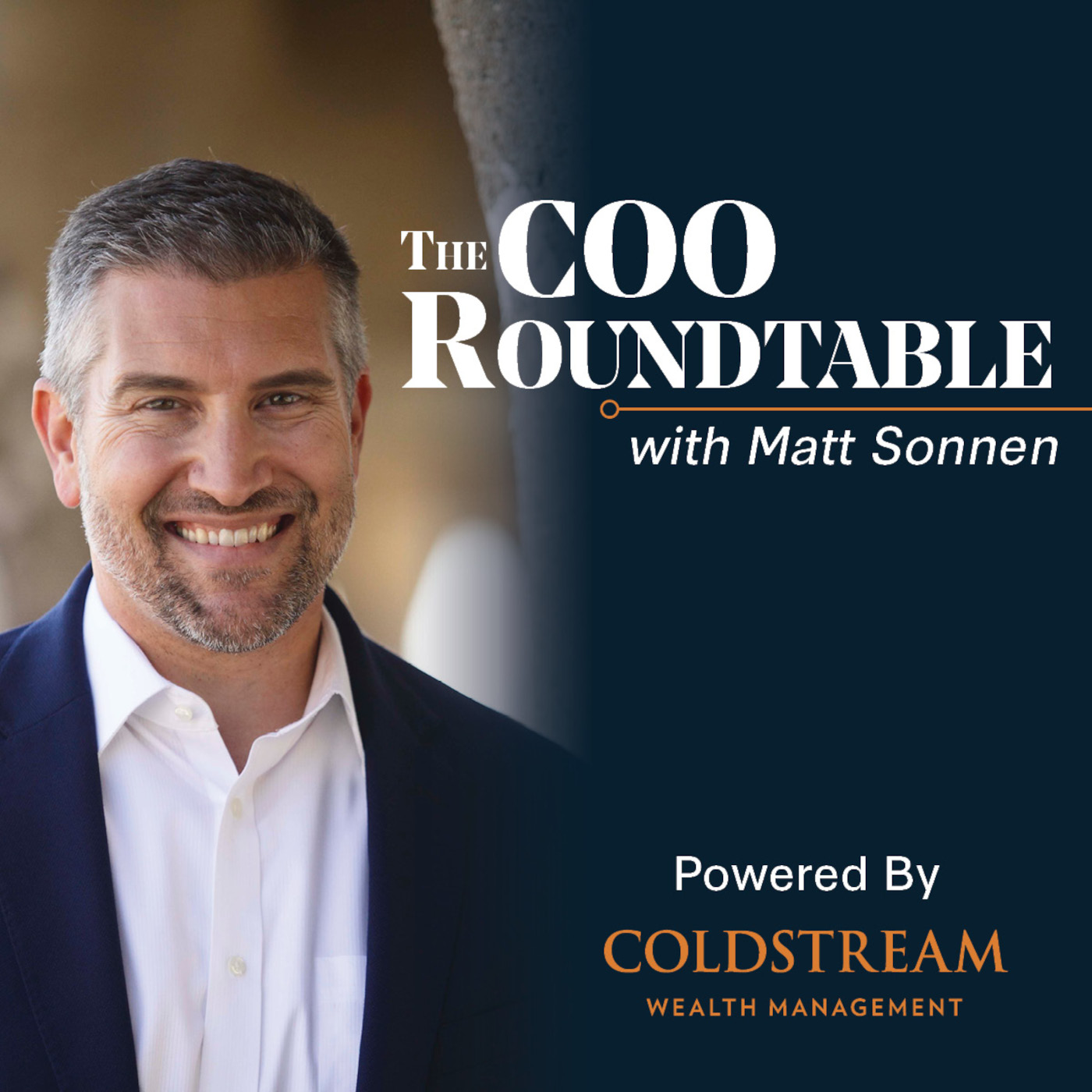
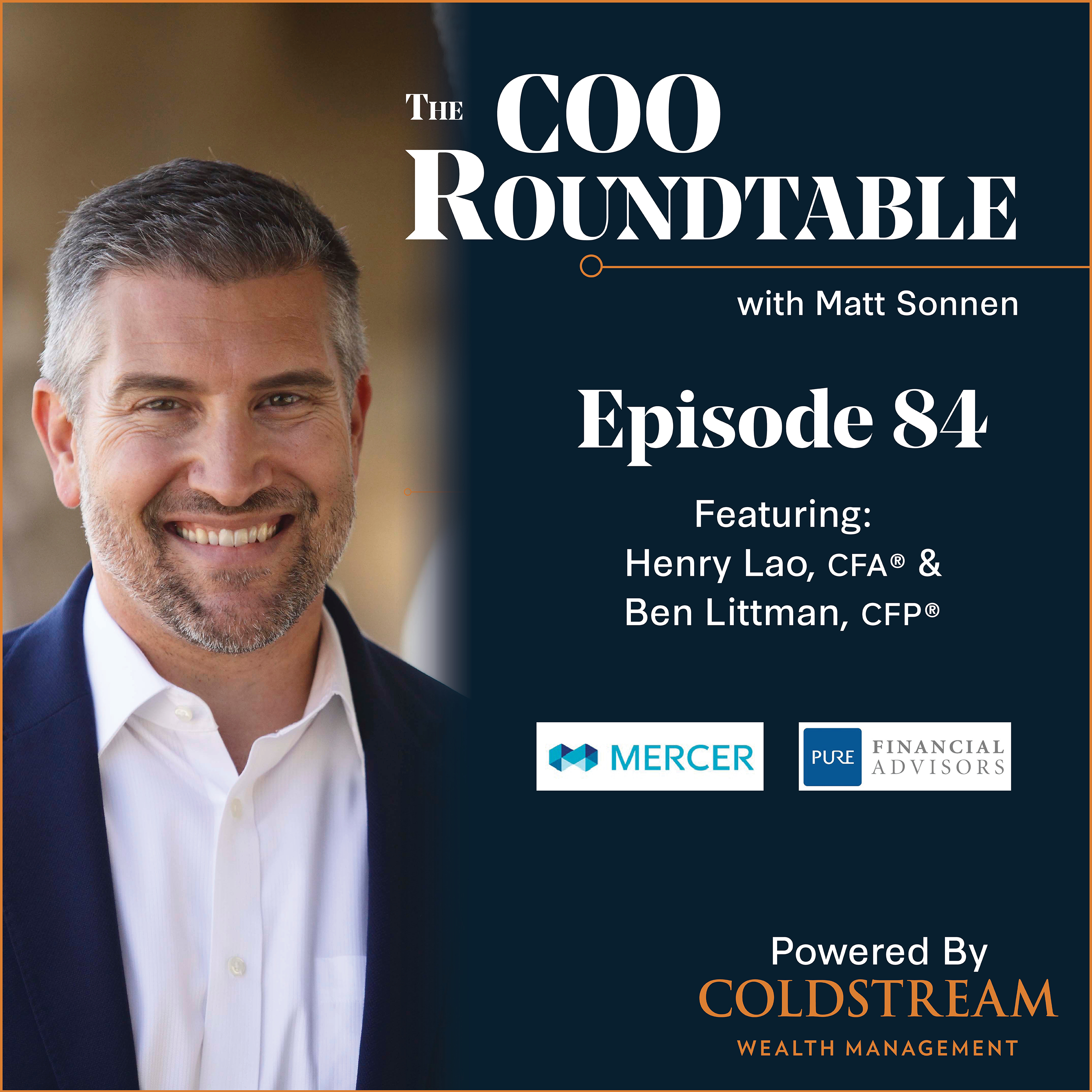
The COO Roundtable
with Matt Sonnen
Episode 84 – Henry Lao, CFA® & Ben Littman, CFP®
[00:00:00] Matt Sonnen: Hi, I'm Luke Sonnen. Welcome to The COO Roundtable, powered by Coldstream Wealth Management. Here's your host, Matt Sonnen.
[00:00:14] Welcome, everyone, to Episode 84. We have another pair of fantastic guests today. These two actually have been friends for over eight years. Joining us from Pure Financial Advisors, headquartered in San Diego, California is Ben Littman.
[00:00:29] Ben is a founding member of the firm and his current role has him leading corporate development. Ben's LinkedIn bio reads, "Ben uses his operational and technological expertise to work with advisors and RIA principals on mergers and acquisitions. He helps other firms create succession plans and unlock growth opportunities by leveraging Pure's scalable platform and experience."
[00:00:53] And all of that seems very relevant to this podcast. So, Ben, welcome to The COO Roundtable.
[00:00:59] Ben Littman: Happy to be here, Matt.
[00:01:01] Matt Sonnen: Joining Ben is Henry Lao from Mercer Advisors in Denver, Colorado. Henry has held a number of different positions at the firm. He is currently a Vice President of Investments. He's also an adjunct professor at the University of Colorado, Boulder, so that's really interesting.
[00:01:17] Henry's bio states that, "he has substantial expertise in the areas of portfolio management, financial modeling, and investment operations. Previously, Henry led the trading desk and fixed income management for Mercer Advisors." So Henry, welcome to the podcast.
[00:01:33] Henry Lao: Great to be here. Thank you, Matt.
[00:01:35] Matt Sonnen: Well, I think our listeners are probably very familiar with both of your firms.
[00:01:39] You both have really big brands in the RIA market. But, Ben, why don't you give us a rundown on Pure Financial Advisors?
[00:01:46] Ben Littman: Sure. Thanks Matt. We were founded in 2007 really to try and bring fiduciary fee-only financial planning down to the mass affluent. That was sort of, you know, what we set out to do.
[00:01:59] Back then, there was a lot more commissionable products and things than there are now. And yeah, we wanted to be a fee-only RIA and we were trying to see if we could, you know, implement all the areas of the CFP-based financial planning down to folks who maybe if they didn't find us, they may run out of money.
[00:02:16] So for us it's really, you know, $500,000 to $5 million is sort of our AUM sweet spot. We're about $11 billion in total assets. I think our ADV reads eight point something, so, we've got about 200 employees and historically, you know, we've grown mostly through adult education and content media. So teaching classes, podcasts, TV show, and you know, recently, or you know, when COVID happened and we couldn't get in front of people anymore, we added a digital channel.
[00:02:50] So think Smart Asset and all of their competitors: we work with most all of them, effectively buying leads.
[00:02:57] Matt Sonnen: Got it. Interesting. Henry, most people know Mercer, but give us the background on Mercer Advisors.
[00:03:02] Henry Lao: Absolutely. Thanks Matt. So, Mercer Advisors founded in 1985 by Kendrick Mercer, really was the starting mission of wanting to serve clients with financial planning first.
[00:03:16] So putting clients first, thinking about how we can encompass all of their financial needs under one roof and bring that to the end client. So our focus is always saying, being able to deliver the family office for your family. Right now, we have the privilege of serving over $90 billion of client assets, and that encompasses 1500 employees, over a hundred offices across the country.
[00:03:50] So it's a really exciting time within the industry and it's also exciting time here at Mercer Advisors.
[00:03:57] Matt Sonnen: Incredible. Yeah. The growth you guys have had has just been second to none. It's been really fun to watch. So, as I mentioned, Henry, you've held a number of different positions at Mercer.
[00:04:08] You've been at the firm for over 16 years. So tell us about your career journey that got you to the position you're in today.
[00:04:15] Henry Lao: Yes. So when I think about my background, Matt, I started out in portfolio accounting. It was a brief stint, got me an entry role into financial services, and I really learned the nuts and bolts of client reporting and client analytics and data.
[00:04:35] So, after nine months there, shifted to what I would say my first half of my career spent in fixed income management and leading trading. So, as head of trading, we were focused on making sure that clients rebalance their portfolios, invested their accounts, managed all the distributions, and rebalanced portfolios throughout the year and tax loss harvest.
[00:05:01] So my role was really dynamic in that sense because in the earlier stages of Mercer, we were obviously much smaller and there were a lot more opportunities to partake in managing portfolios hands-on. So we actually had a Bloomberg, which was really exciting and we still do. But I think when I think about those early days, it's always exciting to kind of see how the firms started out.
[00:05:26] And then my role next was going to investment management and taking on the director of investment research and building our platform and offerings. That was also concurrent with our move to Denver, Colorado. So originally our headquarters was in Santa Barbara, California, and now it's in Denver, Colorado. And that's where I'm at.
[00:05:48] And that role was exciting because it was really an opportunity to institutionalize all of our portfolios and think about how to roll out new solutions, how to integrate that with technology, how to deliver that through operations. So that was my focus coming into that role. And then shifting to helping partner firms integrate into our organization.
[00:06:17] So, you know, at this current state, we've had over a hundred partner firms join us in this effort to continue serving clients and putting clients first, so that was an exciting - call it carve-out - of my role because it, it helped me put two and two together in terms of: how are other organizations doing it currently? How do we bring those ideas and those best minds in the industry to partner up with us and integrate into our broader institutional platform. So that was a really exciting time.
[00:06:55] And then in 2023, my next role, my current role actually, is heading up portfolio consulting. Portfolio consultant is really focused on helping advisors deliver the end-to-end investment management experience to clients.
[00:07:12] So what does that look like in practice? It encompasses both providing analysis to constructing portfolios for clients, to ultimately implementing all these accounts and making sure that we deliver on our promise. So we have 50 plus portfolio consultants across the country that are tied to local markets that are dedicated to being that one stop shop of experts for advisors.
[00:07:43] So that's my role. It's really building out the platform, thinking about strategy, and how do we continue to serve more families across the country. And most importantly, committing to delivering the best client experience.
[00:07:58] Matt Sonnen: We're going to talk in a minute about the operational side of trading and the implementation of portfolios.
[00:08:05] So we'll get to that in just a second. So, Ben, as a founding member of Pure Financial, you've been at the firm over 18 years, I believe. That's incredible. So give us your career story.
[00:08:16] Ben Littman: Sure. Thanks guys. It was great to hear that, Henry. Amazing. Yeah. For me, I probably have to go back more than 20 years to the summer of 2005.
[00:08:29] I was going into my junior year at San Diego State and that was back when there was this thing called a catalog and it was like 10,000 pages and I needed to figure out what my major was going to be. And, you know, I think - I took some finance classes and I'm not sure I understood corporate finance at the time.
[00:08:49] I was definitely a people person and I found this tiny little sub-major in the school of Finance that was called financial services, and then it said in tiny little letters, oh, by the way, if you take all the hardest electives, you can graduate with a Bachelor's and be able to take this CFP test. I never heard of it, but I was like, two birds with one stone: sign me up.
[00:09:11] You know, I got decent grades up until that point, and then - then I was all in. I did pretty well. I was really, you know, enamored by financial planning. I didn't know this at the time, but the chair of our program, Tom Warschauer, basically like created the CFP exam in 1974. So I was really learning under one of the founders of financial planning. Again, I was 20 years old. I was just like, this is cool. I really like Tom. And we hang out - office hours and you know, I'm really into this financial planning stuff. Graduated in 2007, got through the CFP exam, you know, a few weeks later. And then I started my job search and it was all mostly commission-based product sales and the people interviewing me didn't know anything about financial planning.
[00:09:55] And remember, this was almost 19 years ago. So I expanded my search to Monster and Craigslist. I almost got scammed by a Nigerian prince - true story. And then I was on Craigslist and I saw our founder Mike Fenison's initial ad, and it said, "looking to start a new type of firm where advisors are on the same side of the table as the client, fiduciary, fee-only, where we're doing real financial planning. Must be a CFP professional and have five years of experience in order to apply." Now, I passed a test, but I still had three years to go to get the marks, and I had no experience, but I was like, I've got to talk to this guy. So I went and met with Mike and Paul, our other founder - sadly passed away recently - and little did I know, but they recruited Tom Warschauer, the professor I was talking about to our initial board, pre-launch.
[00:10:44] So, I guess I got a recommendation - I still don't know, but, they effectively hired me on the spot, didn't know what I was going to do yet, couldn't barely pay me anything, but, you know, Mike wanted to treat it like a startup. So he's like, here's some worthless stock options. I said, yay, you know, that was exciting.
[00:11:01] So, you know, we hit the ground running and we took out all my study materials, all the different areas of financial planning and decided how comprehensive we wanted to be. You know, we really - we really from day one wanted to provide that level of financial planning to folks that we felt really needed it.
[00:11:21] And as a startup, you know, we all wore almost every hat. Our current CEO, Joe Anderson, joined us in December, 2007. We started the firm in August and he, you know, he is ten years older than me and, you know, knows so much about financial planning, but he's really the rainmaker: the host of the TV show and the radio show and taught the classes, the educational classes at night and really spurred our growth.
[00:11:48] So back then as we started to get clients, I was putting together all the initial financial plans and you know, we've had Salesforce and eMoney since day one. So, I got really into eMoney, making sure we were super comprehensive in creating processes and procedures as we grew. Brought on a couple folks from my program at school to help me do that after a few years.
[00:12:08] As we started accumulating clients and assets, I think Mike, our founder, read an article about Tamarac in 2008 and just bought it and said, Ben, you know, you're 15 years younger than the next oldest person at the firm. You need to run with this. So I said, okay, that sounds really fun. I learned a little bit about Excel, I learned a - did my first VLOOKUP, I think. Yeah, got really into building the investment platform.
[00:12:34] Eventually, I transitioned the financial planning stuff off to Brian and Susan, who I brought on from my school program. Now Brian's a Senior Advisor. Susan, we call her our Chief Financial Planning Officer: I think she manages a team of 25 today.
[00:12:48] And I just, head down, focused on building our investment platform and making it scalable for, I don't know, 13 years. During that time, I learned how to code. I wrote a bunch of software, which maybe we could get into later if anyone's interested. Built these relationships with asset managers like at Dimensional and Vanguard and State Street, and really figured out how to build a tax overlay for Pure, where it wasn't about picking what investment is going to perform better in the future. It was more about what are the things we can do operationally that we can scale that's going to add value to clients. So think screening daily for rebalancing, lot-level tax loss harvesting, asset location, things like that, and taking that off of advisors' plates.
[00:13:32] So building a lot of collateral that was client-facing. Building systems within Salesforce with our Salesforce engineers to make sure that advisors' instructions were communicated and executed on properly. So that sort of phase of my career really culminated in becoming our first Chief Investment Officer in, I don't know, I think it was like 2018, 2019.
[00:13:54] Did that for a few years, was kind of managing trading, billing, reporting, client portal stuff, advisor communication. That's where there's a lot of overlap with Henry's journey. Then, in 2021, we took on some private capital and had this idea of what if I was out there telling our story and trying to help grow the firm because I've been here since day one and in the past - I think it's been like two years now - but I've been focused on M&A and advisor recruitment, and that's been awesome because, you know, I went to school to become a financial advisor.
[00:14:33] I never really did that, and now I kind of get to scratch that itch, you know, meeting with founders and trying to help them with their next phase of their career and their life, and taking all the knowledge I've learned over the past 19 years and applying it. So I will pause there.
[00:14:48] Matt Sonnen: So 83 episodes before today, I'm pretty sure you're the first Craigslist ad responder. You started your career thanks to a Craigslist ad - that's really incredible.
[00:15:02] Well, I mentioned that you both have been friends and a sounding board for one another as you've grown in your careers and as you've built your firms. So, Ben, talk to us about your friendship, how it started, and how you've leveraged one another in your career journeys.
[00:15:16] Ben Littman: Yeah. Henry and I are really good friends.
[00:15:18] I would say we talk, you know, a few times a quarter business wise, and you know, we try to see each other on a personal level. We've hung out both in Denver and San Diego with our wives slash fiancee in Henry's case.
[00:15:32] Yeah, there's a gentleman by the name of Shawn Jaberzadeh - I don't know if I pronounced the last name right - he was at DFA for like 20 years and now he recently moved to Vanguard, which I think surprised a lot of folks. But he invited us out to dinner at an investment conference, I believe in Austin in 2018. And yeah, we just hit it off. And I think one of the reasons why is because we're both - I don't - I can't think of a better term, but we're both grinders, if you will. So we'll see a challenge, a problem, whether it's really intricate data or some sort of trading situation, or God forbid, someone made a trade error and we have to clean it up. And this is, you know, back when, it's - I'm not doing that much of those things anymore.
[00:16:17] But you know, both of us are willing to put in the time and effort and energy until whatever it is we're working on gets done. No matter how long it takes or no matter how many hours. So I just think that that tenaciousness is something that we've always shared. And, you know, having been in roles where we're interfacing with both operational teams and advisors and trying to deliver service and kind of being that one that's responsible for that communication to the advisors, I think we've encountered a lot of the same challenges and a lot of the same personalities and figuring out how to overcome, knowing when to hold your tongue and just from a compliance perspective, a client experience perspective, a trading perspective, we've just done a lot of the same things and we've been at our firms forever. So it's great to just, you know, obviously not talk about any sensitive information, but just kind of in generalities when we connect on the phone or in person.
[00:17:14] It's great. Henry, I'd love to hear your perspective.
[00:17:17] Henry Lao: I just love being friends, Ben. So for me, it was a friendship born out of, like Ben said, really having similar backgrounds, really solving similar problems at rapidly growing organizations in parallel. So what was exciting was to have someone that you can call and just soundboard ideas off of.
[00:17:39] And in a space where sometimes financial services can feel overwhelming, there's a lot of different corners of financial services. It's also a small industry within wealth management, right? And financial planning and being able to connect with like-minded individuals as friends, as professionals, as colleagues, to think through how to solve different problems at scale.
[00:18:06] That's what I find fun. And Ben and I - anytime we can grab Mexican food in San Diego, I'm game. So, for me, hanging out with him, talking with him, and understanding how he's grown the business has been really a pleasure to see and watch first row.
[00:18:21] Ben Littman: And for me it's like, they're like big brother, right? We're a fraction of the size, of Mercer. And so, you know, as we started our M&A journey, they were already in the fifth inning, so just great to have that sounding board.
[00:18:35] Matt Sonnen: So, our listeners know that a big part of this podcast is just simply my need to show that the, you know, the value of operations teams and what they can bring to their firms.
[00:18:47] And one area where that is abundantly clear in my mind is in M&A. You just touched on it a little bit, Ben. So I believe that operations is the key to convincing an RIA owner or an advisor, if they're going to sell their business to an RIA, that RIA needs to show that they have systems and processes in place that will make the life of that advisor easier once they join, and take a lot of the administrative burden off of that advisor trying to run their firm, you know, take that burden off of their shoulders.
[00:19:18] And both of your firms, as we've talked about, are very active in M&A. So, Ben, in your role, as you said, you're directly speaking with these RIA owners that are contemplating joining Pure Financial. So talk to us a little bit about how that conversation typically goes and how important the operational backbone of Pure Financial is to that conversation.
[00:19:40] Ben Littman: Sure. I mean, I really look at that like two different parts. One is the successful integration from an operational perspective of the firm. So that's having project leads, using some sort of project management software, coordinating things that can be done chronologically, sequentially, at the same time with milestones.
[00:20:02] Really just project management and having dedicated resources to flex into that.
[00:20:07] Matt Sonnen: Mm-hmm.
[00:20:08] Ben Littman: And two, it's that concept of doing what you love and giving up the operational burden and the administrative tasks. So, I think it's really talking about our team of CFAs that's executing the trades, our client service team that's doing all the ACATS, Roth conversions, distributions, you know, taking that off their plate.
[00:20:29] Our centralized planning team, tax planning team. So it's really, you know - most - I think most founders that want to stick around just really enjoy the relationship piece of the business and working with their clients and we try to commit to them if that's what they're interested in. You can be doing that a hundred percent of the time.
[00:20:46] Matt Sonnen: And Henry, what is your take on how integral operations is to that M&A conversation?
[00:20:53] Henry Lao: It's critically integral to that. So when I think about operations, I would expand on what you said earlier, Matt, around committing to it to help advisors do their job. I would say it's committing to it so that advisors can do their job so that we can serve clients with excellence.
[00:21:13] And that's always the end goal is how do we continue to serve clients with excellence? So when we have new partner firms join us or explore joining us, for that matter, there's a lot of conversation around what they currently focus their time on. And oftentimes what you'll find is that organizations that are looking to scale, they can be buried by some of the more administrative, more operational - whether it's trading, whether it's even compliance, and other dimensions of running an organization.
[00:21:47] And so for us it's always putting the idea of like, how do we continue to deliver excellent client service? So, if that's the ultimate goal, then we have to empower our advisors to be able to focus their time on serving clients. So one of the things I always remind my team on is, like, your job is to help advisors focus their time so that they're always walking into a meeting or out of a meeting. And during that meeting, they're successful because we've helped them prepare for what they need. So if that story resonates with folks, and oftentimes it does, when you see a rapidly growing organization and one of our partner firms joining us - they want to focus their time on that.
[00:22:36] So that's what is really exciting about Mercer Advisors. We see the value of a integrated full-service approach.
[00:22:44] Matt Sonnen: And I'm sure a lot of that conversation with the RIA owner - I'm sure a lot of it focuses around what services, what tasks you've centralized versus what services or tasks are going to be the responsibility of the individual advisory teams once they've joined and have integrated into your business.
[00:23:02] So, Henry, I'll go to you first on this one. What services has Mercer centralized?
[00:23:07] Henry Lao: So we think of our - again - the integrated full-service approach of providing a unified team of experts, right? So we have four goals that we think about - four promises, excuse me - that we think about when we provide a family office for your family.
[00:23:28] Number one, it's a unified team of in-house experts. That's the planners, the investors, the folks that are managing the estate planning documents, drafting those up, the tax preparation and tax planning, to a handpicked advisor, which is number two, right? Someone that's focused on serving you. So we have bifurcated the sales and service model.
[00:23:54] And number three is delivering to you an institutional grade personalized portfolio. And lastly - and this is kind of where I want to tie it together to your question, Matt - is a boutique fiduciary with national strength. So the whole idea is that if we centralize, by centralizing, we actually enable advisors to deploy this at the local level.
[00:24:17] And we do have a team of experts actually sitting next to the advisors in those local markets so that we can centralize expertise, but deploy that boutique service to each individual client. So the value of centralization is not just for scale, but to be able to redeploy that back into the markets so that clients can ultimately feel like, wow, I have this entire set of services at my fingertips, and it feels like there's an entire team backing up what we're doing here.
[00:24:50] Matt Sonnen: I love it. Yeah. I think it's so important for the advisor to be able to sell the fact that there's a whole group of people, that it's not just me, I'm not by myself. There's a whole group, there's a whole firm behind me and a ton of resources that are going to help you and your family - You know, you're talking to the client - you and your family reach your financial goals. So I like the way you laid that out.
[00:25:11] Ben, what responsibilities have you taken away from the advisors and put into the centralized services?
[00:25:17] Ben Littman: Sure. Yeah. I mean everything, including marketing and business development.
[00:25:24] So we have - I don't know how big that team is now - 10 or 15 people - that are kind of corralling in all the leads that we're generating from our marketing team and setting those appointments on our advisors' calendars. So when we get a new advisor, they come into work and they might have 10 or 15 first appointments on their calendar every week.
[00:25:43] So we're centralizing the task of going out and actually finding the prospect. Now there's a lot of professional development that we provide our advisors to help them convert those prospects into, you know, financial planning clients and eventually AUM clients.
[00:25:58] You know, we've centralized client service. We've centralized financial planning, tax planning, investment management, and trading, compliance: pretty much all functions of a firm except for that face time with the prospect and client. The thing that brings it all together is our CRM, is Salesforce. We've had, you know, at least one full-time engineer since we started in 2007. I think we have a team of four now. And as you could imagine, over 19 years, I mean, it's fully customized with all sorts of wizards and workflows and procedures to make it transparent, allow you to hold whoever is responsible and accountable if you're delegating something, and you can always see where any task is in the process.
[00:26:42] So you know, our CRM is really the hub of the centralization of allowing the financial planning to be centralized. It's like the advisor has to communicate with them somehow, and they do that through Salesforce. There's some sort of custom visual force page. Same thing with tax planning, trading, client service.
[00:27:01] Then there's a whole other layer, which I think we'll talk about later - a little foreshadowing. But when we talk about owning our data and data warehouse and reporting and analytics, that's only possible if you have clean data and everything's centralized.
[00:27:16] Matt Sonnen: Yeah, our listeners have heard me say this many times.
[00:27:19] My not very funny joke, but the joke I make about Salesforce: the greatest thing about Salesforce - it'll do absolutely anything you want. And the worst thing about Salesforce is it can do absolutely anything you want.
[00:27:31] And I've always said it is critical if you're going to use Salesforce out of the box without one of these overlays, you need a dedicated employee or employees to run it for you. It's so critical and it's worth the investment you put into it. But Salesforce is unwieldy. We've just gone from one full-time Salesforce administrator at Coldstream and we now have two. That's all they're doing, is cleaning up that data.
[00:27:55] And speaking of data, so yeah, you've led us right into the data conversation. So, both of your firms are much larger than the average RIA firm, and one of the things that that size has allowed both of you to do is to have that data warehouse Ben mentioned. So I'm curious. Talk to us, Ben, I'll go to you first. Talk to us about how that data warehouse has helped you push and pull data around the various components of your tech stack.
[00:28:21] Ben Littman: Sure. Yeah. Happy to. Gosh, it all starts with having clean data that's accurate, right? Data warehouse is worthless unless you've got audit procedures and you have things in place to make sure that your data is true and accurate. And in my mind, that all starts with the - where Henry started his career in portfolio accounting.
[00:28:40] So it's the custodians communicating to whatever third party portfolio accounting system you use. We use Tamarac, and having the audit procedures in place to make sure that all the daily transactional holding data, account data is all accurate. And once you're there, then you can take financial planning data and CRM data and you know, all of these different things, and build effectively a data warehouse. You can use AWS, you can use Microsoft Azure, you can use Tableau, you can use Power BI and all these buzzwords. But you know, they all effectively do the same thing. And there's the concept of owning your data, right? Instead of data living at a vendor like Tamarac or Salesforce, we own it.
[00:29:23] Then we can do anything with it, right? So we can store a snapshot of every day's data, compile that with scalable infrastructure, you know, power on demand with Azure or AWS or whatever, and we can do a lot of really interesting things.
[00:29:40] Matt Sonnen: Henry, tell us about Mercer's approach to data.
[00:29:44] Henry Lao: I think Ben hit the nail on the head as far as having clean data.
[00:29:48] Right. I think part of the opportunity when we look to bring data together is: how do we leverage that so that advisors have information at their fingertips to take action. So we have our internal CRM, and for us, it's all about designing it in such a way that advisors have information right at their fingertips.
[00:30:21] And that always starts with having accurate data. And for us, going through that exercise of always observing, analyzing, and ensuring that the data is up to date. We have full-time teams that are dedicated to that. So it's critically important. And for all the new partner firms that do join us, it's one of the key aspects that they're excited to be able to pass off to us because we have that depth of knowledge and that depth of our platform to be able to support that.
[00:30:53] So, which is really exciting because again, they get to focus on serving clients and - data: when we go through any exercise with data, it's always making sure, like, understanding the three things around data too. Like, is it accurate? Am I looking at the right data, and then am I gleaning the right insights off of that data?
[00:31:15] So for us, it's making sure that we filter it through that so that we can take away what we need and be able to apply it for our clients' benefit.
[00:31:26] Matt Sonnen: Great. Well, you both have talked about your unique backgrounds in investment management and operations, and I talk a lot about the fact that sales folks often ignore or undervalue operations teams.
[00:31:41] But I will say that I've also seen plenty of investment professionals under-utilize their operations teams as well. The investment team, a lot of times they'll make their investment recommendations in a vacuum and they're - they don't think to include the operations team to determine exactly how those investment recommendations are going to be implemented in the client portfolios.
[00:32:03] So, Ben, how does Pure Financial bridge that gap between your investment team and your operations team?
[00:32:12] Ben Littman: Yeah, I mean I think it's pretty simple. We have several of our traders sit on our investment committee, so as we're debating on, you know, adjustments to the portfolios, it's like the traders are right there and the conversation many times will shift to implementation: oh, can we still rebalance? Can we still tax loss harvest? Can we still asset locate with that change? All of these things are so operational, how is that going to be perceived by the advisor? How is that going to be communicated to the client? So, I mean, the operational folks in terms of the, you know, the people actually executing the trades, you know, are in at the ground floor on an IC level.
[00:32:53] Matt Sonnen: That's great. That's so important. Because yeah, a lot of times they're just not in the room, they're not at the table. So
[00:32:59] Ben Littman: Because it's like, look, like one of the big value adds is the tax alpha, and that's all operational, right? It's like being able to have screens and look every single day for rebalancing, tax loss, harvesting, and asset location opportunities. And that adds up to, you know, extra performance without market risk.
[00:33:17] Matt Sonnen: Yeah.
[00:33:18] Ben Littman: So it's just as important or more than the asset allocation decision.
[00:33:22] Matt Sonnen: Yeah. No, well said. Henry, how do you guys solve for this at Mercer?
[00:33:27] Henry Lao: We have to work together and to me, it feels like when we have the three legs of the stool working together, we're always better prepared for new solutions that we roll out.
[00:33:38] So the three legs of the stool comes down to having our investment teams, our operations teams, and technology all align. For me, having a background in both operations and investments, of course, it lends me a unique perspective of appreciating where both sides are coming from. And to Ben's point, it's always bringing in folks early into the conversation, right, from day one, and making sure that we understand that there are operational infrastructures that we need to put in place in order to make a successful launch of any new solution that we bring to market. So when I think about investments and operations, it's like always this push and pull. But - and in reality, it's really working together and thinking about: what are all the steps that we need to think about? What are the behind-the-scenes work that we need to make sure gets done before we go to market?
[00:34:38] And the exciting part is usually both sides bring out the best in each other and you know, sometimes it also challenges each other to kind of take on the other side's perspective. So for me that's what is exciting for an advisor to be able to know is that our investment team and operations teams are always trying to put their best foot forward and partner up with technology as well, of course, to make sure that we have successful launches.
[00:35:07] Matt Sonnen: Well, staying on that theme of operations being underappreciated, let's wrap up with a real high-level question: Henry, where do you see operations directly impacting the client experience? This is another area I think that operations just doesn't get credit for the way they impact the client experience itself.
[00:35:28] Henry Lao: So the way I see it is this is really the delivery of our promise. Our president, Daniel Gourvitch, reminds us that there's two things that we do - it's make promises and keep promises. I love it. So being Yep. Being able to keep promises is really what operations is focused on: bringing portfolios to life.
[00:35:51] Always reminding teams and, and even again, our partner firms, what our role is, is our job is to bring portfolios to life through operational infrastructure, through technology lift, through our depth of investment due diligence. That's what we do. And what's exciting and when I look at operations is that I think there's a convergence with technology that's really exciting. Of course, we didn't mention the word AI, so I figured I'd do it. I think for all of our sake, it's always an opportunity for thinking about how we can do things better, right? Especially as we continue to serve more families.
[00:36:32] Matt Sonnen: We almost made it a whole episode without talking about AI. You, you blew it. Well, Ben, I'll give you the last word here. How do you see operations shaping the client experience?
[00:36:45] Ben Littman: Well, I won't talk about AI specifically, but I think I'll focus on a concept called Next Best Action. And in my mind, you know, that's the holy grail.
[00:36:56] Every advisor wants to access some system that tells them what they need to do for their client, you know, right before their meeting or whatever, and that all of that data and all of those decision points are created by the operational teams, right? So if the client's taking distributions, if they need to do a Roth conversion, if they, you know, whatever's going on with their money, it's being processed by our internal operational teams.
[00:37:24] And I think that, you know, in a perfect world, that all gets put together and synthesized to where an advisor can access a system and they know not only what has been done, what the opportunities for planning and investment management are for this client based on today, on their life situation, and ultimately what's the next best action.
[00:37:43] So they can have that review meeting or that financial planning strategy meeting or whatever and come in prepared. So, yeah, I think operations are super valuable to an RIA.
[00:37:55] Matt Sonnen: Yep. That's great. Well, Henry and Ben, I can't thank you enough for being here. You both have, obviously you have a ton of experience in all areas of RIA operations, so I think this has been a really fun conversation.
[00:38:09] So thank you both for being here.
[00:38:11] Henry Lao: Thank you, Matt. Appreciate it.
[00:38:13] Ben Littman: Thanks Matt. It's awesome.
[00:38:15] Matt Sonnen: Well, that is a wrap on Episode 84, everyone. We will talk to you soon.
*The CFA Institute owns the certification marks CFA® and Chartered Financial Analyst®. Certified Financial Planner Board of Standards Inc. owns the certification marks CFP® and Certified Financial Planner™ in the U.S.
© Coldstream. All rights reserved. May not be reproduced, republished, or distributed without prior written consent. Information drawn from third-party sources believed to be reliable but not guaranteed as to accuracy, timeliness, or completeness. None of the information provided constitutes an opinion or a recommendation or a solicitation of an offer to buy or sell any particular security. Coldstream analyses are not intended to provide, and should not be construed to constitute, complete accounting, insurance, legal, or tax advice. The investment strategies and securities shown may not be suitable to you. Past performance is no guarantee of future results.