Episode Transcript
The COO Roundtable with Matt Sonnen
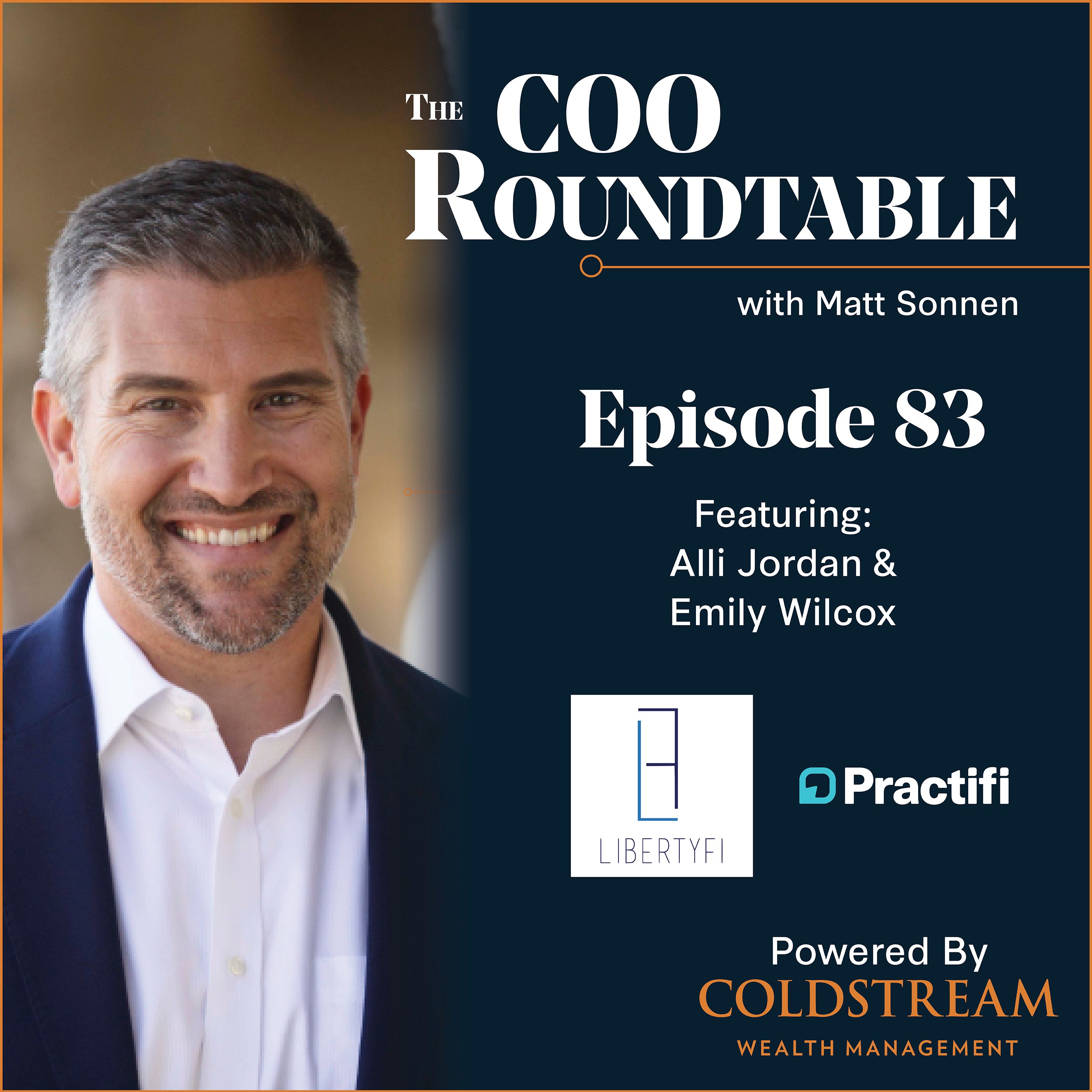
Episode 83 – Alli Jordan & Emily Wilcox
[00:00:00] Matt Sonnen: Hi, I'm Luke Sonnen. Welcome to The COO Roundtable, powered by Coldstream Wealth Management. Here's your host, Matt Sonnen. Well, welcome everyone to Episode 83. We are joined today by two people I've admired for a very long time. They're both COOs or have been COOs at their respective firms and those firms support RIAs in their technology and workflow processes and decisions. So they have a very unique perspective on all of the topics that we normally cover here on the podcast. First up is Alli Jordan, former Chief Operating Officer and now president at LibertyFi. For those of you that don't know Alli, she is a performance reporting wizard.
LibertyFi helps growth-oriented RIAs drive revenue and scale their businesses with the Envestnet platform. So their personalized consulting services. It includes the implementation of Envestnet, streamlining operations and middle office support. So not only does Alli help RIAs scale their own operations, but she's been at LibertyFi since it was founded in 2017. So she's helped her own business navigate the challenges of growth and scale, and we're gonna tackle a lot of those topics today. So Alli, welcome to the COO Roundtable.
[00:01:21] Alli Jordan: Thanks for having me, Matt. Really looking forward to the conversation. Awesome.
[00:01:25] Matt Sonnen: And joining Alli is someone I had never met before until we started prepping for this episode, but I have been a big fan of hers for many years. She writes incredible practice management articles that I share all the time on social media, and that's Emily Wilcox, the COO at Practifi. And most of our listeners, I think, are familiar with Practifi.
It's a CRM platform designed specifically for wealth management. It sits on top of Salesforce. And I went to AI and I asked for a brief description of Practifi, and this is what it spit out for me. It says, Practifi provides a unified workspace for financial advisory firms to manage clients, integrate core CRM capabilities with practice management features to improve client relationships, streamline workflows, and assist with compliance and marketing efforts.
So just like Alli, Emily works every day with RIAs, helping them run more efficient businesses, but she's also a practitioner herself. She was employee number three at Practifi and they're now a firm of 70. So she's been building her own business while helping others with theirs. So Emily, welcome to the podcast.
[00:02:35] Emily Wilcox: Thanks, Matt. Super excited to be chatting with you guys.
[00:02:38] Matt Sonnen: Well, Alli, I stole some of your thunder there, but why don't you, tell us a little bit about LibertyFi.
[00:02:43] Alli Jordan: I was gonna say, you did such a good job. I don't have much else to add, but, no, you, described it all perfectly, but just a little more background and color on LibertyFi and who we are.
We were founded in 2017 and really our whole core is to support RIAs that are growth minded looking, really wanna be able to scale their business. They're either focused on growing inorganically, so they wanna be in an inquisitive mode. Or they really wanna focus on how can we bring more services to the table to be able to support our clients and grow client headcount.
So when we think about the firms that we're supporting, those are really who they are Today we work really closely with 23 RIAs across the country. It's around 21 billion in assets that we're supporting for them. And there's eight of us on the team, which really speaks to the scale that the technology that we work with at in Envestnet really can provide a firm because we do that ourselves.
Another really exciting thing that happened to LibertyFi two years ago, which is crazy, is we went through a strategic acquisition in 2024 with Aptus Capital. They're actually based in Alabama as well, down in FAIrhope, and they're more on the investment side of the business. But what that really allows us to do now is be more holistic to the firms that we support and those that we will support in the future. So I'll touch a little bit about that too, because I do think, you know, as we're talking about scale and firms that are growing and, you know, RIAs sometimes get a bad wrap on how do they grow organically, right? Is it just all market? But we'll talk some about our firms and how we look at that.
But really looking forward to this discussion.
[00:04:20] Matt Sonnen: Great. Thank you. And Emily, in your own words, not the words of AI, tell us how Practifi works with advisory firms.
[00:04:28] Emily Wilcox: Yeah, fantastic. AI did actually a pretty good job as well, but, Practifi definitely is where the AI enabled CRM built specifically for RIAs and the wealth management firms.
And so we've been, our core tenants of our inception with our co-founders were technology and wealth management, and we take the power of the Salesforce platform and deliver something that can work out of the box and is constantly evolving for our clients. We have spent the last couple of years in particular, I mean, we're all hearing AI in almost every conversation we have every day, probably even with kids at this point.
But we've spent a long time making sure that our future looking strategy is not bolting AI onto an old system, but it's building intelligence into how advisors manage client relationships, identify opportunities and deliver service holistically to their clients, because ultimately, as we are gonna chat about a bunch today, it's about scaling and scaling efficiently, scaling well and scaling for the future.
[00:05:21] Matt Sonnen: Perfect. Yep. Scale, scale, scale. That is the word of the day. So Emily, you've been at Practifi for over a decade, so tell us how you got there, back in 2015 and the different roles you've had that led you to what you're working on today at the firm.
[00:05:36] Emily Wilcox: It's interesting. I was thinking about this not that long ago actually, but I'm not sure anybody goes to sort of college, university thinking I wanna be a COO one day.
I feel like yeah, right. It's a little bit of a nebulous concept for many. And still today. I mean, COOs look different in every firm, no matter where you are. But, I actually was a recovering law student, graduated with a law degree and decided very firmly that that was not the path that I wanted to go down.
I was very fortunate, to meet Glenn and Adrian, our co-founders, and rolled into Practifi really early, just as a little bit of a discovery mission. Honestly, I didn't have much of a plan, but very quickly, I became extremely passionate about how we do things at like both at the top level and sort of down into the minutia and how you can grow that.
And frankly, as a third employee, I was very, very fortunate 'cause I got to be there at the absolute ground level figuring things out from literally from nothing. And so at Practifi, I've been here obviously a very long time, and I was, at the forefront of our expansion here into the U.S., particularly operationally.
So I've probably played every role in Practifi at various points in time, sales implementation with our clients, client success, operations obviously, for a few terrifying moments I wrote code probably won't do that again. But yeah, it, certainly in my position, it does give me a very unique benefit that I, genuinely have touched every part of the business personally as well as like, helped it grow.
So it's fun. It's the, it's the magic. It's, it's knowing everything across. We have to be professionally nosy people, right? That's, that's our job.
[00:07:07] Matt Sonnen: Yeah. This is always my favorite question that I ask people because, over and over and over again. Everyone says it slightly differently, but it all comes down to exactly what you said.
I didn't really have a plan, but I was curious.
[00:07:19] Emily Wilcox: Yeah, exactly.
[00:07:20] Matt Sonnen: And that's really all it comes down to. I was curious.
[00:07:22] Emily Wilcox: Just curious and organized.
[00:07:22] Matt Sonnen: Kept, kept zigging and zagging. Yeah. That's great. Exactly. Well, Alli, tell us your story, how you got to LibertyFi, what you were doing before, and how your role has changed over time.
You went from COO to President fairly recently.
[00:07:35] Alli Jordan: Yes. And, and mine is a little like yours, Emily. I actually got a health science degree, so even, a little more out there than, what, my anticipated path was. But I ended up moving to Birmingham in 2012 and working for Sterne Agee, which was a regional broker dealer based in Birmingham for my first job in finance.
And, to your point, Matt, curious and willing, I think is another good word, right? Raising your hand, being in meetings that you probably didn't deserve to be in. I had really great bosses and mentors that kind of saw my eagerness to learn and so they kept putting me in spots where I just got such great exposure to all components of our business.
And I think, you know, part of what makes a COO or an operational role or is, you know, an executive within our space is just it makes us, so it makes us so unique and different is whenever we've actually had our hands on the product. Right? So those four years prior to starting LibertyFi, I was in the weeds.
I worked with advisors, I set up, you know, solutions and platforms and I, we always kind of took a different approach of instead of trying to play to that least common denominator, right? When we were supporting advisors, we tried to understand their practices and how we could support them in where they are, right?
Meet them where they are, which allowed us to kind of think differently. And so we talk a lot about scale. I always like to say personalized scale, right? Customizable scale. How can we still scale, but have some personalization to it? And so that kind of first four core years of my path in finance really led me to where I am today.
But whenever, we went through an acquisition back at Sterne Agee, and when that happened, my partner at the time, Trey Ruck, he and I, we co-founded LibertyFi in 2017, but we really saw a niche in the space of the RIA movement was obviously, you know, really getting off the ground and becoming more professionalized.
Matt, you've obviously done a really good job of bringing attention to the need of that, but how could we support those firms that. We're looking to grow, we're looking to add kind of a professional way about how they serve their clients. And so the timing of it all just worked really, really well. And, Emily, you, you being similar, right?
Being employee number three, you just wear a ton of hats when you're starting the business.
[00:09:57] Emily Wilcox: Absolutely.
[00:09:57] Alli Jordan: As far as like. Oh, how do we order computers or put Microsoft Office on it? You know, like, where are we gonna sit? My kitchen table for a while? And then, you know, that all evolves and you become a real company overnight.
So, man, just being in those meetings, and I remember when, when Trey called me and you know, we're still small and nimble and, but I wanna name you COO 'cause I want people to know the respect that you deserve because of everything that we've built here and you're just as important as I am whenever it comes to conversation.
And so that was a, you know, that was a monumental thing for me. And then, you know, recently when we, went through the acquisition, kind of moving on to president, but still wear a lot of those same hats and it's been just such a fun ride. And I, love this space and, for people to get into it.
Even if you have a health science degree, you know there's a place for you if you're willing,
[00:10:50] Matt Sonnen: I probably shouldn't admit this. Coldstream's not gonna be happy with me, but I had a call yesterday talking about just all the different things that come across your desk from day to day and, and also that point about, well, someday you'll be a real company.
And had a conversation yesterday with my IT department and they were saying, well, there's a card table in the kitchen where people make, we have a jigsaw puzzle that people will come by.
[00:11:12] Emily Wilcox: Oh, I love that.
[00:11:13] Matt Sonnen: When they, when they're getting a snack and we're gonna take that. That card table, and we're gonna put it in another office, and that's where the intern is gonna sit.
And I was like, we're a real company. Why are we, why are, how are we having this conversation? Why are we putting the intern at a card table? But it's like, well, we're outta desks at the moment. We're outta spots. So yeah, the things you have to do on a day to day basis is, is incredible.
That's so funny. Yeah. It's too funny. Well, Alli, as you, as you've described, your firm allows RIAs to outsource a lot of their back office functions to you, and, and that's really all about scale as we've been talking about, allowing these firms to concentrate on what they do best and then outsource as much as they can to, to you and your team.
I'm sure most, if not all, of your conversations with your clients or your prospective clients, I'm sure all of those conversations are around, well, we've hit a wall in our growth. We can't do everything ourselves, so how can you help us? So talk to us about scale and, what you've learned after all these years helping RIAs think about scale.
[00:12:13] Alli Jordan: Yeah, man, there's just so many components to it, right? And we kind of always just go back to, for RIAs especially, right? There's just so many things that, and every RIA looks different, right? What their, their goals are for their clients, how, what services they're providing. But what we always try to go back to is if you can centralize your operations and your investments or whatever it may be, right?
As much as you can centralize and outsource. The minutia that's really gonna allow you to be able to grow. So, whenever I say that I think about billing, right? Like billing is, not a, lavish thing in our space, but billing is really important that it's done right and it's done well, and it's done on time.
And that's important to the client, that's important to the advisor, that's important to the SEC, right? Like all of those things. And we look at our firms and our firms don't have billing teams, right? Because they're leaning on the technology and our expertise to be able to make sure that's done well for them.
And so instead of now having two billing people, they can have two people that are focused on planning or new business acquisition, or bringing on a new service that benefits their clients. So that's when we're talking with firms that get to a point where they're like, we cannot add another client.
We try to think about, okay. What does your billing look like? What does your trading look like? How are you delivering performance reports? What is that client experience and the integrations that go along with it? And if we can have meaningful conversations around those four areas, that really alleviates the teams to be able to, again, do more for those clients and focus on kind of their needs.
I just did the, of course, it's early 2026, I just did the refresh of our firms looking at, you know, how did they grow last year? So we support the 23 RIAs, and this just speaks for itself, right? There's 23 of our firms, it's around 21 billion in assets. And okay, let's look at their average growth.
And this is just AUM. 18%. Our highest grew at 46%. Our lowest, they kind of are in a, a lot of their clients are in a redemptive phase. They lost 10%, but 18% average growth. And I, what is even more meaningful to me is, okay, what does that look like on an organic scale? Right? Like, what does your organic growth look like?
RIAs, you know, the, the NAC is, they grow between two and 4%, maybe organically. Our firms on average, grew 13% organically, and that is incredible and that's a testament to them and the value that they've placed. On really being able to outsource and centralize and the technology, you know, if you can make those decisions as a firm, you can grow.
And so like that is my mic drop there. It's like you can do it. As Matt, we like to talk about, it's like change management is impossible for RIAs, for whatever reason. But those that can do it, it can be extremely meaningful to your bottom line, which, you know, is ultimately, you know, something that, that people become an important factor in our space, so.
[00:15:07] Matt Sonnen: Yeah. And then Emily in your world, the CRM is where everyone turns to answer the question, how are we gonna take on more clients this year without our service level dropping? So you're also very involved in scale questions from your clients. So what advice do you have for firms looking to get larger but in an efficient and profitable fashion?
[00:15:29] Emily Wilcox: Completely. And I think it's so funny, I feel like at the moment, not only wealth management, but the world. We're just drowning in technology choices at the minute. I feel like, I mean, you look at the Kitces map every other day and there's three or four new tools, and so sometimes it's just become such an overwhelming concept to even look at change through technology.
But, as Alli called out, like technology and partners, that that's how you do it. And just a deep, deep, deep understanding of how your business works. And I think, where we see success, and obviously there's inorganic and organic growth and we deal with both a lot and you need to approach both slightly differently.
But I think the firms where we see they're starting to scale successfully and sort of the people part of the changes going really well. It's when they treat their CRM, or their, their CRM provider or if they're in an implementation of a CRM, they treat it as an operational strategy, not just a technology purchase where they're like swapping something out for something new.
I think you really do need to understand how you want your clients to be treated and how you want them to fill when they're working with you, because ultimately, like your clients are absolute indicator of growth and how you do that with your team. Effectively, efficient scale means, not every single person gets exactly what they want, right? And so I think Ally as you said, change management is one of my biggest passions. I'm slightly obsessed with it. My team get over, just get frustrated with me talking about it all the time, probably. But if you don't start early and you don't help people understand the change that's coming and how it's actually going to benefit them, then I think you sort of lose before you even begin.
And I think scaling is it's, it's serious. And I mean, all of us on this call, we are all in roles where scale is really important to our own firms, let alone the firms or clients that we're working with. And so I think understanding that deeply and understanding what good service looks like for your clients, because you can't systematize it until you understand it. Right? And I think where you see scale falter, or I don't wanna say fail, but have trouble, is when the client experience starts to falter through the process. And I think you just can't lose focus on that. And whether that means like how you service them, how you communicate with them, the services that you're actually delivering, I think yeah, it, you just cannot lose sight of that at all ever.
You have to be obsessed with it, otherwise it's, you fail before you begin.
[00:17:46] Matt Sonnen: Yep. No, that's very well said. So, let's talk about the tech stack. So, Alli, you're managing the Envestnet ecosystem for your clients in all areas of their tech stack. They're either pushing data to or pulling data from Envestnet.
So I'm guessing you get really in the weeds on different tech stack configurations and figuring out how they're gonna integrate with, invest in it, different components of what systems they have. So I'm sure you've seen this a lot. Do you have any words of advice or even horror stories that you'd like to share with us as far as things not to do when building an RIA tech stack?
[00:18:21] Alli Jordan: Of course both. Right? No, and Emily, I'm glad you mentioned it. We obviously all love Michael's output and, you know, knowing the data and what's out there. Yeah. But that map drives me crazy because it's overwhelming.
[00:18:32] Emily Wilcox: It's overwhelming, it's amazing, but it's overwhelming.
[00:18:33] Alli Jordan: It's too much. It's too much. And advisors.
Love 'em. I love 'em. But they, you know, shiny object syndrome can get the best of 'em, especially when they're building that tech stack for the first time. Right. There's so much cool things out there. That just solve a sliver of their business. But what we, you know, we really try to preach is unless you're large and you have a CTO and you have someone that really can understand each of these different 15, 16 different technologies that you have, you are not going to get the value out of it. Right. And so, I mean, it's like, it drives me, you know, that's a big conversation.
And so it really comes down to, and, and I know, you know, the three of us obviously very operational minded, and so I always, I have to remind myself like the pretty stuff is also important to an advisor and to a client experience. But we really try to focus on, okay, let's think about how can we best make sure you can operate and then what, is there one or maybe two things that can really help you as far as the flash, right?
But that's my biggest thing is unless you are a really professionalized firm with a CTO, you cannot expect your staff to understand every different component of the technologies that you have. And so less is more, especially for those firms that are starting out or those that we deal with, you know, in that 500 million to $2 billion range.
That to me is really important. And I will say, I always try to make sure, like firms that we've worked with for a long time, or firms that are on different technologies for a long time is, always use your relationship with them and do a demo of what you already have. Because sometimes we find firms are looking for, you know, something else and they already have it, right?
They have what they're looking for, they just don't even know it. 'cause they don't know the depth of what the technology is doing or the technology is changing so rapidly. So that to me is my biggest advice to advisors before they're like going out and trying to find something new or solve a need, making sure they're talking to their partners like, hey.
This is something that we're focused on in our business. How can we, what can we do to solve for that? Do we need to bring someone else in? Do we need to look at different solutions or is it something that we have or can kind of come into? So that, that to me is a big thing that we are always trying to preach to the firms that we're working with.
[00:21:01] Emily Wilcox: I love it. Could not agree with you more Ally. I think that, yeah,
[00:21:06] Matt Sonnen: In my consulting days, people would call me up, Hey, I need you to help us look at X, whatever it was. And I'd say, but you said you have Y as already a part of your tech stack. It can do that, you know, it can, the salesperson said I needed the new tool. No, you don't need the new tool.
[00:21:25] Alli Jordan: But salespeople, as we all wanna remember. They're thinking up for themselves. I always say, I'm like, I'm a really bad salesman because I am thinking like, okay, how can I be consultative in this approach? Like, what works best for you?
But as salespeople should, they're looking to make the sale.
[00:21:41] Emily Wilcox: 100%. Yeah, I agree. And I think Alli, I guess just to follow on a little bit from that, like we talk to people all the time. I mean, integrations is a huge part of our product strategy, right? We work in a world where all of our clients have a very complex tech stack, increasingly complex as well.
And so the thing that we always talk about is integrations aren't just technical. It's about data hygiene, process, discipline, but also really importantly, not every integration or not every integrated tech stack is created. There's a really big difference to having a single sign onto something, to having client data flow from one system to the other, or for it to actually enable a process to reduce touch that you're not updating addresses in four different places or just like the really simple things like that.
And honestly, one of the biggest mistakes that we see is, and I guess it follows on from like you're not asking questions of your existing providers, is that firms go out and buy these breast of breed solutions without thinking about who owns the integration and the ongoing data quality because. We operate in a world of very sensitive information, and it's changing.
Unless you truly step back and think about if you're integrating like your CRM to your portfolio management tool, for example, what do you want to achieve with that? How is it going to make your firm and your employees and your team service your clients better? By not wasting as much time on small administrative things.
And if you can't answer the question of why you want it to be integrated, I think you do need to take a step back and think about it. Because frankly, if our clients come to us all the time asking about integrations and we love it because there is no better value that can be driven by your CRM, I mean, often the CRM is the core.
It holds a lot of the, like your client, your client relationship is in your CRM, right? And so, it's in everyone's best interest for that to feed into everything.
[00:23:30] Alli Jordan: We refer to the CRM as the putter, right? You've gotta have a good CRM to kind of be the main stake of your, if you're thinking about involved terms, right, in the back.
[00:23:39] Emily Wilcox: Hundred percent. And it's funny because, I mean, you know, we're seeing firms get super excited about AI capabilities, but the firms that will benefit the most are the ones that have clean, well-structured data. And so, like AI doesn't fix bad processes. It makes 'em faster. But if you take the minute to make sure that the core is solid, everything else becomes a lot more easier.
But I also think, and like this sounds like a sales pitch, and I promise you it's not like you need to make sure that you are working with partners who really care and who understand what you're trying to achieve. Because sometimes I think, RIAs are sort of hesitant to share information, but if you share like what you're trying to grow, like what are you trying to achieve with your firm this year, if you talk to your key technology partners about that, they want to help you.
It's in their best interest to help you. And so I think, yeah, I fully agree. I think that it's so overwhelming and we, I mean, Alli, we talk to people all the time as well with people who don't have CTOs and they're just trying to wrap their head around it. It's just so challenging and sometimes the worst thing you can do in that situation is just get more tools, because then it just becomes an unmanageable mess, right? And so, yeah, I think coming back to first principles, what are we actually trying to achieve? What tools do need to be integrated? And by integrating them, are we actually going to streamline the things that we are doing every day?
Because what AI should be doing is taking away some of the manual grunt work out of your team so they can be spending more time with your clients. Like that's the goal because the people part of our world never goes away. Right. But technology needs to make them be able to spend more quality time with their clients.
And it's not straightforward. And I think people sometimes underestimate that ,for sure.
[00:25:16] Matt Sonnen: I have a AI CRM story that, that encompasses everything you guys are both talking about. I was at a conference recently and they had some AI specialist up there and hey, I work with, RIAs. And they said, well, if you, if an RIA hired you, what's the first thing you would do to, what would you build, you know, AI related, what would you build?
And he said, well, I would build, he used all these fancy terms, AI terms and things. I would build this. Agentic, LLOM, blah, blah, blah, that sits on top of the CRM. That would tell you how long it's been since you met with your client. I was like, can tell that's the most basic function of a crm. Like, I can do that today in my crm.
Why do I, you sure it doesn't deliver it in a LLM? You know, it doesn't sound like Jarvis from Iron Man. Yeah, when it tells me it's been too long since I met with Mr. Jones, but I already have that today.
[00:26:05] Emily Wilcox: Well, and it's so funny. Like, that's such a good point because like, frankly, AI is going to change the way we work and it already is, right?
And everyone's so excited about it. But what we all have to try to do is see through the hype cycle a little bit because. There's a hype cycle for sure. And everyone's talking about it. That's all anyone cares about at the moment, really. And so challenging yourself to see through the hype cycle is hard.
'cause I mean, I get caught up in it myself sometimes. It's exciting. We are living in a very exciting technological change at the moment
[00:26:36] Matt Sonnen: For sure. So Emily, when a prospective client comes to you, they're obviously looking to change their CRM and that is a very disruptive endeavor for an RIA because as we said, the CRM is so important and so central to the whole tech stack.
And we've already touched on change management a little bit, but I figured this was a good spot to ask, you know, because you're at that question of how do I change my CRM? You've gotta be somewhat of an expert now at change management. So what advice do you have for our COOs that are listening that they have to lead their firms through change?
[00:27:11] Emily Wilcox: I think change is hard. There's absolutely no ifs and or buts about it. And Alli, you said it really well. We love our, we love our RIAs, we love our clients, but for the most part, it's definitely a bit of a blind spot, or it's definitely underestimated the power of really effective change management when you're trying to.
I mean, CRM is as you said, Matt, it's one of the core technology pieces in a firm, and so frankly, in my opinion, change management is 80% communication and hearts and minds and 20% tech. Because if you are asking people to change what they do every single day, the system that they log into every morning, if you're switching that out, if they don't understand the why and how it's going to benefit them early, it's gonna be a very hard change.
And I think our jobs as COOs is to sort of reduce the disruption, right? It's to make people supported, there's going to be disruption. Obviously there has to be, but it's our job to support them through it, right? And like there are some really basic things. Get early adopters involved in sort of some of the design and the concepts and things like that.
Communicate the why relentlessly have people be bored of you talking about how and why it's gonna benefit them. I think. And it's just one of those like really things, we have a thing at Practifi, it's like celebrate every small win, every single one, because sometimes it's easier to only focus on the big things.
And I think by celebrating the small wins, it feel, it makes like what could be a big project feel slightly more surmountable. But yeah, people, people, people like invest in training time and effort, communication kind of. Have people be bored of you. Basically. That's how much we should be pushing it and emphasize the value.
[00:28:47] Matt Sonnen: Yeah, overcommunicate. Yep. I'm gonna steal that quote. I love that. Change is 80% about the hearts and minds of the employees and only 20% about the actual tech tool itself.
[00:28:58] Emily Wilcox: 1000%. And the other thing frankly is like, and this is probably CRMs, very CRM specific, but when you are putting in new technology, sometimes limiting the amount of change can help and doing sort of iterative change helps. So if you were moving from like a very basic CRM to something slightly more complex or something slightly more heavier hitting, don't think that you need every single thing that you possibly could have on day one because you didn't have it to begin with.
And so getting people familiar with. The systems that they're working in and then improving it over time. Sometimes that actually is better. It's like, I mean, I learned to drive in an automatic car because I was stressed out about manual, but then I hopped in a manual car once. I'd been on the road for a while and it was fine.
It's kind of the same thing, right? It's getting people comfortable and I think sometimes people get excited and it's exciting. Technology changes is exciting and, and Alli, I'm sure you work with this too, but everyone's like, they want everything 'cause they've obviously been through a sales process and they've seen everything that they could possibly have, but figuring out what's day one, day two, day three, I think can really make that change process a lot more simple for everybody. Because if you're trying to change all of your business processes at the time, or at the same time of implementing new technology, that's challenging. You're asking a lot of people.
[00:30:15] Matt Sonnen: The other quote we've been using a lot at Coldstream recently is somebody's perceived rejection of change isn't, they're not rejecting the change, they're just rejecting the ambiguity. They don't understand what you're asking them to do.
[00:30:27] Emily Wilcox: 100% agree.
[00:30:28] Matt Sonnen: It goes to your point about over-communicating and making sure that they understand what the next step is and what you're actually asking them to do.
[00:30:34] Emily Wilcox: Just why, like why we're changing, like we're changing our CRM because we need a tech stack that's gonna help us scale.
We need to grow and we want to grow, right? Like, it's sometimes it's really simple. I think we just, we lose sight of that. Like the simple, just having people understand why. So they're on the journey. It sounds like a cliche, but it's kind of true.
[00:30:50] Matt Sonnen: Yeah. And then Ally, you're in a very similar boat.
When a prospective client comes to you, they're thinking of changing all of their internal processes around reporting, billing, trading, all of, you know, all of that is super stressful for these organizations to contemplate making. Such a dramatic switch. So what have you learned in the change management area that would be useful for our listeners?
[00:31:11] Alli Jordan: Gosh. Well, first I just wanna like emphasize, underline, exclamation point, everything Emily said, it's just like that is so spot on. 80% I love that also. And just the communication, the why and, and for us, because it is so data driven, right? When you're thinking about the billing and the trading and the reporting and the historical and making sure it's set up right on the new system, you know, the organization of the data.
And making sure that the team, because it's gonna be the team that's doing it, right, it's typically not the person that's making that decision. They're making that decision because maybe of some things that are going on with the team, but the team is the one that's going to be doing it. So making sure they're very involved in the front end, and how and why it's gonna make it better for them, right?
That goes to Emily's point on communication. And another thing we see is you're asking a lot of your team to do that, and so putting some incentive around it and timing around it, we've seen, you know, firsthand be, make that much more successful. And not that the team isn't willing to do it, but again, you're asking a lot of them when you are making a change like this.
So good data. Good team. The communication around why and having the people that are actually gonna be doing the work involved in those discussions early on makes it just so much more successful. And, I'll end with a good team can do it, you know, like, you can do this and so I think sometimes there's just a scariness around doing it, but right partners, good team, good data can absolutely do it.
[00:32:43] Emily Wilcox: And just like a willing attitude, I think willing, you said right at the top Alli, it's so important.
[00:32:50] Matt Sonnen: Well, switching gears a little bit, so you both are so integral to your businesses. We've talked about it. Every component of the business seems to run through both of you. So how do you personally prevent yourself from getting lost in the weeds every day? How do you allow yourself to take that important step back of, out of the daily minutia of what's going on and find time to actually think strategically?
About your businesses and Emily, I'll, I'll let you answer first on this one.
[00:33:18] Emily Wilcox: Yeah. So that's something I fail at almost daily. It's sort of like every year I look at the head of the new, I'm like, alright, I need to create the space because I mean, just by very virtue of the role that we play in our organization, we have to be out of the weeds sometimes.
And I think sometimes it's definitely a daily discipline and not something I've perfected, but. I do think about it, it's we need to, like, if we think about the real practicalities of it, we need to build systems that don't need us, frankly, like invest in documentation, playbooks, empowering team leads to make decisions like if something requires my daily input, it's a system failure, not a badge of honor.
Right. Yeah, and I think certainly in a scaling firm, that's a shift. I think that's a really big shift because sometimes you get used to being the answer to most questions, but as you're growing. If that continues to be the case, then something needs to change because it's, because it's not sustainable.
I do my best to protect strategic thinking time. It's tough because, and we all know this, like we have people coming to us with things right at the bottom of the organization, from like ordering office supplies up to like board level decisions and board preparation and presentations. And so you're often switching, like the switching cost is crazy for us. Yeah. And I think that we all experience that on a daily basis as well, but it's definitely something that I have to work on. And I do and I think that as your firm grows and you build in really competent department leads or people leads across the org as well, it's working with them and learning to trust them and just make sure that you have the systems in place.
And system doesn't necessarily mean technology either. It just means processes, like operational processes or all of that sort of stuff. It's. It's not straightforward, but it's, I don't know that I'll ever perfect it. Actually. I'm curious if you guys have, but, because if you do, I'd love to know how.
But it's definitely a daily battle.
[00:35:11] Matt Sonnen: I will say that whenever I have my regularly scheduled one-on-ones with our CEO, he's very good at, we always start, before we dig into all the things that are going on and all the craziness and, you know, all the things we need to talk about, he, he's very good, he always starts with. Are you using DNS? You know, do not schedule. Are you putting DNS? You know, are you putting blocks on your calendar? Do not schedule. Do not schedule, because the way we have it scheduled here at, or set up here at Coldstream, everyone has access to your calendar, which is great. It saves all the back and forth emails.
Or are you available at two 30 today? It's, you know. Everyone can just see it, see your calendar and throw a meeting on. So, to protect that kinda strategic thinking time, you just have to put some, you know, we just put DNS or whatever you want to call it, but, some kind of block on your calendar to protect your calendar and give you time to think.
[00:35:57] Emily Wilcox: Completely. I'm really good at putting it on there, like sticking to it. That's my challenge. I think the other thing is just because of our roles as well, we're such, we're always delivering. We're delivering all the time. And sometimes I think when, certainly personally for me is like if I have a day where I haven't delivered or I haven't completed things, I feel like it wasn't a productive day.
But sometimes the absolute opposite is true 'cause I've moved something very complex forward like strategically or something. And I think that's also a tricky balance inner scaling business to get used to.
[00:36:29] Matt Sonnen: Yeah. Well, Alli, you had your third baby in 2025, so you have to be a time management guru by now.
So what, what tips or tricks do you use that's helpful?
[00:36:41] Alli Jordan: Yeah, I've gone like the opposite of, like I think I said earlier, like less is more of like just the having three young kids and obviously a lot on my plate in a lot of different areas. And I always am trying to be like very intentional with my time and where I am in my seat.
And so I think Emily, you kind of touched on this, but for us to be in the business that we're in, all of us, right? It's like you have got to delegate and you have got to trust your team. Right? If the team around you, you cannot trust to do the tasks that need to be done, like then you know, there's some self-reflection that needs to happen. And obviously there's a lot of incoming and reactiveness that happens on a day-to-day basis just because that's the world we live in. But you know, that I feel really fortunate with those that I'm surrounded by, that we've gotta a really good thing going in that regard.
And, you know, whenever, i, what I've, I've tried to do is it's, you know, whenever I had my first baby, it was like, okay, my email is pinging on my phone notifications all the time. Right? I'm like, I'm turning that off. I still have an email on my phone, but I have to go look for it. So it's like, okay, that at least whenever I am trying to have my time.
To think or I'm at home or whatever it is. It's like you're not kind of getting pinged in all the different directions. 'cause that to me is the hardest part. It's like when you're trying to sit down and think about something strategically, like all the incoming things, like just take you away from it immediately, you know?
One of the things that I'm trying this year, you know, we're nine days in, so check in in a little a couple months, but I'm trying on the 5 to 8:00 AM and 5 to 8:00 PM just have. Nothing on my phone. Right. And that is, I think a way of like being able to think in the mornings before you're reading an email that just spirals everything.
You know? I hate that when that happens. Or you know, the vice versa of whenever you're at home and you read an email at 6:30 and it just ruins your night and then that ruined your experience at home and you're like, okay, I can't do that either. Those are, it's a little different, right, if you're thinking about the time management, but that to me is really important for like my wellbeing, which I think is really important to the business and what I can do and think about during that day. And again, like just being really intentional with the seat that I'm in. 'cause like there is no balance, right? Like that's such a joke whenever you're thinking about life. Balance is not a thing, but I think you can be really intentional with the time and the people that you're around and you know how you're managing it from that perspective. So, every day is always different and that's, you know, the world we live in. And that's why I like it. But I do try to have a few things that help me be a little more organized to be able to be a little more intentional. So.
[00:39:22] Matt Sonnen: I probably, most people, I use the alarm on my phone as my alarm clock. And so, you know, I'm laying in bed and I pick up my phone to set the alarm and I've had to, I've done this for quite a while now, but I had to get very intentional about, you will not check email. Because I was, do it all the time.
I'd pick up the phone to set the alarm to, I'm going to sleep now. And I'd like, well, lemme just check. And something's always there. That's gonna keep you up on online.
[00:39:46] Emily Wilcox: Yeah. Every time.
[00:39:48] Alli Jordan: Yeah, every time. It's like we have to sleep.
[00:39:50] Matt Sonnen: Yes, I set the alarm and I purposely, I look at it, I see Outlook sitting there, and I'm like, Nope, I'm not gonna go in there.
I have to have that conversation with myself every night. Well, let's wrap up with a, a high level question. Lemme throw this out to both of you. In your mind, what makes a successful RIA operations professional? 'cause that that's who you're working with at all the, all your clients, right?
Is the OPs folks. So, we all know the world is changing quickly. Our industry is evolving rapidly. So what tools or skills does an RIA operations professional need, to ensure success in this role? And Alli, I'll let you go first.
[00:40:29] Alli Jordan: Yeah, I think we've touched on a little bit of it already, right.
But it's just being organized, being willing, being eager, raising your hand. I mean, I just think there, like if I look at my path right, to how I got to where I am, it's just if you have any willingness to learn and to be helpful. And I think especially in the operational space, it's by doing is how you learn.
And that is so valuable to an advisor, right? If you know and to the end client, if you know how to do something, your value just continuously increases. So for those that are younger in our field or thinking about our field, just, you know, I think stay at it and learn and be as much of a sponge as you can be.
It's really gonna just treat you well. 'cause I think if we look over the next 10 years, there's so much opportunity in our space and those of us that really are well, skilled and diversified across the board, right. Really set you up to be able to do a lot of different things. And that's how I feel about myself and what I've tried to do with our team.
I always say like, we're really good generalists, right? It's like we can have really good, meaningful conversations with our advisors and they trust us because we kind of have that skillset of being generalist across the board of what helps them. So.
[00:41:50] Emily Wilcox: I agree. It's funny, I often say when people don't really understand what my job is, which is often I'm like, think of me like as a professional generalist.
It's just sort of, that's the exact phrase I use. It's like I know a little bit about a lot.
[00:42:04] Matt Sonnen: So, Emily, what, what. Other than the generalist, what skill or skills are in your mind are crucial for a COO to possess?
[00:42:11] Emily Wilcox: Yeah, I guess, I mean, I guess looping back to the top of our chat, it's a funny thing you can't really prepare for.
It's something that you experience and understand, I guess, through the course of your career, but from my perspective. I mean, systems thinking, it kind of goes without saying. You need to be able to see how all of the pieces across the org or your business connect. I think probably the biggest one, where people get the most uncomfortable is just being comfortable with ambiguity, because, I mean, not in OPs, you rarely have perfect information and you're having to make good decisions with sort of incomplete data or partial information, and you need to sort of be able to trust your judgment and be comfortable with that.
But obviously cross-functional fluency is probably the other one. I would say. You need to be able to speak the language of your team, and I think it doesn't mean you have to be an expert, but you definitely need to understand and understand how that connects into the broader business and sort of, and how it impacts what you're trying to achieve within your firm? Right. So I think honestly, I would probably, and again, I really loved Alli calling out willingness because sometimes you are flying by the seat of your pants trying to figure something out on the fly. And you have to back yourself to be able to sort of process a lot of information quickly and understand quickly to be able to make a good decision.
And sometimes it's not easy, and sometimes I think it's a muscle. It's definitely a muscle that we flex every day for sure.
[00:43:29] Matt Sonnen: Yep. Well, Alli and Emily, I cannot thank you enough for being here today to share your, thoughts with all of us. Your honesty on all these questions. Your expertise has helped a lot of people today.
I know I've learned a lot, so thank you both for being here today.
[00:43:43] Alli Jordan: This was awesome, Matt.
[00:43:44] Matt Sonnen: Absolute pleasure. Yeah, thanks. Thanks so much.
Well, that is a wrap on episode 83. We will talk to everybody soon.