Episode Transcript
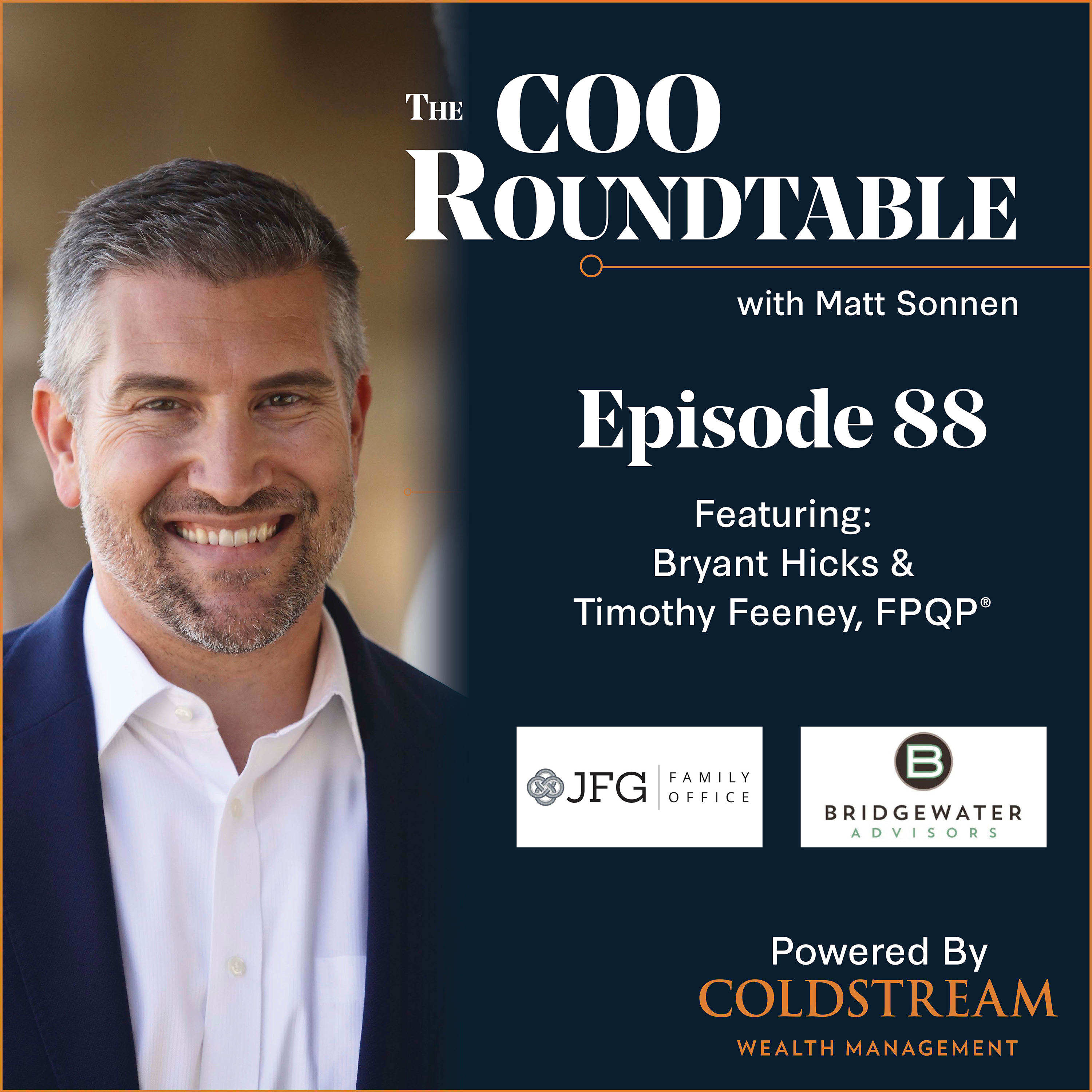
The COO Roundtable
with Matt Sonnen
Episode 88 – Bryant Hicks & Timothy Feeney
00:00:05:05
Hi, I'm Luke Sonnen. Welcome to The COO Roundtable, powered by Coldstream Wealth Management. Here's your host, Matt Sonnen.
00:00:14:23
Matt Sonnen: Welcome, everyone, to episode 88. If there are any Dallas Cowboy fans out there, we're going to call this the Michael Irvin episode. I think 44 was the Reggie Jackson episode. So we'll go with Michael Irvin for 88. We have two more fantastic guests to speak with this month with a lot of great advice to share.
So we're going to jump right in from JFG Family Office, headquartered in Denver, Colorado, is Partner and Director of Operations Bryant Hicks. JFG is an interesting firm. They have three office locations: Denver, as I mentioned; Washington, D.C.; and Dallas, Texas. About half of their assets are in private funds. And we've talked a lot on this podcast about the complexities of alternative investments from an operations standpoint. So I'm sure we'll touch on that a bit today.
Bryant’s bio reads, “he is responsible for overseeing operations, driving solutions for scalable growth through disciplined execution, strong teams, and efficient processes and scale.” Scale is going to be the topic of the day. We're going to be we're going to talk a lot about that. So Bryant, welcome to The CEO Roundtable.
00:01:25:27
Bryant Hicks: Thank you for having me Matt. Happy to be here. Thank you.
00:01:29:00
Matt Sonnen: And joining Bryant from Bridgewater Advisors in New York City is Operations Manager Tim Feeney. I am waiting with bated breath to hear about Tim's career path, because his bio states that after graduating college with a business degree, he traveled with his rock band playing shows all over the Northeast. And our listeners know very well - I say it all the time - that my goal as a teenager was to be the next Eddie Van Halen, but I wound up settling for second best, which was a career in RIA operations.
So I cannot wait for Tim to give us his career story in just a few minutes. But Tim, welcome to the podcast.
00:02:08:26
Tim Feeney: Thank you for having me, Matt. It's great to be here. I have no hair anymore, but I am still rocking and rolling, so thank you for having me.
00:02:15:09
Matt Sonnen: I love it. Well, Bryant, why don't you start us off? Tell us a little bit about JFG Family Office.
00:02:22:23
Bryant Hicks: Yeah. Happy to. Thanks again for having me. You know, JFG Family Office has been an amazing place for me to land in my career. I am in my fourth year here at JFG Family Office. I started back in 22 - you know, prior to JFG, I served in the military and had a number of positions at fintech firms in the Denver area.
One of my early jobs out of college was working for a small company called Matrix, which ultimately got bought by Broadridge. And in the midst of covid, I decided to kind of make a career change and have the opportunity and meeting some folks here at JFG Family Office, our founder, Brandon Johnson, and really got to know the staff here and had an amazing opportunity to join a very unique firm.
JFG Family Office was really founded as an extension of a single family office. You know, over time we evolved into more of a full family office platform and formally transitioned into a multifamily office in 2010. You know, that that origin story coming out of the single family office is really important, because this firm was really founded, and very much we still think like owners, you know, we built the firm to serve the founding family, but really that shaped the entire model with how we support clients today at a high level.
Our mission at JFG is to change the family office and wealth management industry through a better way. You know, for us, that means better alignment, better service, and better outcomes for both our staff and families. We are not trying to serve thousands of clients. We are boutique in nature, you know, founded with the thought of white glove service in limiting the number of families we work with to make sure we have strong value alignment.
You know, the ideal client for us is not just someone with financial complexity, but a family that values human capital as much as financial capital, you know, cares about philanthropy, wants really a long-term relationship rather than a transactional advisory experience. You know, we say internally that we want to grow the right way with families that make the
So that's a little bit about JFG. I will say, historically, growth for our firm has come from staying disciplined and who we serve and building trust with families, and that ultimately leads to referrals. So, you know, looking forward for our growth strategy and vision, it's intentional. And we want to continue to scale on the platform, but not at the expense of culture or alignment with our families.
So today we manage about $5 billion in assets. We have about 62 teammates and have kind of three different office locations. We mentioned we're very much not high growth phase. I would say 22 of those teammates have been added within the last 18 months or so. So tremendous growth of our staff and really just trying to set ourselves up for to continue to grow and scale without dropping in the level of service, for instance.
00:06:00:22
Matt Sonnen: Great. Well, Tim, give us the rundown on Bridgewater Advisors.
00:06:05:02
Tim Feeney: Okay. First I want to say, Bryant, thank you for your service. That's an awesome career path you've had there. So yeah, Bridgewater advisors started in 1993. Our founders, Leo Marzen and Milton Stern, I think they kept - they were independent advisors and they kept running into each other at a Schwab branch. And I think they shared like ideas and decided to come together and start Bridgewater.
We're an independent, fee-only firm. Like I said, we're based right here in Rock Center, New York City. Right now we're managing about $2.8 billion. Depends where the market is right now. And then we're not at $3 billion yet. I don't think today looks too good, but we have 25 people working with us. That's probably ten advisors, five associates, maybe 5 to 7 in ops.
I think we got a new Office Manager today. So that's pretty awesome. Our typical client is coming to us with around $5 million in investable assets - they usually need helping navigating the really complex messy stuff tax strategy, estate planning, multi-generational family dynamics. Historically, I think our growth has been driven entirely organically. Kind of like what Bryant said. It's the high-touch word of mouth service that our clients keep telling their friends about.
Leo and Milton never wanted to build a giant corporate empire. I think they just wanted, like I said, deeply personal people. First way of doing business though, looking to the future, our vision. It's not becoming a corporate behemoth. It's about, you know, building that internal infrastructure and hiring specialists. So we kind of scale what we're doing right now, that intimate premium experience, and we're able to grow it and still kind of provide the same service.
What gives us our edge? I think that independence, you know, I think as like with me, you have your doctors, they disappear after a year. Your local banker is gone. Everything's becoming its corporate thing. And I think people do appreciate that boutique service that that we give. We also come from, you know, the people I work with are nontraditional backgrounds.
We got - we have a philosopher, some musicians. I'm not the only one - a book writer now. So I think it gives us a unique blend of empathy and kind of a different way of looking at things and solving clients problems. So yeah, I think that's Bridgewater in a nutshell.
00:08:37:26
Matt Sonnen: That's great. Well then, Tim, tell us the story, your career path, how you wound up as operations manager for Bridgewater Advisors sometime after your induction into the Rock and Roll Hall of Fame?
00:08:51:23
Tim Feeney: Yeah. So I originally went to college for like, music and audio engineering, but I did get like a business degree. So right out of the gate, I kind of spent my early years, I was temping, but then also managing the touring rock bands where we did like one national tour, but mostly stuff was done in the northeast, so long weekends, things like that.
And I think that was kind of my first view into operations. It was a baptism by fire logistics, just learning how to manage chaos, kind of, you know, looking for the money or when there was any money, there wasn't much money there. But I think and then the temping, I think the temping was like a huge part too, because I think if you want a perfect training ground for an operations person, go temp.
Because if you take a job that only lasts for two weeks, you don't have a month to get acclimated. You have to learn the entire workflow like on day one. So I think it completely trained my brain to drop into any environment, spot how things function, and kind of map out the logistics immediately. And then so from temping, I kind of transitioned into wealth management operations.
I kind of I was at a firm in Tarrytown. I was there for a little over ten years, and I kind of started at the bottom. And then in the end, I was managing the execution trading desk. So I was doing all the trades, I was reviewing all the paperwork, and I was that custodian liaison. So from there I came to Bridgewater, and that's where I'm at now.
Since I've been at Bridgewater, Leo is very into education. So right when I got here, I got my FPQP® designation. And then last summer I got my Series 65 because, not that I needed it for this role, but I'm generally interested in the field and kind of just wanted to make sure I was constantly growing and adding value to the firm.
Yeah. So I think that's been my career path. And now, right, I became Operations Manager this year, so that's very exciting.
00:10:47:24
Matt Sonnen: Awesome. Well, congrats on that. Well, Bryant, you ran through your career path a little bit, but did you want to go through any more detail? I did see on your LinkedIn bio six years in the Air Force. So thank you for that. And yeah, walk us through your career path.
00:11:01:02
Bryant Hicks: Yeah. So my career path was not a straight line into family office operation, but I would actually say that I got contacted by a recruiter. I didn't even know what a family office was. So, you know, for me, I did start my career with kind of a foundation and service through the U.S. Air Force. I was in the Colorado Air National Guard out of Buckley here, spent six years in service there, did get to go on a deployment, which is really important for me.
Had I not been on a deployment, I would have felt like I kind of cheated the service in a way. So really good experience. Got the chance to go to places you wouldn't get to see otherwise. And I would say time in the Air Force really shaped how I think about leadership and standards and really teamwork, you know. I think you learn so much from, you know, working with a diverse group of people. So I knew that time is very important and critical to where I've grown today.
You know, after that, I did serve, you know, close to ten years at a fintech company here in the Denver area, kind of supporting operational roles, trade settlement, fund the county and supporting bank and TPA clients more on the retirement side of the business.
So that kind of brought me into the industry, and it gave me a strong foundation in controls and risk management and really execution. When I came to JFG, it was really through relationships, similar to Tim. I was in kind of a temporal, my first job out of college and, you know, really 12, 13 years later, I just - I retained a relationship with that placement recruiter and just happened to grab lunch, you know, every once in a while or catch up at least on the phone.
And ultimately, that recruiter ended up being one of the primary recruiters for JFG and said, hey, you know, you're leaving other operations team in your other roles, and but there's an opportunity to come over to this family office and really help them with the operations and run a team there. And I just really got excited about meeting the different teammates.
You know, I had a very long interview process, which I think is extremely important for retaining culture in an organization. And so I got the opportunity to meet advisors, you know, investments team, the operations team directly, the C-suite. And I just felt like it was the time for me to kind of make a transition in my career. So today as the Director of Operations and member of the executive team and leadership team, my role is really about helping JFG scale. So thinking about how we align our leaders, improve our systems, and really strengthen the JFG playbook, especially as we move into new markets and just thinking about that growth and how we keep from diluting our client experience and our culture, so...
00:14:02:01
Matt Sonnen: Well, we talk a lot on the podcast about the fact that our industry has a pretty clear-cut career path for those who want to go the advisor route, but on the operations side, it's a lot more vague. A recurring theme we've heard from our guests is that advancing in operations isn't necessarily about following a well-defined career ladder.
It's really about just raising your hand, identifying what needs to be fixed at the firm, and essentially building your own path. You both have received promotions at your current firms, so you're living proof that upward mobility is possible on the operations track. So, Bryant, I'll start with you. What's the what's the best advice you'd give someone in an operations role who wants to move up but doesn't really have a clear roadmap in front of them?
00:14:49:20
Bryant Hicks: Yeah. You know, I would say stop waiting for the roadmap and just start solving problems that matter most to the firm. Yeah. You know, when I, when I think about firms and where you can add value a firm, it's really, like you said, raising your hand. Where can I help? What is the problem that is in front of us and how can we solve it?
You know, I think too often what we like to say around here is that people identify problems, but then they don't go solve the root causes. And so I think for someone early in their career, that’s looking to kind of grow within their firm. It's really taking a step back. And you know, yes, you may have a problem, but let's make sure we solve the root causes.
I think too often we get busy doing things and have a short-term mindset. But really the value-add to an organization is when you can, you know, train people, document process, and make the firm better. And so I think from a practical standpoint, you know: be good at your job, understand the business and solve problems before they become escalated. And I think that makes you more effective.
00:16:01:20
Matt Sonnen: Yeah, I like that. Don't come to me with problems. Bring me a solution. Right. I like that, yeah. Tim, I know you just recently earned your promotion, uou mentioned. So what did what did you do to demonstrate that you were ready for more responsibility?
00:16:17:09
Tim Feeney: Yeah, I'm probably going to mirror kind of the things that Bryant just talked about, but maybe I'll go back to my audio engineering days. And I think I believe I'm good at turning down the noise, you know? So there's a lot of noisy things that go on in operations. There's a lot of noisy things in advisors’ ears. So I think it's my job to kind of turn down the rest of that noise so the advisors can focus on the more important things.
You know, other than that, you know, I did bring this jack of all trades mentality to the table because I wanted to handle all that noise so our advisors could stay focused. Like I just mentioned, I really tried to position myself as like a practical bridge between the firm's big-picture vision and our daily execution. So instead of waiting around for assignments, I actively hunted for what I call those silent frictions: annoying, hidden bottlenecks that kind of slowed the team down day after day.
So by shifting our operations team from a reactive kind of like firefighting unit, maybe to like a proactive system building unit, it became clear that I think I was ready to step up and run with more responsibility. Yeah.
00:17:26:17
Matt Sonnen: I love it. Yeah. You've got to - both of you are saying you've got to take the bull by the horns and create your own path. Is, is really the best advice because - we keep talking about it. The industry keeps saying we're going to start building clear career paths for operations. But I don't think it's - we're there yet.
So, we're still – we’ve got to take our careers into our own hands and build the path ourselves. So I like that from both of you. Thank you. Well, let me ask another question. That's always top of mind for our listeners. Bryant, I'll go to you first. How are you leveraging technology to scale the firm?
00:18:02:17
Bryant Hicks: Yeah, it's a great question. And we're very much at a unique time. You know, it's- not a day goes by where you turn on the TV and there's something about AI and Anthropic and Claude, and it's a really interesting time. You know, I do believe that, you know, technology is certainly an inflection point where we really do have to think about how we grow and scale and leverage technology.
You know, I think - around here we look at technology as a force multiplier, not a replacement for people or relationships. You know, I think the goal is to remove low-value work from our teams so they can spend more time with client relationships and planning and kind of being proactive, right, trying to remove the bottlenecks, similar to what Tim was talking about, whether that's advisors or operations.
You know, I think the lens is important to look through it that way, because multifamily office and technology really has to support the white-glove model that we offer for clients. And so, I would say right now we're focused on a few major themes. You know, we just converted, you know, our tech service provider recently. And I think that set a good foundation for our firm to continue to grow and scale.
You know, I think partnering with a good technology firm is really important. We actually leveraged one out of the Bay area that - it kind of specializes in multifamily offices, private equity, and just financial firms in general. And we've found that to be a really good relationship, where we can kind of leverage their thought leadership and, you know, best practices for firms that are like us. In a way, it's learning what Big Brother and Big Sister are doing out there, you know, and just getting that knowledge from a technology standpoint, you know.
Second, I think - for us, a big one was getting an enterprise solution on board for us, but in a safe manner. And so, we did some due diligence with the help of our MSP, to think through how we could operationalize an enterprise ChatGPT model, which allowed us to really start growing and scaling our business.
And I know really everyone in the firm has a license to our enterprise solution. And, you know, we are actively using it. It's the main thing - there is adoption and training. And so once again, with the help of our MSP, they've kind of had a number of different sessions to train people on: Hey, this is how you use ChatGPT enterprise.
Make sure you're doing enough context. Here's how you do good prompting all the way through. You know, here's how you input skills into ChatGPT. Here's how you leverage agents and codex. Right? So we we're jumping all in. You know, I view it as a benefit - joining our firm - is that employees have this tool that's kind of ready to go.
And it has the security and guardrails around it. So, you know, at the end of the day, our clients’ reputation is the most important thing for us. And so we wanted to be sure that we were using a secure model. And so now that we have that, we feel like we can really leverage the technology. Beyond that, I would say another AI tool that we are using today is an AI meeting note taker.
And the goal here is to really give time back to our advisory facing folks. You know, too often we have folks - a number of different teammates in a meeting with a client. And maybe one or two of them are just there to take notes. And now with a meeting note taker, as long as the client feels comfortable with it, we're able to kind of turn on that AI assistant, and then everyone can kind of be present in that meeting, which I think is really powerful for our clients.
So whilst for execution, decisions being captured, and makes follow up a lot easier for our advisors. So technology is certainly helping close those gaps. You know, in closing, I'd say, you know, technology does not scale a firm, but adoption scales a firm. And so that's where I think, you know, it's making sure that we're supporting advisors and teammates with training and making sure that leadership is reinforcing the use of the software that's turned into actual enterprise value for us.
00:22:44:11
Matt Sonnen: That's great. I love that you're doing the training. That's what I'm worried about - is just rolling out an enterprise version of whichever AI tool. But without that training, it kind of goes by the wayside.
I didn't know who shared it, but I saw it on LinkedIn this weekend, and then I reshared it and it got a bunch of people liking it because I think everyone's in the same boat. It was a multi paneled cartoon in the and the guy on stage, he says: “what do we want?” And the crowd screams, “AI agents!” And then he says, “should we fix our data first?” And they go, “no!”.
He says, “What do we what do we want AI to do?” And they said “we don't know.” And he goes “when do we want it?” And they said, “right now.” And that's pretty much where we are right now.
00:23:31:11
Bryant Hicks: That's so true. Yeah. There is an element of sequencing, right. Having a clean data storage is super important. And we might be in front of it with the AI enterprise solution. But you know, I do think a data - like a central data repository - is not far in our future. You know, I think you have so many silos of data between your reporting system and trading systems and CRMs, right?
Like to best use that information for AI, like having clean data is central to that. And so that's such a – yeah - your comment on that posting is spot on.
00:24:11:17
Matt Sonnen: Yeah. Yeah. It's - I mean – yeah, you've got to get the data clean and then that, that – like, what do we want AI to do. We don't know! Like, the fact that you guys did training with it. Some prompt training: some – Hey, these are these are the things you should be using it for. These are things you shouldn't be using it for. because nobody knows. Everyone wants it because they see these headlines. But I love that you guys did the training with the rollout. That's great. Well, Tim, what tech initiatives are you implementing at Bridgewater Advisors?
00:24:40:20
Tim Feeney: All right. Well, yeah, I think Bryant just kind of went over like a lot of the stuff we're kind of doing with AI. We're a Google Workspace company, so we're working with Gemini. So I think we're using AI to kind of do those little repetitive annoying things. But we still want that human connection. So I can give you some fixes I've done with like Google Workspace in the last couple of years, just using Google Workspace, things we didn't know we had, and we kind of built things out around it.
So we do have a CRM, but the problem is that a lot of our advisors don't want to use the CRM. So any type of tasks, you know, we'd be in office, there's a sticky note. One of our ops people would have an email, someone would get a call. So I wanted to say, so how do we fix this?
We were already using Google Workspace, so I implemented Google Groups to funnel every single operational task into one centralized shared inbox. So I think that completely changed the game because it created kind of a transparent collective memory. We could see exactly who assigned everything instantly and sharing that - nothing ever fell through the cracks. So on a practical level, we also looked for tech solutions to kind of stop recurring errors.
So, we do a lot of QCDs - qualified charitable distributions - and we were having some issues. When clients say, hey, I want this mailed to me, I want it mailed to the charity. So we had a couple mistakes. So I decided, hey, how can we fix this? So I built like a standardized uniform spreadsheet in Google Sheets that the whole team now has to use.
It has specific dropdown menus for everything, whether it's mail the client, mail the charity, or if it needs to go out overnight, whichever. But what I like about it is that it forces the processor, who's usually handling a million things at once, to physically slow down for a second and kind of intentionally think about the mechanics of what they're doing. And plus, since, like, clients tend to give us the exact charities every year and they're always asking us, who did I give to last year? Now we kind of have like one big Google Sheet that we use. So I think that's a big thing.
So we are you trying to use Google as much as possible. I'm building inside of Google. They have SLOs which kind of like are these agents. So it's kind of looking through my emails and and NSF checks, you know, things that I should double check - bonds maturing, anything over $1 million - send me a chat. So I double check that that cash is just not sitting there for days. So yeah, we're trying to just with our tech kind of see what we have from Google and just use it as much as possible – building… Google Gems is another thing. Yeah. So, we use Tamarac. We could have 100 securities come in one day, and we have to go in and individually classify those securities. So, I built a Google Gem that's inside of Gemini. So it knows the specifics of how Bridgewater classifies securities. So I could dump all these securities in there. And then it gives me a CSV back of the way we classify things.
And I could just upload intoTamarac quickly. So again, it's back to those little annoying things that we don't want to spend hours on. And that's how we're trying to use AI. So yeah, I think that wraps it up.
00:27:58:22
Matt Sonnen: I love that. So you're talking about tasks. I'm curious for both of you - what tasks or responsibilities have you not necessarily used AI for, but what have you centralized? So, like, Tim, I know you told me you've worked really hard to get a lot of the trading responsibilities away from advisors. So how has that helped you scale?
00:28:18:21
Tim Feeney: Oh, hugely. Yeah, I think that's been an absolute game changer for us. Our advisors are still guiding the overall investment strategy, of course, but when I came, advisors were using Tamarac, but they weren't using it to the best of its abilities. So when I came in, associates kind of couldn't monitor their book of business because they weren't linked to the accounts.
Advisors would kind of have to look at their whole book of business and see what changes they needed to do. So when I came in, I built out the dedicated service teams. So now the associates are the ones monitoring cash balances, tracking out model tolerances… And I think that - it completely relieves the advisors of those manual day-to-day tasks and unlocks their time, I think, to focus on, you know, client onboarding, relationship management…
And then - so also these advisors, if we were doing a big model change, they would have to go through and look at each client. So a model change could take a month. So now my colleague Ben who's the head trader here - we're handling all the central trading ourselves. So that ensures every client across the firm gets our best thinking simultaneously.
As for what's next on that front, I'm currently exploring Tamarac’s UMA platform. We're looking into that. So I'm just kind of looking - how can we make, you know, small accounts easy for us? Because even a small client - we don't - hey, I see I have $2,000 that's been sitting here for a couple of weeks. We don't want that happening. So I'm just trying to see what else we could do on the trading front to kind of streamline everything. Yeah.
00:29:59:25
Matt Sonnen: Great. Bryant, I know you've centralized a lot of trading and capital call activity. We mentioned you guys are heavy into alternatives. How has all of that helped advisors stay focused on their client-facing responsibilities?
00:30:14:17
Bryant Hicks: Yeah for sure. Before I answer to that, Tim, real quick in terms of Tamarac, we are also users of Tamarac. Your idea and how you built your AI tool to classify securities was definitely heard. I'm going to get on that right away. Make sure I build that out. That's a -that's a good one. I like that, yeah, thanks.
So yeah, you know, Matt, I think really centralizing trading is super important. We've had that for a number of years. Even when I joined, it was centralized with the trading team. I would say over the last four years though, what we tried to do is shift the autonomy and give greater and greater autonomy to the ops team, to kind of own and manage the trading process.
And so I think centralization has been critical for scale and really risk management as well. You know, if every advisor is out there handling operational work differently, you create inconsistencies across the firm. So I think that creates risk for clients, frustration on the teammates. And so by centralizing things like rebalancing or tax-loss harvesting and then on the private side, subscription documents, capital calls, we create more of a controlled, repeatable model, which I think is super important.
So - similar to what Tim said, you know, when you have it set up that way, it allows advisors to spend more of their time creating the most value. And where that is, is really deepening those client relationships and understanding family goals, rather than being worried about the mechanics of how we execute a rebalance or whatnot.
So, I think it also improves the general team experience here at JFG. You know, advisors don't have to reinvent the process. You know, the operations team can really build an expertise through repetition, and our investment team can kind of stay focused on investment decisions. So I think you get a more consistent experience across the board with respect to, you know, capital calls for our operations team. That is all centralized as well, in the same way that we want it to be centralized for trading.
It allows for the opportunity to really define and own that process, which allows for our team to kind of have a seamless white-glove experience for our clients in a space that is more technical, right? Like the private capital of markets are not like the publics, where you get a new price for everything every day. And, you know, it's easy to make the trade.
There's a lot more work that goes into it from subscription documents, capital calls, you know, quarterly statements, distributions, all of that. So that all - it all remains centralized to our ops team. So, super important.
00:33:19:09
Matt Sonnen: Well, you mentioned consistency. My ears picked up when you when you said that word. So let's talk about one of my favorite topics, something I know both of you have been passionate about as well. That's the importance of documented processes. So Tim, I'll go to you first. How has it aided the growth of Bridgewater Advisors to have a defined - you know, this is how we do things - as opposed to having all the processes just residing in people's heads.
00:33:46:26
Tim Feeney: Yeah, yeah. God, yeah, we need these. We need these. So like when processes, I feel, live only in people's heads, you have that huge key man risk. So last summer, I went to my ten-year anniversary trip with my wife. I was going to be gone for two weeks, and I just was in a - kind of like a presentation to my -- group with Trevor Hodges from Sax, who's been on this podcast before, I think.
And so he was kind of going over how he builds SOPs. And so our COO, Tom Smith, has done a great job putting a lot of the big things in CRM, a lot of the big workflows that the client… onboarding. But I realized a lot of my Tamarac things that I do are - I think they are living in my head.
So we were already on Gemini at the time, so I started just documenting everything I do. You know, from my - there was a billing process, but I just went straight through it. So I built a clean billing SOP, trading SOP. I kind of just started building everything. And I think that guarantees that the Bridgewater experience kind of remains completely consistent and it's repeatable no matter who is doing the task, right?
So I think, without these things, you cannot scale at all because, yeah, you could do these things when you manage a billion and you have this many people and you're doing it fine, but as you grow, if one person leaves, you need everything really written down. So I think it's super important. And back to AI, I think we're going to look into using Scribe, which I've heard people have had a great experience with.
So as I do things in Tamarac, it could give like training videos for new employees. And I think that would be a game changer to with onboarding employees as well. Yeah. So, build SOPs.
00:35:52:20
Matt Sonnen: And Bryant, with your three office locations, I know once all the employees aren't in the same physical space, it drastically increases the need to have all of these things written down. So talk to us how you've used your documented processes to help with training, and just the day-to-day tasks of your teammates.
00:36:11:04
Bryant Hicks: Yeah for sure. Yeah. When you have multiple offices, you can't rely on kind of hallway conversations or water cooler talk and just general share best practices, right? It's a lot harder. So, you know, a big focus for us really this year actually - 2026 - is we need to kind of reinforce, you know, what is the right way?
And so as part of our, you know, points of view for the year, which are big pillars of things that we want central to our firm and where we plan to kind of put resources and execute for the year. One of those is what we're calling the JFG playbook, right? And so, you're really bringing into the fold consistent onboarding, clear workflows, share best practices, better knowledge sharing, and travel across offices and teams, right?
So, you know, as we continue to grow, we want that client experience to feel consistent, regardless of which office or team is serving the family… with some flexibility, right? Like, people in different office locations may do certain things that are a little different, but central to the client experience is making sure that they have that white-glove simplicity and peace of mind experience that we offer for families.
So a big part of that is this playbook and initiative that, you know, our Director of Strategic Initiatives and our project manager are really partnering on this year is thinking about how we continue to do that. You know, it's kind of a funny story. We - in terms of onboarding new employees, we have an individual here who's done a tremendous job kind of standing up our intern practice and really grew that intern cohort each year from really one person up to 4 or 5 each year.
And we got some great feedback at the end of these internships that really these interns that were coming in for a period of 90 days were getting a better onboarding to our firm that our own employees. And that was through the hard work of our product manager who was really owning that process. And so we took that same framework that we're using to kind of spin up interns.
And now she's done a tremendous job, you know, applying that to the whole firm so that if anyone has a new employee, whether it's an advisor, someone starting in compliance, or starting in, you know, the DC area or Dallas, they have something that they at least have a starting spot that sets, you know, the best practices of onboarding and the certain conversations that need to be had across the firm.
So it's really allowed us to process and grow that culture at scale. So I think it's super important, especially when you have multiple locations. Yeah.
00:39:10:17
Matt Sonnen: Well, shifting gears a little bit - I'm a firm believer in the adage, “if you aren't growing, you're dying.” So I'm always pushing for growth, growth, growth. But one area that growth can create real challenges is with culture. As your firm grows, you're inevitably going to have certain employees that are going to fight it along the way.
And we'll continue to say things like, well, this isn't how it used to be. I used to know every employee here, and now I don't. Or they'll say, why are we implementing all of these new policies? We didn't have these before. So, Bryant, how have you maintained the firm's culture as you guys have grown as fast as you have?
00:39:48:13
Bryant Hicks: Yeah, it's a great question. And it's certainly been central to our executive team over the years. You know, I mentioned earlier that we've added over 20 staff in like the last 18 months. And that certainly - it gets hard. So, you know, I think the first thing is recognizing that culture does not maintain itself. And as the firm grows, culture has to become a little bit more intentional.
And so, you know, I think at JFG, we really anchor back to our core values of teamwork, integrity, and passion. And we really enforce those in how we hire, how we lead, how we communicate. I think when you talk a lot about value alignment - not only do we have with teammates but also with client families. Growth only works if you're adding people and families who strengthen the culture rather than diluting it.
So we really - through any additional family we bring on or employee - it's really, do we have alignment with this individual or this family - because it's super important as you grow. So, you know, I think central to our team is also this belief in challenge culture, right? So as you're growing and scaling, there's pain points that you're going to experience that you've never experienced before.
And so you know, healthy firms are not afraid of kind of getting into some of those harder conversations. Because ultimately, you know, the best ideas come out of disagreements. And so, when we have enough trust between people that can surface problems and challenge ideas, that's where some of our best thoughts come from. And so, I think that's central to maintaining culture too - is, you know, having people explain the why and listen and be willing to make necessary decisions.
So, you know, I think in closing, the other thing that I would say is with culture, you know, people often say, you know, don't let our culture change. And I think it's important to recognize that with each person you lose or each person you bring on, that culture does change, right? And it's I think it's unfair to say that you're trying to keep it from changing.
I think what is central to it is keeping what we call the core values or the strong ethos behind our culture - that may stay the same. That's what we don't want to change. But ultimately it -culture is going to change as you continue to grow. And so having some flexibility around how you define that is super important.
00:42:25:18
Matt Sonnen: I like that - I think that's exactly right. Don't let people white knuckle it and say, we have to hold on to our culture. It's going to evolve over time - I like that. Well, Tim, what have you done as you've grown to keep the firm's culture intact or, you know, to not have people freak out about the change of the culture?
00:42:42:27
Tim Feeney: Yeah, I think a lot of it has to do with hanging out, like - we hang out a lot. Like I said, we're like 25 people here. But we make a huge point to prioritize, like, out of office connection, quarterly happy hours, annual - we're about to have an annual summer party at our owner's house, which is always a blast.
We sit at like - we're here, we're hybrid, but we're here three days a week and, you know, 12 to 1:30, you'll see probably 12 people all sitting around a big table eating lunch together. So we're always talking, not always about business, you know, about personal things. I think it kind of brings us together. And I think another way we do that here at Bridgewater, which is different than the other firm I work - that we don't silo our staff.
So like, I think a lot of big firms will kind of like lock people into, like, rigid, isolated client teams. But we structure our service team so that everybody works with everyone pretty much on a daily basis. So an advisor is going to work with each associate that we have here. That is a pain in the butt when it comes to me and, you know, keeping tabs on my Tamarac service teams.
But in the end, I think it kind of keeps the culture unified. And also, I think hiring - I think we try and hire like kindred spirits who kind of share - like Bryant said – you’ve got to share the core values. Culture is going to change. But if you kind of keep the core values and you keep that people-first service, it's kind of going to go in the right direction. So yeah.
00:44:25:26
Matt Sonnen: That's great. Well, my last question - I'm just going to throw out kind of a broad open ended one to both of you. So we've talked a lot about growth and scale. What's a lesson or lessons you've learned as you've shepherded your firm through all of this growth that we've talked about today. So Tim, I'm going to let you answer first with: what's kind of a lesson or lesson you'd like to share with everybody?
00:44:51:07
Tim Feeney: Yeah, I think it's that to actual scale and for us to scale in the kind of like this vision we have, like people first, white-glove, you know, comprehensive planning, you kind of have to transition away from those individual heroics, the Swiss Army knife type of people, which I am. So it's hard for me. But I think you have to move toward like intentionally designed, repeatable systems, like we're saying, those SOPs.
So to do that, I think you have to embrace special specialization, which I think we have been doing in the last couple of years. Like when I first started, an advisor would be in the marketing department. They'd be, you know, in financial planning or investments. In the last couple of years, you know, we've hired an in-house Marketing Manager.
We just hired a Director of Investments. We have a Director of Financial Planning. So I think it's about hiring those specialists who are like an inch wide and a mile deep, instead of trying to touch everything and trying to save the day. And I think it's about not to give a shout out to future proof, but about future proofing your business, which was a great thing I went to last year.
But I think you need to we need to build the operational infrastructure that we became. We want to become not for what we are now. So maybe if your CRMs aren't working right now, you're like, oh, it's good enough. Well, is it going to be good enough in five years? Like as AI comes, we need our data clean.
Like start thinking about that today. I think that's - yeah, that's what I have to say on that.
00:46:27:29
Matt Sonnen: I love the specialization comment. So many RIAs are built in the early days: let's just go find good people and we'll find a role for them. And that works in the early days, but it does not work as you get larger and larger. You have to have a job description and you have to hire specifically for that job.
00:46:46:14
Tim Feeney: 100%. Yeah. Like I said, that works when you're small. And yeah, you could do it, but as you grow, you can't. You're going to start slipping, right? Yeah.
00:46:53:24
Matt Sonnen: Yep, yep. I love that advice. Yeah. Well Bryant, what advice do you have for our listeners who are trying to scale their firms?
00:47:01:29
Bryant Hicks: You know, I think this question kind of brings everything to the point of all the different elements that we've been talking about here today with technology and culture. But, you know, what I would say is, I think the biggest lesson is that growth and scale are really not the same thing. And growth is adding clients, revenue, and people.
Scale is improving your capabilities without complexity increasing at the same rate, right? And so yeah, you know, I think a lot of firms grow before they are ready to scale. And that's frankly what is so important for us right now at JFG is that we're trying to make sure that we build that infrastructure before we need it.
And so, you know, what I would say is - my advice is to get very clear on your North Star, you know - know who you are. Who do you not serve? What experiences are you trying to deliver and what are you unwilling to compromise, right? And then you build the infrastructure around that. And so right now, our firm is really trying to take a step back. And to Matt's - to Tim's point about growth: think about who you want to be five years down the road - we're kind of going through that, you know, process right now - is really thinking about, you know, what do we want the ideal client experience to be? What do we want our teammates’ experiences to be? And then really thinking about building an operating model around that. And so we're kind of taking a step back. And in the midst of all the tech changes that are happening right now, we're really thinking exactly about those questions, trying to hone in on those so that we can make sure we make thoughtful decisions, because the goal is not to become a bigger version of a disorganized firm, but more so become a more disciplined and consistent firm that allows us to grow and scale with our clients, so…
00:49:00:28
Matt Sonnen: I love your comment that growth and scale aren't necessarily the same thing. I always quote Mark Tibergien's definition of scale, and he defines scale as “your revenues are growing faster than your expenses” – that’s scale. And so many - you know, I've talked about it a lot, I've actually written articles about it - so many RIA owners, their goal is just literally more: I want more clients, I want more offices, and I want more employees.
That's our strategy for next year. And unless you're doing or bringing on more, with air quotes around it, in a way that your revenues are growing faster than your expenses, you're going backwards. Yeah. So I love that you point that out, too. That growth and scale aren't necessarily the same thing. That's great.
Well, Bryant and Tim, I want to thank you both for being here today and sharing your thoughts with our listeners. I've jotted down quite a few takeaways from both of you. So thank you both for being here.
00:50:01:26
Bryant Hicks: Thank you, Matt, so much. And I wanted to give a shout out to your colleague Danielle that I met at the Schwab RIA management program. That was pretty cool - I said, oh, she works with Matt!
00:50:11:28
Matt Sonnen: Danielle McDonald. She's fantastic. Yes.
00:50:14:04
Bryant Hicks: Yeah, it's yeah, it's a great program running right now.
00:50:18:28
Tim Feeney: Yeah. Thank you Matt, thanks for the invite. Happy to be on the podcast with you today. Great discussion.
00:50:25:05
Bryant Hicks: Yeah. Thank you so much.
00:50:26:29
Matt Sonnen: That is a wrap on Episode 88, everyone. So we will talk to you all soon.
© Coldstream. All rights reserved. May not be reproduced, republished, or distributed without prior written consent. Information drawn from third-party sources believed to be reliable but not guaranteed as to accuracy, timeliness, or completeness. None of the information provided constitutes an opinion or a recommendation or a solicitation of an offer to buy or sell any particular security. Coldstream analyses are not intended to provide, and should not be construed to constitute, complete accounting, insurance, legal, or tax advice. The investment strategies and securities shown may not be suitable to you. Past performance is no guarantee of future results.